


If you’re a farmer trying to figure out where to get affordable credit this season, you’re not short on options. You might be short on clarity.
Between the Kisan Credit Card, PM-Kisan, crop insurance, and half a dozen state-level schemes, it’s easy to lose track of what you actually qualify for. This guide breaks down the government loan schemes that matter most in 2026, in plain terms, so you can make an informed decision instead of a rushed one.
- Kisan Credit Card (KCC)
The KCC remains the single most important credit tool for Indian farmers. It works like a revolving credit line rather than a one-time loan, so you draw and repay according to your crop cycle instead of reapplying every season. Under the Modified Interest Subvention Scheme (MISS), the Union Budget 2025-26 raised the subsidised loan ceiling from ₹3 lakh to ₹5 lakh, and Budget 2026 has kept this framework unchanged, giving farmers continuity going into the year. The base interest rate is 7%, but a 2% interest subvention plus a 3% prompt repayment incentive can bring your effective cost down to just 4% per annum if you repay on time. Collateral-free borrowing is also now available up to ₹2 lakh, up from ₹1.6 lakh earlier.
One detail worth flagging: Aadhaar linking with your bank account is mandatory to claim the subvention, and repaying even a day late can cost you the full 3% benefit. It is a small detail that trips up the most farmers.
- PM-Kisan Samman Nidhi
This isn’t a loan, but it’s worth understanding alongside your credit options because it strengthens your overall repayment capacity. PM-Kisan provides ₹6,000 a year to eligible landholding farmer families, paid in three installments of ₹2,000 each via direct bank transfer. The 23rd instalment, released in June 2026, reached over 9.44 crore farmers with a payout of ₹18,880 crore, taking cumulative disbursements past ₹4.46 lakh crore since the scheme launched in 2019. PM-Kisan beneficiaries are also given priority when applying for a new KCC, so the two schemes work well together.

- Pradhan Mantri Fasal Bima Yojana (PMFBY)
Taking on credit for a crop season is a lot easier to justify when that crop is insured. PMFBY, the world’s largest crop insurance scheme, protects against yield losses from natural calamities across Kharif and Rabi seasons, with the central and state governments absorbing a large share of the premium so the burden on farmers stays low. In West Bengal alone, the 2026-27 rollout aims to cover close to 1.10 crore farmers across roughly 30 lakh hectares (Goodreturns), a scale that shows how central this scheme is to de-risking farm credit.
- Fisheries and Allied Activity Credit Limits
If dairy, fisheries, or beekeeping is part of your income, don’t overlook this: the credit limit for fisheries and allied activities under MISS was raised from ₹2 lakh to ₹5 lakh in 2025-26, matching the crop loan ceiling. Many farmers still assume KCC is only for crop loans but it isn’t.
- Digital Access Through the Kisan Rin Portal
The Kisan Rin Portal (KRP) and Jan Samarth Portal now allow end-to-end digital applications and real-time tracking of your interest subvention claims. For banks, it has cut delays in processing; for farmers, it means fewer branch visits and faster clarity on where your application stands.
Making the Right Choice
None of these schemes cancels each other out. Most farmers benefit from stacking them: a KCC for working capital, PM-Kisan for an income cushion, and PMFBY to protect the season against weather risk. The key is timing your application correctly and keeping your KYC and Aadhaar linkage current, since that single step decides whether you get the subsidised rate or the base rate.
How Agriwise Supports Your Application
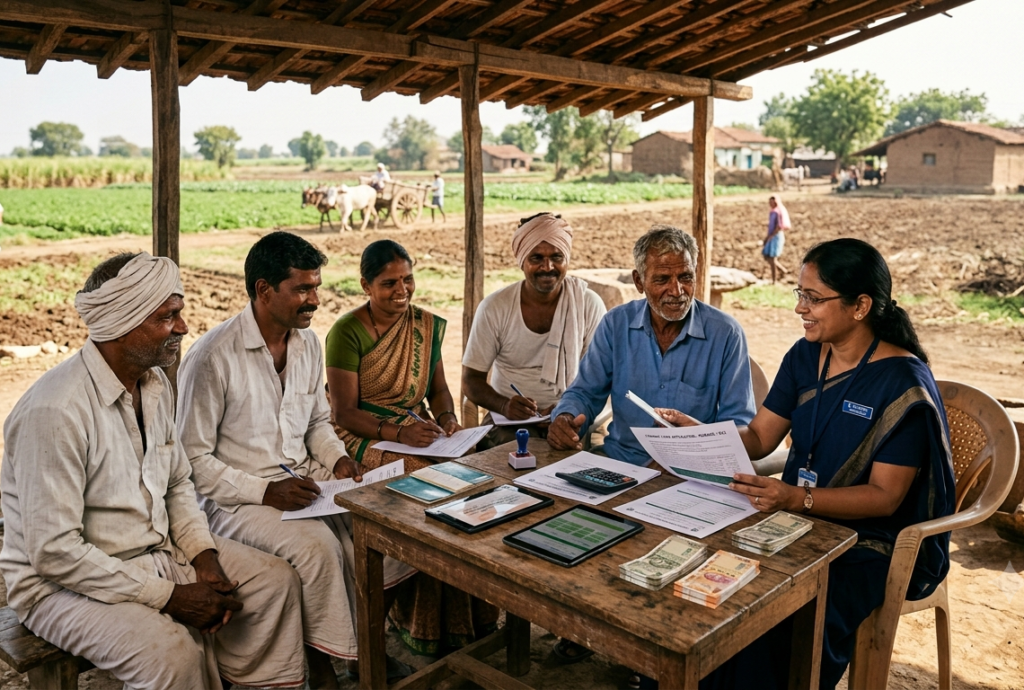
Navigating paperwork and bank timelines is often the most frustrating part of accessing farm credit, and that’s where Agriwise steps in. As the financing arm built for the agricultural ecosystem, Agriwise helps farmers identify the government loan schemes they qualify for, assists with KCC-linked applications, and offers equipment and input financing structured around a crop cycle rather than a rigid EMI calendar.
Government loan schemes exist to make farming financially sustainable but only if you know how to use them. Start with the KCC, layer in PM-Kisan and PMFBY, and keep your documentation current. That combination alone puts most farmers in a far stronger position than going it alone.
FAQs
- What is the maximum loan amount under KCC in 2026?
Farmers can avail up to ₹5 lakh under the Modified Interest Subvention Scheme (MISS), a limit raised from ₹3 lakh in Budget 2025-26 and unchanged in Budget 2026. - What is the effective interest rate on a Kisan Credit Card loan?
The base rate is 7%, but with a 2% interest subvention and 3% prompt repayment incentive, timely repayers pay an effective rate of just 4% per annum. - Is PM-Kisan a loan or a grant?
It’s not a loan. It’s direct income support of ₹6,000 a year, paid in three instalments, meant to supplement a farmer’s overall financial stability. - Can fishermen and dairy farmers apply for KCC too?
Yes. The credit limit for fisheries and allied activities was raised to ₹5 lakh in 2025-26, matching the crop loan ceiling. Many farmers overlook this. - What’s the biggest reason farmers miss out on subsidised interest rates?
Not linking Aadhaar to their bank account, or repaying even a day late. Both directly affect eligibility for the subvention benefit.