

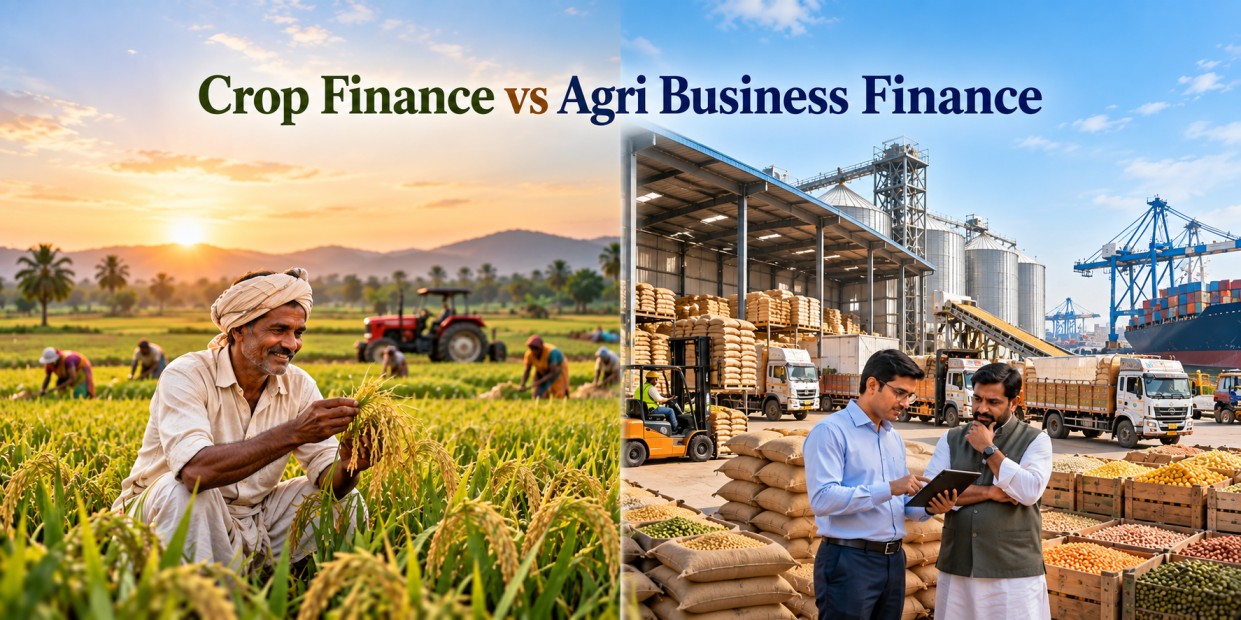
Agricultural finance is no longer limited to borrowing money before sowing and repaying it after harvest. India’s farm economy now includes farmers, FPOs, traders, processors, input suppliers, warehouse operators and other agri-businesses, each with very different cash-flow cycles and capital requirements.
The scale of formal agricultural lending reflects this expansion. Ground Level Credit (GLC) for agriculture reached ₹28.69 lakh crore in FY2024-25, including ₹15.93 lakh crore in short-term loans and ₹12.77 lakh crore in term loans. The government has set a ₹32.5 lakh crore GLC target for FY2025-26.
Within this broader ecosystem, two terms often appear together but serve different purposes: Crop Finance and Agri Business Finance. Understanding the difference can help borrowers match the financing structure with the actual requirement.
What is Crop Finance?
Crop Finance is primarily designed around the production cycle of a crop. The funding is used for expenses that arise before and during cultivation and, in some cases, immediately after harvest.
This can include seeds, fertilisers, pesticides, labour, irrigation, harvesting and other seasonal working-capital requirements.
The Kisan Credit Card (KCC) remains one of the most established channels for this kind of financing. According to the Ministry of Finance, India had 7.81 crore operative KCC accounts by Sept 2025, with outstanding credit of ₹10.39 lakh crore.
Crop finance is therefore closely connected to the agricultural calendar. A farmer may need capital at the beginning of the season, while revenue comes only after the crop is harvested and sold. The financing requirement is largely about keeping the production cycle moving.

What is Agri Business Finance?
An agri-business may need money not just to produce a crop, but to purchase inventory, store commodities, expand a processing facility, purchase equipment, manage receivables or maintain working capital while waiting for customers to pay.
For example, a commodity trader may need short-term capital to purchase agricultural produce. A processor may require funds to procure raw material in bulk. An FPO could need working capital to aggregate produce from farmers. A warehouse-based business may need finance against stored commodities.
Crop Finance vs Agri Business Finance: The Key Difference
|
Basis |
Crop Finance |
Agri Business Finance |
|
Primary borrower |
Farmers and cultivators | Farmers, FPOs, traders, processors and agri-businesses |
|
Main purpose |
Crop cultivation and seasonal expenses |
Working capital, expansion, inventory and business operations |
|
Financing cycle |
Closely linked to crop cycles |
Linked to business cash flows and operating cycles |
|
Typical requirements |
Seeds, fertilisers, pesticides, labour and cultivation expenses |
Inventory, receivables, expansion, equipment and business working capital |
|
Common instruments |
Crop loans, KCC and other short-term agricultural credit |
LAP, warehouse receipt finance, invoice bill discounting and other structured finance |
| Repayment | Often aligned with crop income and harvest |
Based on the underlying business cash flow and financing structure |
Why the Distinction Matters
Consider a farmer who needs ₹2 lakh to purchase inputs for the upcoming season. Crop finance is designed around that immediate cultivation requirement. Now consider the same farmer after harvest, holding commodity worth several lakhs in a warehouse. Selling immediately may not always be commercially attractive, but cash may still be required.
Warehouse Receipt Finance can address this gap by allowing eligible borrowers to raise short-term finance against stored produce. Similarly, a trader waiting 60 or 90 days for buyers to settle invoices has a different financing requirement altogether. Invoice Bill Discounting can convert eligible receivables into working capital without waiting for the full payment cycle.
The Expanding Agricultural Credit Landscape
The scale of KCC lending also shows how important short-term agricultural credit remains. The average KCC loan size increased from ₹1.02 lakh in 2020-21 to ₹1.32 lakh in 2024-25, according to government data. The collateral-free agricultural loan limit was also increased from ₹1.60 lakh to ₹2 lakh from 1 January 2025.
At the same time, the structure of agricultural credit is broadening. In FY2024-25, around 60% of agricultural credit was directed towards short-term crop loans, while the remaining portion went towards investment credit for agriculture and allied activities.

How Agriwise Supports Different Financing Needs
For farmers, Farmer Finance can support requirements such as agricultural inputs, cultivation and working capital across the farming cycle. Agriwise also offers Warehouse Receipt Finance, enabling eligible borrowers to access short-term finance against agricultural commodities stored in recognised warehouses.
For businesses operating across the agricultural value chain, Agriwise provides solutions such as Loan Against Property, Invoice Bill Discounting and Warehouse Receipt Finance. Invoice Bill Discounting, for instance, can help businesses convert eligible sales invoices into working capital rather than waiting for the complete receivables cycle.
This creates a financing approach that can address different stages of an agricultural business, from cultivation and post-harvest requirements to cash-flow management and expansion.
Choosing Finance Based on the Need
Crop Finance and Agri Business Finance are not competing concepts. They solve different financial problems. Crop Finance is closely tied to what it takes to grow and harvest a crop. Agri Business Finance is broader, addressing how an agricultural enterprise buys, stores, processes, sells and grows.
As India’s agricultural economy becomes increasingly integrated, financing will need to follow the same evolution. The right question is therefore less about finding a generic agricultural loan and more about identifying the financing structure that matches the actual cash-flow cycle, asset and business requirements.
FAQs
- What is Crop Finance?
Crop Finance refers to financing primarily used for crop production and related seasonal requirements such as seeds, fertilisers, pesticides, labour, irrigation and harvesting expenses. - What is Agri Business Finance?
Agri Business Finance covers a broader range of funding requirements across the agricultural value chain, including working capital, inventory, receivables, expansion and business investments. - Is KCC a form of Crop Finance?
Yes. Kisan Credit Cards are widely used to provide timely short-term credit for crop production and related agricultural requirements. - Can farmers access Agri Business Finance?
Depending on eligibility and the purpose of borrowing, farmers can access different forms of business-oriented finance, particularly when they are involved in activities such as trading, storage, processing or other agricultural enterprises. - What financing options does Agriwise offer?
Agriwise offers Farmer Finance, Warehouse Receipt Finance, Invoice Bill Discounting, Loan Against Property and Solar Finance, catering to different requirements across agriculture and agri-businesses.