


Farming has one unusual problem: a farmer can do almost everything right and still have a difficult season.
Seeds can be selected carefully. Inputs can be applied on time. Irrigation can be planned well. Yet excessive rainfall, drought, hailstorms, floods or other unforeseen events can affect the final crop.
That uncertainty is exactly why crop insurance in India matters.
Crop insurance cannot stop a weather event or prevent crop damage. What it can do is reduce the financial shock when an insured crop suffers a covered loss. Here is what farmers need to understand.
What is Crop Insurance?
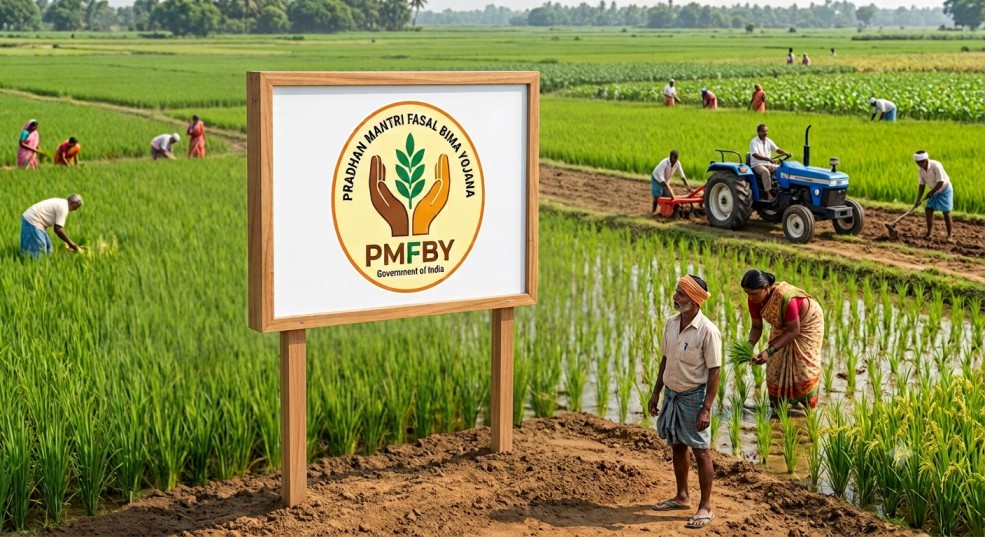
Crop insurance provides financial protection against specified risks that can affect agricultural production. A farmer pays a premium for eligible notified crops. When a covered event leads to an assessed loss and the conditions of the policy or scheme are met, compensation may be payable according to the applicable rules. India’s most prominent crop insurance programme is the Pradhan Mantri Fasal Bima Yojana (PMFBY).
How big is PMFBY?
The scale of the programme shows how important agricultural risk protection has become.
PMFBY continues to report coverage across millions of farmers and applications. For Kharif 2025, the dashboard reports coverage of more than 2.01 crore farmers, with a sum insured of approximately ₹1.36 lakh crore. The dashboard is also already reporting enrolment data for Kharif 2026, although the ongoing-season figures remain dynamic and should not be treated as final.
This is why farmers checking crop-insurance statistics should always look at both the season and the date of the data.
How much premium does a farmer pay?
One of PMFBY’s important features is that the farmer’s premium contribution is capped. Under the scheme, the maximum farmer premium is generally:
- 2% of the sum insured for Kharif crops
- 1.5% for Rabi crops
- 5% for annual commercial and horticultural crops
The remaining actuarial premium, subject to scheme provisions, is supported through government subsidy. This structure is designed to keep insurance affordable even when the actual actuarial premium is higher.
What risks can Crop Insurance cover?
Coverage depends on the notified crop, location, season and applicable scheme conditions. Certain govt schemes can protect different stages or types of crop loss, including risks associated with prevented sowing, standing crops, localised calamities and specified post-harvest losses. This is an important distinction.
Crop insurance should never be understood as compensation for every decline in farm income. A fall in market price, for example, is different from an insured production loss.
Farmers should therefore understand exactly what is covered and what is excluded before enrolling.
How can farmers apply?
Farmers can access crop-insurance information and enrolment options through the official PMFBY ecosystem. The portal provides a Farmer Corner for enrolment, an insurance premium calculator and facilities for checking application status and reporting grievances or crop loss. Depending on the season and state, farmers should verify notified crops, cut-off dates, required documentation and applicable insurance companies before applying.
What should farmers check before buying Crop Insurance?
The cheapest premium cannot & should not be the only consideration.
First, check whether your crop and location are notified under the relevant scheme. Then understand the sum insured, covered risks and claim procedure. Farmers should also maintain accurate records. Land documents, sowing information, Aadhaar-linked details, bank information and photographs or other evidence required for loss reporting can become important during claim processing.
Most importantly, understand the reporting timeline. Certain localised or post-harvest losses may need to be reported within prescribed periods. Waiting too long can affect the claim process.

How Agriwise helps
Agriwise Finserv complements agricultural risk protection with broader financial solutions across the crop and business lifecycle. Through partnerships, Agriwise facilitates access to agricultural insurance solutions, while its financial portfolio includes Farmer Finance, Warehouse Receipt Finance, Invoice Bill Discounting, Loans Against Property, Solar Finance and customised working-capital solutions. Together, insurance and appropriate financing can help agricultural stakeholders manage both unexpected risks and everyday liquidity requirements.
Insurance and finance solve different problems
A crop loan provides money to cultivate. Working-capital finance provides liquidity. Warehouse receipt finance can help unlock funds against eligible stored commodities.
Crop insurance, however, is designed around risk.
Farmers increasingly need all these tools to work together because modern agricultural financial planning is not only about obtaining credit. It is also about protecting the ability to recover when something goes wrong.
For a farmer, therefore, crop insurance should not simply be another form to complete before sowing. It should be understood as part of a larger financial safety net, one that helps ensure that a difficult season does not automatically become a long-term financial setback.
FAQs
- What is crop insurance and why is it important for farmers?
Crop insurance provides financial protection against specified risks that can damage crops and affect agricultural production. It can help farmers manage the financial impact of events such as drought, floods, storms, pests and diseases, subject to scheme conditions. - What is PMFBY?
Pradhan Mantri Fasal Bima Yojana (PMFBY) is a Government of India crop insurance scheme designed to provide financial protection to farmers against eligible crop losses arising from specified natural and other risks. - How much premium do farmers pay under PMFBY?
Under PMFBY, the maximum farmer premium is generally 2% of the sum insured for Kharif foodgrain and oilseed crops, 1.5% for Rabi foodgrain and oilseed crops, and 5% for annual commercial and horticultural crops, or the actuarial rate when lower. - What crop losses are covered under PMFBY?
Depending on applicable conditions, PMFBY can cover yield losses from specified non-preventable risks, prevented sowing, certain localised calamities and specified post-harvest losses. Farmers should check the notification and policy conditions applicable to their crop, season and location. - How can farmers apply for crop insurance in India?
Farmers can use the official PMFBY portal’s Farmer Corner to apply and can also access tools for premium calculation, application-status tracking and crop-loss reporting. Financial-service providers such as Agriwise Finserv can complement risk protection with agricultural finance solutions.