

Tag Archives: agri finance trends 2025

Solar loans for agriculture & MSMEs: Pay less, save more

September 11, 2025

Agriculture and MSMEs across India are turning to renewable energy to cut costs, increase productivity, and achieve sustainability. A solar loan allows farmers and small businesses to invest in solar energy systems—like rooftop solar, irrigation pumps, and other installations—without the hefty upfront cost. Thanks to favorable interest rates, subsidies, and flexible repayment structures, these solar loans are reshaping the financial landscape for agriculture and MSMEs in 2025.

Why choose a solar loan?

  • Huge cost savings: With rising electricity tariffs and unpredictable diesel prices, switching to solar via a solar loan can slash monthly energy bills by nearly half for farms and businesses.
  • Access to subsidies and schemes: Government-backed Solar Loan Schemes in India—such as the Pradhan Mantri Kisan Urja Suraksha evam Utthaan Mahabhiyan (PM-KUSUM)—offer attractive subsidies for farmers installing solar pumps. Likewise, MSMEs can access Solar Loan Subsidy India programs for rooftop and off-grid solar systems.
  • Rapid return on investment: The payback period often ranges from 3 to 5 years thanks to lower utility costs and high solar irradiation, especially in regions like central and southern India.
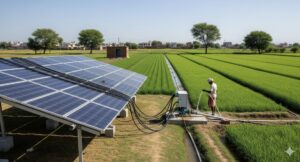
solar loans

Types of solar loans available

  • Solar loans for agriculture: Agricultural producers can finance solar-powered irrigation systems through the solar irrigation pump loan. These loans are frequently bundled with schemes like PM-KUSUM and other agricultural solar financing initiatives. Farmers benefit from subsidized interest rates and better loan terms under solar loan scheme India offerings.
  • Solar loan for farmers India: Specifically tailored for India’s farming community, these packages support installation of solar arrays to power operations—reducing dependence on grid electricity and diesel. The combination of subsidy, credit-linked support, and financing makes farmers solar loan India an attractive option.
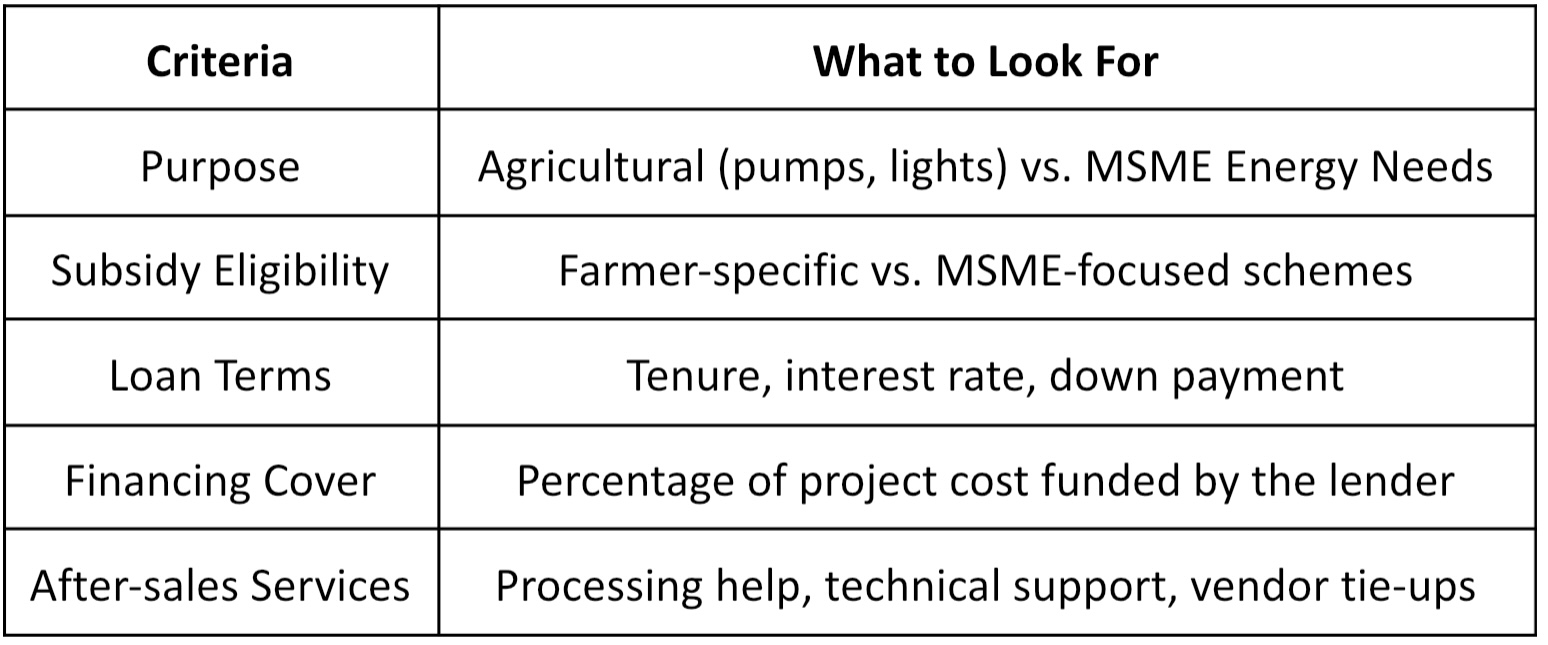
  • MSME solar loan & solar financing MSME: Small enterprises can access MSME solar loan or solar financing MSME products to install rooftop or ground-mounted solar systems. Financing terms typically cover up to 90% of project costs, with loans spread over 7–10 years. Businesses can use this to lighten their electricity burden and enhance profitability.
  • Rooftop solar loans & solar panel loan India: Rooftop solar adoption is soaring—and rooftop system loans powered by solar panel loan India or solar power loan India make installation more affordable. These loans help businesses and households structure payments that align with lower electricity bills, making clean energy installations more accessible.

solar financing

Industry figures in 2025

As of April 2025, India’s installed solar capacity stands at 107.94 GW_AC, generating 144 TWh of electricity—up from 116 TWh in 2024. The National Solar Mission target of 100 GW was surpassed in January 2025. For agriculture, the RBI raised the collateral-free loan limit from ₹1.6 lakh to ₹2 lakh to improve access to credit.

On the household front, the Pradhan Mantri Surya Ghar Muft Bijli Yojana, launched in 2024 with a budget of ₹75,021 crore, will provide 1 crore households with rooftop solar and 300 free units of electricity per month. In addition, collateral-free rooftop loans up to ₹2 lakh at a subsidized 6.75% interest rate are available for systems up to 3 kW. Finally, the GST on solar devices has been cut from 12% to 5%, lowering project costs by nearly 5%.

Agriwise solar loans

When it comes to tailored financial support, Agriwise loans are designed with the farming and MSME ecosystem in mind. For solar loans, we offer:

  • Competitive interest rates
  • Flexible repayment terms up to 10 years
  • Assistance with subsidy processing, including PM-KUSUM and state schemes
  • Expert guidance on required approvals, vendor selection, and installation monitoring

Whether you’re a farmer seeking a solar irrigation pump loan, or an MSME looking for a rooftop solar loan, Agriwise ensures that you get the best match between financing, subsidy, and delivery. Our streamlined process saves you both time and effort—so you can concentrate on cultivating growth.

How to choose the right solar loan option?
Conclusion: Pay less, save more

A solar loan provides a powerful lever to pay less for energy and save more for your enterprise—whether you’re a farmer leveraging farmers solar loan India or a small business financing rooftop arrays through MSME solar loan programs. With the aid of solar loan MSME India, solar loan scheme India, and solar loan subsidy India, investing in solar has never been more financially prudent.

Let Agriwise guide you through agricultural solar financing and ensure you seize the full potential of solar loan for farmers India or solar financing MSME offerings. Going solar is not just an environmentally smart move—it’s a financially savvy strategy for long-term prosperity.

Disclaimer

The content published on this blog is provided solely for informational and educational purposes and is not intended as professional or legal advice. While we strive to ensure the accuracy and reliability of the information presented, Agriwise make no representations or warranties of any kind, express or implied, about the completeness, accuracy, suitability, or availability with respect to the blog content or the information, products, services, or related graphics contained in the blog for any purpose. Any reliance you place on such information is therefore strictly at your own risk. Readers are encouraged to consult qualified agricultural experts, agronomists, or relevant professionals before making any decisions based on the information provided herein. Agriwise, its authors, contributors, and affiliates shall not be held liable for any loss or damage, including without limitation, indirect or consequential loss or damage, or any loss or damage whatsoever arising from reliance on information contained in this blog. Through this blog, you may be able to link to other websites that are not under the control of Agriwise. We have no control over the nature, content, and availability of those sites and inclusion of any links does not necessarily imply a recommendation or endorsement of the views expressed within them. We reserve the right to modify, update, or remove blog content at any time without prior notice.

Future of agricultural finance: What’s changing for rural borrowers?

June 25, 2025

As India’s farming sector continues to modernise, agricultural finance is playing an increasingly crucial role in supporting rural livelihoods, enhancing productivity, and promoting sustainable growth. The future of agri finance is being reshaped by digital technology, government schemes, and evolving credit models that are transforming how rural borrowers access capital. From traditional seasonal loans to innovative credit tools, the entire value chain of agriculture financing in India is adapting to meet the rising needs of farmers in 2025 and beyond.

As per the Press Information Bureau, over the past decade (2014-15 to 2023-24), agricultural credit disbursement has witnessed an average annual growth rate of more than 13%, reflecting the increasing financial support extended to the sector. In the financial year 2023-24, agricultural credit disbursement reached ₹25.48 lakh crore. For FY 2024-25 the Government of India has set a GLC target of ₹27.5 lakh crore with a dedicated sub-target of ₹4.20 lakh crore for allied activities.

The Changing Landscape of Agricultural Finance

For decades, rural credit in India has been largely dependent on informal sources and subsidised lending through public-sector banks and cooperatives. While this helped bridge immediate capital gaps, it often left farmers vulnerable to exploitation and underfunded for long-term needs. However, in recent years, the sector has witnessed a dynamic shift toward formal, tech-enabled, and farmer-centric financial models.

Key trends reshaping agricultural finance include:

  • Digitisation of loan disbursement and repayment: With the increased penetration of smartphones and internet connectivity in rural areas, financial institutions are utilising digital platforms to process and disburse loans faster and more securely.
  • KYC-linked access to credit via Jan Dhan accounts: The government’s financial inclusion drive through the Jan Dhan Yojana has provided millions of farmers with formal banking access, enabling direct benefit transfers, crop insurance claims, and more transparent rural credit in India.
  • Customised loan products: Banks and NBFCs are now offering crop-specific, equipment-based, and input-linked loans tailored to individual farmer profiles.
  • Credit scoring through agri-data: Lenders are leveraging weather data, satellite imagery, soil health records, and market trends to assess creditworthiness, especially for first-time borrowers without collateral.

These developments mark a clear shift in agriculture financing in India—from reactive lending to proactive, risk-assessed financial solutions.

agricultural finance

Agri Finance Trends 2025: What to Expect

As we look toward 2025, several agri-finance trends are expected to shape the sector further:

  • Integration of agri-fintech platforms: Startups and agri-focused fintechs are creating seamless digital ecosystems that enable farmers to access loans, insurance, market prices, and advisory services through a single app.
  • Climate-resilient finance: Lenders are increasingly factoring climate risk into their decisions and offering products such as weather-indexed insurance and resilience loans to help farmers recover from crop losses.
  • Value chain financing: Financing is moving beyond production to cover the entire agri value chain—including warehousing, processing, and marketing—creating new opportunities for FPOs and agri-entrepreneurs.
  • ESG-aligned lending: Sustainable farming practices and traceability in agri supply chains are attracting ESG (Environmental, Social, Governance) aligned investments, incentivising farmers who adopt eco-friendly methods.

These agri finance trends 2025 reflect a growing acknowledgement that rural borrowers are no longer just recipients of credit—they are active participants in a larger, data-driven, and value-oriented ecosystem.

The Role of Agriwise: Empowering Farmers with Smart Finance

Agriwise, one of India’s leading agri-financing institutions, is at the forefront of enabling the future of agricultural finance through a unique blend of technology, partnerships, and farmer-first solutions.

With a mission to provide timely and affordable credit to India’s rural backbone, Agriwise offers:

  • Customised term loans and working capital for farmers, agri-input dealers, processors, and traders.
  • Digital loan processing with minimal paperwork and faster turnaround, leveraging data analytics and remote verification.
  • Partnerships with FPOs and input companies to expand the reach of structured credit offerings.
  • Risk mitigation tools, such as insurance tie-ups and advisory services, enhance credit sustainability.

By addressing both the supply and demand side of rural credit, Agriwise ensures that financial support is not just available but also accessible and impactful for India’s farmers. Their work exemplifies the kind of financial innovation needed to drive inclusive growth in agriculture financing in India.

Bridging the Gaps: Challenges and Opportunities

Despite the progress, several challenges persist in ensuring the full potential of agri finance is realised:

  • Many smallholder farmers still lack formal credit history or collateral.
  • Credit penetration in tribal, remote, or rainfed regions remains low.
  • Women farmers continue to face barriers in accessing loans.

To address these, greater emphasis is needed on credit awareness, digital literacy, gender-inclusive policies, and improving last-mile delivery. Strengthening rural banking infrastructure and encouraging public-private partnerships will also be crucial.

On the other hand, rising agri exports, increasing food processing investments, and growing rural entrepreneurship are creating fresh avenues for structured agricultural finance.

Conclusion

The future of agri finance in India is being driven by innovation, inclusivity, and integration. As traditional lending models give way to more innovative, data-led, and customer-oriented approaches, rural borrowers are gaining more control over their financial decisions. Agriwise is redefining how agricultural finance is delivered and the road ahead looks promising for millions of farmers who now see finance not as a burden—but as a tool for growth, security, and prosperity.

As we step into the next chapter of rural credit in India, one thing is clear: agriculture and finance are no longer parallel tracks—they are converging to create a robust, resilient, and digitally empowered farming future.