
Tag Archives: agri MSME

cash flow projection

How cash flow is managed in Indian Agriculture MSMEs

December 23, 2025

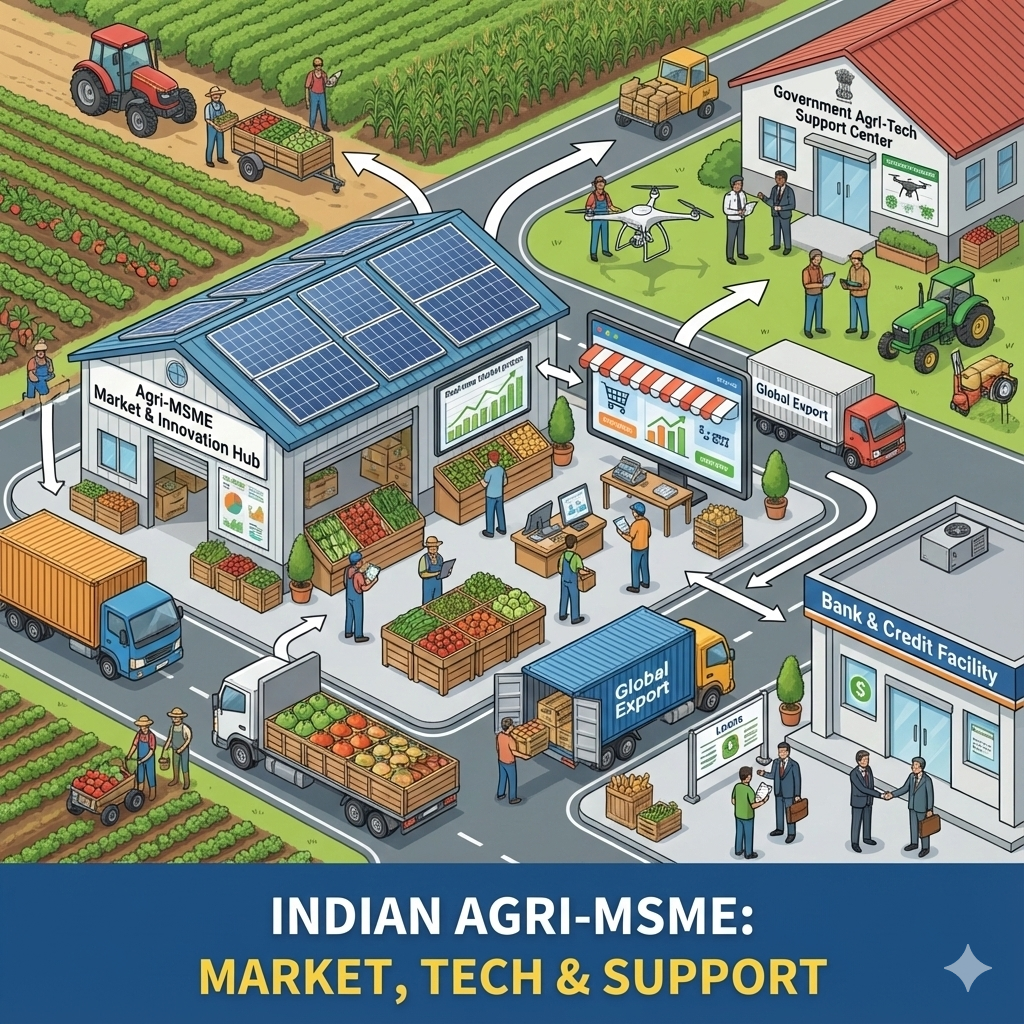
Indian agricultural MSMEs are demonstrating strong resilience and adaptability in the current dynamic economic landscape. With greater access to markets, technology, and institutional support, these enterprises are well-positioned for sustainable growth. Strengthening cash flow practices allows them to convert this potential into performance, ensuring liquidity, continuity, and confidence across business cycles.

According to the Ministry of MSME, as of 2025, there are over 6.8 crore registered MSMEs in India, collectively employing nearly 30 crore people across sectors, including agriculture-linked enterprises. However, money flow remains one of the most persistent and painful challenges for MSMEs in Indian agriculture, affecting their ability to operate efficiently, invest in technology, and scale profitably.

Why cash flow is a critical issue for agricultural MSMEs?

Unlike large agribusinesses with diversified revenues, MSMEs operate on thin margins and often depend on seasonal cycles tied to planting and harvesting. Seasonal revenue variability combined with delayed payments from buyers and procurement agencies can create acute liquidity shortfalls.

Moreover:

  • Only 16–20% of MSMEs in India have access to formal credit, leaving the rest dependent on costly informal financing.
  • Chronic payment delays, reportedly amounting to unpaid invoices worth over ₹10.7 lakh crore nationwide, exacerbate working capital stress across the MSME value chain.

Such constraints reduce MSMEs’ capacity to procure raw materials, pay labour on time, adopt new technology, and fulfil large orders reliably.

cash flow

Key cash flow pain points in the agriculture MSME landscape

  • Delayed payments and long receivable cycles: A significant drain for agricultural MSMEs. Large corporate buyers, government agencies, and even cooperative procurement systems sometimes delay payment beyond standard credit periods. This leaves MSMEs stretched thin as they fund operations while waiting for payments.
  • Inadequate access to affordable credit: Despite targeted schemes like the Credit Guarantee Fund Scheme (CGTMSE) and Mudra loans, formal finance penetration remains modest. Many MSMEs, especially those linked to agriculture, lack sufficient collateral or credit history, forcing them to turn to informal credit at high interest rates.
  • Seasonal business dynamics: Agricultural MSMEs often generate significant revenue during crop harvest seasons. During off-season periods, operating expenses still accrue, including payroll, utilities, and inventory storage, which demand consistent cash flow management strategies.

Strategies to improve cash flow for agricultural MSMEs

  • Leverage digital payments and invoicing: Adopting digital financial tools can reduce payment delays and improve transparency. E-invoicing and e-payment systems help MSMEs track receivables more accurately, speed up reconciliations, and reduce disputes with buyers.
  • Adopt short-term working capital facilities: Flexible working capital loans or lines of credit calibrated to agricultural cycles help balance the mismatch between revenue inflows and payables. MSMEs should explore specialised merchant cash advances, invoice discounting, or receivables financing to maintain liquidity during peak operational periods.
  • Use financial forecasting and planning tools: Forecasting cash flow helps predict cash shortfalls before they occur. Simple budgeting tools and forecasting models can be valuable for MSME owners to prepare for lean periods, plan inventory purchases, and negotiate better credit terms with suppliers.
  • Negotiate payment terms with buyers: Proactive negotiation with buyers to shorten credit terms, such as moving from 90-day to 45-day payment terms, can significantly reduce receivable days and strengthen cash flow health. Early payment incentives for buyers can also encourage prompt payments.
  • Formalise supplier and buyer agreements: Formal contracts with defined payment terms, interest on delayed payments, and dispute resolution clauses improve financial discipline and reduce unplanned cash flow disruptions.

cash flow forecast

Government initiatives aiding cash flow management

The Indian government has boosted MSME support through enhanced credit guarantees and fiscal budget allocations. In FY26, the Union Budget allocated over ₹23,000 crore to the MSME ministry to strengthen credit access, skill development, and technological upgradation.

In addition, initiatives such as collateral-free business loans up to ₹1 crore and broader coverage under CGTMSE have eased access to financing, helping MSMEs maintain smoother cash flow cycles.

Yet many agriculture-linked MSMEs remain unaware of, or underutilise, these schemes, highlighting a need for tailored financial guidance and easier access mechanisms.

How Agriwise helps agricultural MSMEs

At Agriwise, we understand the unique cash flow challenges faced by MSMEs in the agriculture ecosystem. Our services are designed to empower MSMEs with the financial tools, insights, and support they need to operate with confidence:

  • Working capital solutions: Tailored financing products that match seasonal needs, enabling agribusinesses to fund procurement, inventory, and operations without liquidity stress.
  • Credit access support: Assistance in securing formal loans under government schemes like CGTMSE, MUDRA, and priority sector lending, improving access to affordable credit.
  • Cash flow advisory and planning: Expert guidance in financial forecasting, budgeting, and cash flow optimisation strategies to strengthen financial resilience.
  • Digital finance integration: Support for MSMEs to adopt digital invoicing and payment platforms to accelerate receivables and reduce payment delays.

With Agriwise’s integrated financial services, MSMEs in the agricultural sector can improve cash visibility, enhancing stability and enabling growth in a competitive market.

cash flow statement

Conclusion

For MSMEs in Indian agriculture, effective cash flow management is no longer just a financial necessity. It is a strategic advantage. With seasonal income cycles, delayed receivables, and limited access to formal credit, businesses that actively plan, forecast, and optimise their cash flow are better positioned to sustain operations and scale responsibly. By leveraging digital tools, structured working capital solutions, and supportive financial partners such as Agriwise, agricultural MSMEs can shift from reactive liquidity management to proactive financial resilience, ensuring long-term stability and growth in an increasingly competitive agri-economy.

FAQs

  • What is cash flow, and why is it critical for MSMEs?
    Cash flow refers to the movement of money into and out of a business. For MSMEs, steady cash flow ensures payments to suppliers, staff, and creditors are made on time, which is critical for operational continuity and growth.
  • How can agricultural MSMEs reduce payment delays from buyers?
    Agricultural MSMEs can negotiate shorter payment terms, adopt electronic invoicing, and establish clear contracts with defined payment deadlines to reduce receivable delays.
  • What financing options can help strengthen cash flow?
    Options include working capital loans, invoice discounting, receivables financing, and government-guaranteed credit schemes such as CGTMSE and Mudra, which offer affordable credit.
  • Are government schemes effective in improving MSME cash flow?
    Yes, schemes backed by credit guarantees and collateral-free loans improve access to finance. However, awareness and proper utilisation are essential to gain the full benefit.
  • How does Agriwise support cash flow management?
    Agriwise offers tailored working capital solutions, credit access support, cash flow advisory, and digital finance integration, helping MSMEs plan more effectively and maintain liquidity throughout operational cycles.

Disclaimer

The content published on this blog is provided solely for informational and educational purposes and is not intended as professional or legal advice. While we strive to ensure the accuracy and reliability of the information presented, Agriwise make no representations or warranties of any kind, express or implied, about the completeness, accuracy, suitability, or availability with respect to the blog content or the information, products, services, or related graphics contained in the blog for any purpose. Any reliance you place on such information is therefore strictly at your own risk. Readers are encouraged to consult qualified agricultural experts, agronomists, or relevant professionals before making any decisions based on the information provided herein. Agriwise, its authors, contributors, and affiliates shall not be held liable for any loss or damage, including without limitation, indirect or consequential loss or damage, or any loss or damage whatsoever arising from reliance on information contained in this blog. Through this blog, you may be able to link to other websites that are not under the control of Agriwise. We have no control over the nature, content, and availability of those sites and inclusion of any links does not necessarily imply a recommendation or endorsement of the views expressed within them. We reserve the right to modify, update, or remove blog content at any time without prior notice.


How to get an LAP loan (Loan Against Property) for your agribusiness?

September 03, 2025

For agribusinesses seeking capital without compromising operational liquidity, a loan against property (LAP loan) offers a compelling solution. An agri LAP loan leverages your existing property—be it farmland, warehouse, or residential premises—to raise funds, typically at lower interest rates than unsecured credit. For those in the agriculture sector, LAP for farmers/agribusiness bridges the gap between capital needs and formal credit access, especially in the face of rising input/raw material costs. At Agriwise Finserv, we specialize in customized LAP loans for agribusinesses, offering higher loan amounts, longer tenures, and simplified processes tailored to the unique cycles of agriculture.

LAP loan

Current landscape & why an agri LAP loan makes sense?

In 2025, the average agriculture loan interest rate in India stands at approximately 8.2% per annum—a decline from around 8.7% in 2023—thanks to interest subvention schemes that lower effective rates to as little as 4% for prompt repayment. These favourable terms make securing an LAP loan especially attractive for agribusinesses looking for long-term funding.

On the micro-lending end, the cooperative government in Maharashtra has capped private moneylenders’ interest rates at 9% p.a. for secured agricultural loans, reinforcing the advantage of formal borrowing routes such as agri LAP loans. Moreover, MSME loan portfolios remained robust in FY25, with portfolios at risk (PAR) in the 31–90 day bucket at just 1.7%, highlighting the relative safety and reliability of structured, collateral-backed financing such as LAP.

Step-by-Step Guide: How to secure an LAP loan for your agribusiness

1. Assess your eligibility and property value

The first step is to evaluate whether you qualify for an LAP loan. Lenders usually consider the type of property, its current market value, and your repayment capacity. The loan amount is generally a percentage of the property’s value, often between 60–70%. Farmers and agribusinesses should begin by gathering valuation details of their property such as residential, commercial or industrial.

2. Understand the terms of the loan

Before applying, understand the basics: expected loan amount, interest rates, tenure, and repayment flexibility. Agri LAP loans typically come with longer repayment tenures (up to 15 years), making them suitable for businesses with seasonal income cycles. Knowing the terms upfront ensures you borrow wisely and avoid unnecessary strain later.

3. Prepare the required documentation

Documentation is crucial for approval. Generally required papers include proof of property ownership, identity proof, financial statements, and in some cases, details of the agribusiness operations. Preparing accurate documents in advance reduces processing delays and increases the chances of a smooth approval process.

4. Apply through a trusted channel

Once prepared, you can submit your application either offline or through digital platforms. This is where Agriwise adds value—its technology-driven platform guides farmers and agribusiness owners through the application process, ensuring eligibility checks, quick submission, and hassle-free communication with lenders. By doing so, Agriwise helps applicants save time and avoid common errors.

5. Plan the utilisation of the loan

After approval, it is important to use the loan against property strategically. Funds can be allocated toward expanding storage facilities, purchasing farm equipment, or maintaining steady cash flow during crop cycles. Agriwise also provides advisory support to help borrowers align the loan with their business goals and repayment capacity.

Advantages of choosing an agri LAP loan through Agriwise

  • Lower interest costs compared to unsecured or informal credit
  • Longer tenures, up to 15 years, mitigating EMI pressures
  • Higher LTV, preserving capital for other needs
  • Formal, regulated lending environment, reducing risk of predatory terms
  • Less documentation & BT with top-up loan option available

This makes an LAP loan a strategic instrument for building resilience in your agribusiness.

Conclusion

Securing an LAP loan for your agribusiness is not just about unlocking capital—it’s about choosing a sustainable, cost-effective financing structure that aligns with long-term productivity goals. With competitive rates of interest and supportive platforms like Agriwise streamlining access, now is an ideal time to explore agri LAP loans.

Let Agriwise help you navigate the journey—from eligibility and documentation to approval and strategic utilization. When structured right, a loan against property can be the growth catalyst your agribusiness needs—secure, efficient, and attuned to the pulse of Indian agriculture.

Disclaimer

The content published on this blog is provided solely for informational and educational purposes and is not intended as professional or legal advice. While we strive to ensure the accuracy and reliability of the information presented, Agriwise make no representations or warranties of any kind, express or implied, about the completeness, accuracy, suitability, or availability with respect to the blog content or the information, products, services, or related graphics contained in the blog for any purpose. Any reliance you place on such information is therefore strictly at your own risk. Readers are encouraged to consult qualified agricultural experts, agronomists, or relevant professionals before making any decisions based on the information provided herein. Agriwise, its authors, contributors, and affiliates shall not be held liable for any loss or damage, including without limitation, indirect or consequential loss or damage, or any loss or damage whatsoever arising from reliance on information contained in this blog. Through this blog, you may be able to link to other websites that are not under the control of Agriwise. We have no control over the nature, content, and availability of those sites and inclusion of any links does not necessarily imply a recommendation or endorsement of the views expressed within them. We reserve the right to modify, update, or remove blog content at any time without prior notice.

Leveraging supply chain finance for small agri MSMEs

July 10, 2025

India’s agri-MSME sector plays a vital role in supporting the agricultural economy, accounting for nearly 33% of total MSMEs in the country. Despite this, over 80% of small agri-businesses face challenges in accessing timely and affordable credit, which hampers their ability to expand, invest in technology, and build resilient supply chains. This is where supply chain finance (SCF) emerges as a transformative solution—enabling agri-MSMEs to unlock working capital, optimise cash flows, and strengthen trade relationships.

At Agriwise, we recognise that efficient financing is key to empowering India’s agri-value chain. Through structured and digital-first finance solutions, Agriwise supports small enterprises—be it farmer producer organisations (FPOs), agri-input dealers, aggregators, or processors—with the liquidity needed to thrive in a competitive market.

What is Supply Chain Finance?

This finance refers to a set of financial solutions that optimise cash flow by allowing businesses to extend their payment terms to suppliers while enabling suppliers to get paid earlier. It is particularly beneficial in agri-supply chains where seasonal production cycles, inventory turnover, and delayed payments often create liquidity stress for small businesses.
Unlike traditional bank loans, SCF is transaction-based and tied to actual trade flows. This reduces credit risk and ensures that working capital is aligned with real business needs.

Why Supply Chain Finance is Critical for Agri MSMEs?

Small agri-MSMEs often operate on thin margins, limited collateral, and unpredictable cash flows. This creates major financing bottlenecks, especially when trying to scale operations, purchase inputs in bulk, or fulfil large buyer contracts.
Here’s how it addresses these challenges:

  • Improved liquidity and working capital: With SCF, small businesses can receive payments faster without waiting for buyers to settle invoices. This quick infusion of working capital improves day-to-day operations, enhances supplier confidence, and reduces dependency on informal credit.
  • Lower financing costs: Since SCF is typically buyer-led and risk is mitigated through transactional visibility, lenders offer lower interest rates than unsecured loans. Platforms like Agriwise use data analytics to assess real-time risks, ensuring fair pricing for MSMEs.
  • Strengthened buyer-supplier relationships: SCF encourages long-term, stable relationships between buyers and suppliers. When MSMEs are assured of quicker payments, they can deliver better service and maintain quality standards, strengthening their position in the agri-ecosystem.
  • Digital traceability and transparency: Digital SCF platforms like Agriwise provide end-to-end visibility on invoices, payments, and credit terms—enabling MSMEs to plan production and procurement efficiently. It also builds trust among stakeholders across the value chain.

supply chain finance

Agriwise: Bridging the Finance Gap for Agri MSMEs

Agriwise Finserv has been at the forefront of enabling agri-MSMEs with targeted financial tools that meet their evolving needs. Our supply chain finance solutions are customised to support:

  • Input suppliers catering to large farmer clusters
  • FPOs engaged in aggregation and contract farming
  • Agri processors procuring from multiple geographies
  • Retailers and distributors across rural markets

By combining traditional credit underwriting with digital data from agribusiness operations, Agriwise ensures that even first-time borrowers can access structured credit linked to their trade activity. Our approach reduces approval time, minimises documentation, and promotes financial inclusion at scale.

Future of SCF in Indian Agri Ecosystem

With the government’s focus on formalising the agri-value chain through eNAM, ONDC, and FPO promotion schemes, the demand for agile credit solutions like supply chain finance is set to grow. As per industry estimates, the Indian supply chain finance market could exceed ₹60,000 crore by 2026, with agri-MSMEs representing a large untapped segment.

Agriwise Finserv is playing a key role in democratising access to SCF by leveraging alternate data, satellite insights, and mobile-first platforms that reach the last mile. By embedding finance into agri-transactions, they are turning every invoice into a growth opportunity.

Conclusion

Supply chain finance is no longer a luxury—it is a necessity for agri-MSMEs navigating volatility, input inflation, and delayed receivables. With smart financing solutions from Agriwise, small agri-businesses can unlock new markets, invest confidently, and contribute more meaningfully to India’s agricultural growth story. As the agri sector continues to digitalise and integrate, leveraging supply chain finance will be key to building resilient, efficient, and inclusive value chains.