
Tag Archives: agribusiness loans

business loan

Loan Against Property vs Business Loan: Which is Better for MSMEs in 2026?

June 11, 2026

If you run a small or mid-sized business in India, chances are you’ve faced this question at some point: do I mortgage my property to raise capital, or do I go for a straightforward business loan? It sounds simple, but the answer can have a significant impact on your cash flow, your balance sheet, and your business trajectory for years.

Let’s cut through the noise and break it down clearly, especially in the context of where Indian MSME lending stands in 2026.

First, why does this even matter right now?

India’s MSME sector is at a critical inflexion point. According to the CRIF-SIDBI Small Businesses Report 2025, MSME credit exposure in India grew 19.3% year-on-year to ₹45.3 trillion as of June 2025, with active loan accounts rising to 6.9 crore. That’s strong headline growth, but here’s the catch.

Despite that momentum, SIDBI estimates that the sector still faces an addressable credit gap of ₹30 lakh crore, nearly 24% of total demand that formal institutions haven’t been able to meet.

That gap means millions of MSMEs are either paying too much for credit, picking the wrong product for their needs, or simply going without. Understanding the difference between a Loan Against Property (LAP) and an unsecured business loan isn’t just a financial decision but a strategic one.

loan against property for MSME

What is a Loan Against Property?

A Loan Against Property (LAP) is a secured loan where you pledge residential or commercial property as collateral. In return, you get access to higher loan amounts, longer repayment tenures, and significantly lower interest rates compared to unsecured credit.

As of 2026, LAP interest rates in India range from 8.45% to 15% per annum, depending on the lender, borrower profile, and property type. Major banks are offering rates from 9% to 13% for prime borrowers following the RBI’s accommodative rate stance. The repo rate now stands at 5.5% after successive cuts in 2025.

The Indian LAP market itself was valued at USD 758 billion in 2024 and is forecast to reach USD 2,369 billion by 2033, growing at a CAGR of 13.5%. Rising MSME credit demand in Tier 2-4 cities is one of the key growth drivers, as businesses in smaller markets increasingly leverage their property assets to fund expansion.

LAP is best suited for: capital-heavy needs like buying new facilities, purchasing equipment, long-term infrastructure investment, or scaling operations where you need a large ticket size and can afford longer processing timelines.

What is an unsecured business loan?

An unsecured business loan (often called an MSME loan) doesn’t require collateral. It’s faster to process, easier to access, and designed for immediate liquidity needs, but it comes at a cost. Interest rates on unsecured business loans typically start from 16% per annum and can go considerably higher depending on your risk profile. That’s a meaningful premium over LAP, sometimes 5 to 7 percentage points, which adds up significantly over a multi-year loan.

The trade-off is speed and simplicity. Business loans can be disbursed quickly, often without property documentation, and are widely available through banks, NBFCs, and government schemes like MUDRA and CGTMSE. For working capital shortfalls, emergency procurement, or short-cycle needs, they work well.

Business loans are best suited for: short-term working capital, bridging gaps between receivables and payables, or situations where you don’t want to (or can’t) pledge a property.

LAP vs Business Loan: The key differences at a glance

Factor

Loan Against Property Unsecured Business Loan

Interest Rate

8.45% – 15% p.a.

16%+ p.a.

Loan Amount

Higher (up to 60-70% of property value)

Lower ticket sizes

Tenure

Up to 15 years

Typically 1-5 years

Processing Time

Longer (property valuation required)

Faster

Collateral

Property required

Not required

Best For Long-term capital, expansion

Short-term working capital


So, which should an MSME choose in 2026?

The honest answer: it depends on what you need the money for and how urgently you need it.

If you’re investing in something that will generate returns over the medium to long term, new machinery, a bigger processing facility, or agricultural infrastructure, LAP’s lower interest rate will save you substantially more over the tenure of the loan. The upfront effort of property documentation pays for itself.

If you need cash fast to meet a vendor payment, bridge a seasonal working capital gap, or respond to a market opportunity with a short cycle, a business loan’s speed often outweighs its higher cost.

Many smart MSMEs use both: LAP for long-term structural investments, and a working capital line for day-to-day operational flexibility. The goal is to match the type of credit to the purpose. Using expensive short-term money for long-term assets is one of the most common (and costly) mistakes small businesses make.

What’s Agriwise’s role in all this

For agri-linked MSMEs, the decision is often more nuanced because the credit need is tied to seasonal cycles, commodity prices, storage infrastructure, and supply chain dynamics that a standard bank product isn’t designed to handle.

This is exactly the space Agriwise, the NBFC arm of StarAgri, is built for. Agriwise brings a deep understanding of the agri value chain to credit underwriting, offering:

  • LAP: structured, property-backed financing for agri expansion, procurement scale-up, or infrastructure development, with rates designed to be competitive for agri-linked businesses
  • Warehouse Receipt Finance: working capital against commodities stored in StarAgri’s 2,200+ warehouses, providing liquidity without forced selling at low post-harvest prices
  • Supply Chain Finance: unlocking cash tied up in receivables for agri MSMEs, traders, and processors
  • Solar Finance: financing for renewable energy adoption among farmers and agri businesses

Agriwise has disbursed over ₹2,500 crore across 5,500+ customers and works with various banking partners, building a credit infrastructure that understands what an agricultural season actually looks like.

The difference between a good financing decision and a poor one is often just context. A lender that understands your industry, your cash flow patterns, and your assets can structure credit that works, not just credit that’s available.
business loan for MSME

Conclusion 

In 2026, both LAP and business loans will have a clear place in the MSME financing toolkit. LAP wins on cost for long-term, higher-value needs. Business loans win on speed for short-term, operational requirements. The mistake isn’t choosing one over the other. It is choosing the wrong one for the wrong purpose.

With India’s MSME credit gap still at ₹30 lakh crore, getting this decision right matters, not just for your business, but for the broader formalisation of Indian enterprise finance.

If you’re an agri-linked MSME trying to figure out which product fits your situation, Agriwise can help you navigate that decision, with the sector knowledge to back it up.

FAQs

  • What is the main difference between a Loan Against Property and an unsecured business loan?
    A LAP requires property as collateral but offers lower interest rates (8.45–15% p.a.) and higher loan amounts. An unsecured business loan needs no collateral but typically starts from 16% p.a. and suits shorter-term, faster-turnaround needs.
  • Which loan option is better for an agri-linked MSME?
    For long-term investments like infrastructure or equipment, LAP’s lower rate saves significantly over the tenure. For seasonal working capital or short-cycle needs, Agriwise’s warehouse receipt finance is often a smarter, faster alternative to either.
  • What is warehouse receipt finance, and how is it different from a traditional loan?
    It’s credit extended against commodities stored in a recognised warehouse, rather than against property or credit history. Farmers and agri-MSMEs can borrow against stored produce through Agriwise instead of being forced to sell at low post-harvest prices.
  • How does Agriwise assess creditworthiness for agri-MSMEs?
    Agriwise uses proprietary credit models built on 16+ years of agri-sector repayment data, accounting for seasonal cash flows and commodity price cycles, resulting in NPAs consistently below 1%, well below industry norms.
  • Can an MSME use both a Loan Against Property and a business loan at the same time?
    Yes, and many do. LAP works well for long-term structural investments, while a working capital line handles day-to-day operations. The key is matching the type of credit to the purpose. Mixing the two up is one of the most common and costly financing mistakes MSMEs make.

Disclaimer

The content published on this blog is provided solely for informational and educational purposes and is not intended as professional or legal advice. While we strive to ensure the accuracy and reliability of the information presented, Agriwise make no representations or warranties of any kind, express or implied, about the completeness, accuracy, suitability, or availability with respect to the blog content or the information, products, services, or related graphics contained in the blog for any purpose. Any reliance you place on such information is therefore strictly at your own risk. Readers are encouraged to consult qualified agricultural experts, agronomists, or relevant professionals before making any decisions based on the information provided herein. Agriwise, its authors, contributors, and affiliates shall not be held liable for any loss or damage, including without limitation, indirect or consequential loss or damage, or any loss or damage whatsoever arising from reliance on information contained in this blog. Through this blog, you may be able to link to other websites that are not under the control of Agriwise. We have no control over the nature, content, and availability of those sites and inclusion of any links does not necessarily imply a recommendation or endorsement of the views expressed within them. We reserve the right to modify, update, or remove blog content at any time without prior notice.

Top 7 Agri Business Loans to Grow Your Farm or FPO

February 26, 2026

What does it really take to scale an agri venture today? Better seeds? Smarter technology? Stronger market access?
Yes, but behind all of that sits something equally powerful: structured finance.

India’s agricultural credit flow is expected to cross ₹32.5 lakh crore in FY 2025–26, reflecting the government’s continued push to formalise and expand agri financing. Today, agri businesses are no longer restricted to crop loans alone. It includes working capital, value-chain solutions, technology-linked credit, and collateral-free options that help farms and FPOs grow with confidence.

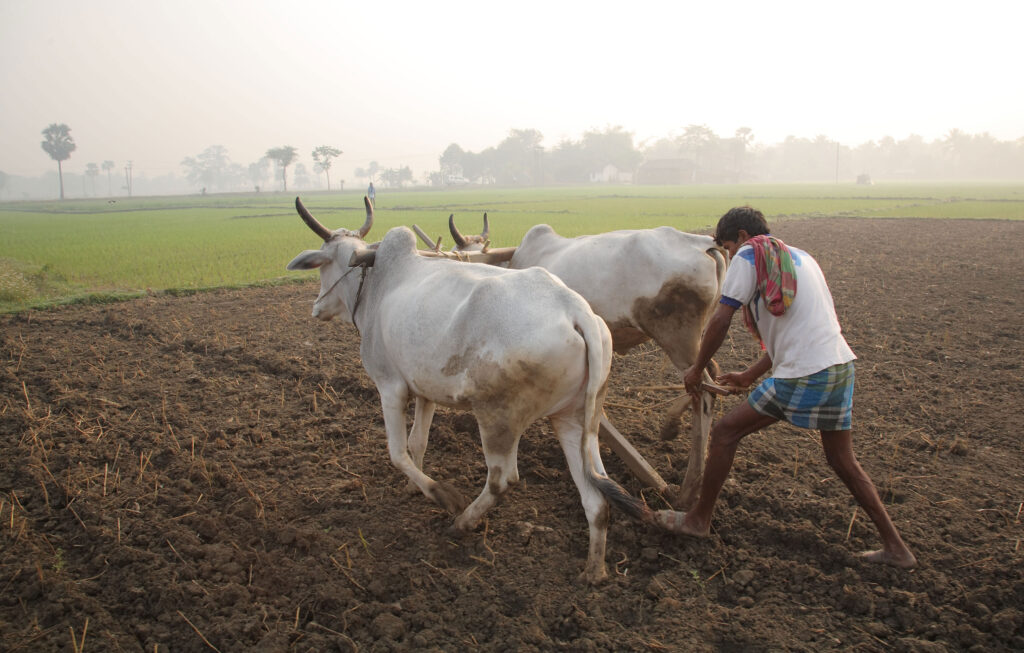
Ploughing with cattle in West Bengal

If you’re building an agri business, whether as a progressive farmer or an FPO leader, here are the top 7 loan options that can help you grow smarter and faster.

  • Kisan Credit Card (KCC): The Kisan Credit Card (KCC) is one of the oldest and most widely used credit products in Indian agriculture. It offers farmers and agri businesses a revolving credit limit for crop inputs, allied activities, and working capital needs.
    As of 2025, operative KCC loans exceeded ₹10 lakh crore (~₹10.05 lakh crore), benefiting ~77.2 million (7.72 crore) farmers in India (Business Standard) After the 2025 Union Budget, the loan limit under KCC was increased from ₹3 lakh to ₹5 lakh, making it more useful for medium and larger cropping cycles. (Business Today)
  • Warehouse Receipt Finance: Stored crops shouldn’t mean idle capital. With warehouse receipt finance, farmers and FPOs can use stored commodities as collateral to secure loans. This not only improves liquidity but also allows them to hold stock for better market prices.
  • Term loans for infrastructure & expansion: For long-term growth, many agri businesses require funding for physical infrastructure, such as cold storage, drying units, and grading and processing facilities.
    Term loans from commercial banks and cooperative lenders support these investments. They are especially critical for scaling up FPO operations and shifting from commodity trading to value addition.

  • Invoice Discounting: Agri businesses often face delayed payments from buyers, which ties up working capital. Invoice discounting lets businesses unlock funds tied in receivables by using pending invoices as loan collateral.
    This financing option is increasingly offered by digital lenders and fintech platforms, cutting down processing times and reducing cash flow bottlenecks.
  • Collateral-free fintech loans: Fintech lenders are playing a growing role in India’s rural credit landscape. By using alternative credit scoring and digital underwriting, many fintechs are expanding access to agri loans for small farmers, traders, and FPOs.
    National data shows fintech players disbursed over 10.9 crore loans totaling ₹1,06,548 crore in FY 2024–25 — a strong indicator of their role in deepening credit access. (The Economic Times) Additionally, the RBI has raised the limit for collateral-free agricultural loans to ₹2 lakh, reducing barriers for marginal borrowers. (adda247)
  • Loans Against Property (LAP): When farms or FPOs look to scale into processing, export, or value addition, larger structured loans may be needed. Loans Against Property (LAP) allow borrowers to use commercial or residential property as collateral to unlock funds at competitive rates.
  • Technology & innovation loans: The Reserve Bank of India is now pushing to include technology-linked expenses, such as soil-testing tools, weather analytics, and organic certification, within loan eligibility norms. (Business Standard)
    These emerging credit products aim to support tech adoption in agriculture, a vital need as data-driven inputs and precision farming become mainstream.

Agriwise offerings: Tailored financing for your agri business

At Agriwise, we believe financing should match the operational realities and goals of an agri business, not the other way around. That’s why our suite of loan solutions is designed for flexibility, seasonality, and real value creation.

Here’s what Agriwise offers:

  • Warehouse Receipt Finance – Unlock capital from stored stock at competitive rates
  • Invoice Bill Discounting – Improve trade cash flows with faster receivables funding
  • Loans Against Property (LAP) – Structured expansion capital
  • Farmer Finance – Working capital assistance tailored for crop cycles
  • Solar & Sustainable Energy Loans – Support for renewable and cost-saving investments

Agriwise acts as a growth partner, not just a lender, helping you leverage the right finance product at the right time to unlock opportunities across your agri value chain.

Conclusion

For any modern agri business, whether a family farm, a medium-scale trader, or an ambitious FPO, access to the right loan at the right time can change the growth trajectory. With the evolving landscape of government support, bank products, and fintech innovation, there are more avenues than ever before to finance working capital, manage risks, and invest in future capacity.

The question now isn’t just “Can I get credit?
It’s “Which loan will help my agri business grow the fastest?

And with tailored solutions from partners like Agriwise, finding answers is easier 🙂

FAQs

  • What are the best loan options for starting or expanding an agri business in India?
    Some of the most popular options include Kisan Credit Card (KCC), warehouse receipt finance, infrastructure term loans, invoice discounting, collateral-free fintech loans, and loans against property for large-scale expansion.
  • Can FPOs apply for agri business loans?
    Yes, Farmer Producer Organisations (FPOs) are eligible for multiple financing options, including working capital loans, warehouse receipt finance, infrastructure loans under government schemes, and fintech-led collateral-free lending.
  • Are there collateral-free loan options available for agri businesses?
    Yes. As per recent RBI guidelines, collateral-free agricultural loans are available up to ₹2 lakh. Additionally, several fintech lenders offer unsecured or partially secured loans based on digital underwriting models.
  • How does warehouse receipt finance help an agri business?
    It allows farmers or FPOs to borrow against stored produce rather than sell immediately after harvest. This improves liquidity and enables better price realisation in volatile markets.
  • How can Agriwise support my agri business growth?
    Agriwise offers customised financing solutions such as warehouse receipt finance, invoice bill discounting, loans against property, farmer finance, and solar finance, all aligned with seasonal cycles and real agri trade requirements.

Disclaimer

The content published on this blog is provided solely for informational and educational purposes and is not intended as professional or legal advice. While we strive to ensure the accuracy and reliability of the information presented, Agriwise make no representations or warranties of any kind, express or implied, about the completeness, accuracy, suitability, or availability with respect to the blog content or the information, products, services, or related graphics contained in the blog for any purpose. Any reliance you place on such information is therefore strictly at your own risk. Readers are encouraged to consult qualified agricultural experts, agronomists, or relevant professionals before making any decisions based on the information provided herein. Agriwise, its authors, contributors, and affiliates shall not be held liable for any loss or damage, including without limitation, indirect or consequential loss or damage, or any loss or damage whatsoever arising from reliance on information contained in this blog. Through this blog, you may be able to link to other websites that are not under the control of Agriwise. We have no control over the nature, content, and availability of those sites and inclusion of any links does not necessarily imply a recommendation or endorsement of the views expressed within them. We reserve the right to modify, update, or remove blog content at any time without prior notice.

business loans

5 Top Benefits of Agri Business Loans in India

February 19, 2026

If there’s one thing the Indian agriculture sector has been transforming over the past decade, it’s access to finance. Today, business loans for agribusinesses are no longer limited to large enterprises or traditional crop loans. They’re powering everything from farm mechanisation and storage to agri-startups and value-chain businesses.
And the numbers tell a compelling story. Agricultural credit in India is projected to cross ₹32.5 lakh crore in FY2025-26, continuing a steady double-digit growth trend and reflecting rising demand for structured finance across the agri ecosystem.


small business loans

So, what makes agribusiness loans such a big deal right now? Let’s break it down in a way that feels practical.

1. Fuel for growth, not just survival

Many agribusinesses operate in seasonal cycles. Cash comes in waves, but expenses never stop. This is where business loans become a growth engine rather than just a safety net.

With structured financing, agribusinesses can:

  • Invest in better equipment and storage
  • Scale procurement or processing
  • Expand to new markets
  • Build working capital buffers

Over the past decade, agri credit has grown at an average of 13% annually, showing that more businesses are shifting from informal borrowing to formal, structured lending. At Agriwise, we’ve seen this shift first-hand. Businesses are no longer borrowing only when they’re in need; they’re borrowing strategically to grow.

2. Better Cash Flow = Better Decisions

Let’s say you’re a trader, processor, or aggregator. You’ve got stock, but payments from buyers take time. Without liquidity, you might miss out on the next opportunity.

This is where business loans help smooth cash flow cycles. With access to timely funding, you can:

  • Hold inventory longer and sell at better prices
  • Manage input costs
  • Avoid distress selling
  • Plan procurement more efficiently

In fact, a significant share of agri credit today is going toward investment and value-chain activities, not just short-term crop loans. That’s a big signal: finance is becoming more business-oriented across the agri ecosystem.

business line of credit

3. Enables technology and modernisation

Curious about why agri-tech adoption is rising so quickly? Finance plays a huge role.

From cold storage to solar pumps and digital platforms, modernisation needs capital. State and national policies are also pushing credit toward productivity and infrastructure upgrades.

With the right business loans, agribusinesses can:

  • Adopt tech tools
  • Upgrade warehouses
  • Improve logistics
  • Integrate digital supply chains

At Agriwise, finance should feel like a growth partner. That’s why solutions like warehouse finance, invoice discounting, and LAP are designed to align with how agri businesses actually operate.

4. Reduces dependence on informal borrowing

Not too long ago, many agri businesses relied heavily on informal credit. Today, institutional lending is taking over, improving transparency and affordability.

The rise in formal credit availability means businesses can access:

  • Better interest rates
  • Structured repayment plans
  • Scalable funding
  • Financial credibility

And credibility matters. Once an agri business builds a borrowing track record, it opens doors to larger funding and partnerships.

5. Expands opportunities beyond farming

Here’s something interesting: agricultural credit isn’t just for farmers anymore. It’s expanding across the entire value chain: traders, processors, exporters, FPOs, logistics providers, and MSMEs. Government credit targets have been steadily rising, with expectations to meet the agriculture credit target of Rs 32.5 lakh crore for 2025–26.

For agri entrepreneurs, business loans can help:

  • Launch processing units
  • Build storage infrastructure
  • Finance trade cycles
  • Expand export operations

best business loans

Agriwise’s role & where it fits

At Agriwise, we like to think of business loans as more than just financial products. They’re tools that help agribusinesses move with confidence. Every agri business has its own cycle, and financing should fit that rhythm, not disrupt it.

That’s why Agriwise offers a range of solutions designed specifically for the agri ecosystem:

  • Warehouse Receipt Finance to unlock liquidity from stored commodities
  • Invoice Bill Discounting to improve cash flow during trade cycles
  • Loans Against Property (LAP) for long-term working capital and expansion
  • Farmer Finance to support input purchases and productivity
  • Solar Finance to enable energy efficiency and cost savings 

Each of these options is built to support real, on-ground needs; whether it’s managing inventory, funding procurement, or investing in infrastructure. With flexible repayment structures and an understanding of agri seasonality, Agriwise ensures that business loans feel practical, accessible, and aligned with how agribusinesses actually operate.

Conclusion

India’s agri economy is evolving fast, and access to structured finance is one of its biggest growth drivers. With agricultural credit expected to keep rising and value-chain financing gaining momentum, the role of business loans will only become more central.

So here’s a question worth thinking about:
If finance is now more accessible than ever, what could your agribusiness do with the right funding at the right time? That’s exactly the conversation we want to be part of.

FAQs

  1. What are agribusiness loans?
    Agri business loans are financing solutions designed for agribusinesses such as traders, processors, FPOs, and agri-entrepreneurs to manage working capital, expansion, and infrastructure needs.
  2. Who can apply for agribusiness loans in India?
    Farmers, agri traders, processors, warehouse operators, input dealers, and agri startups can apply, depending on eligibility, business size, and financial documentation.
  3. How are business loans useful for agribusinesses?
    They help manage cash flow, fund procurement, invest in storage or equipment, and scale operations without disrupting seasonal cycles.
  4. What types of agribusiness loans are available?
    Common options include warehouse receipt finance, invoice discounting, loans against property, and working capital loans tailored for agri trade and infrastructure.
  5. How can Agriwise support agri businesses?
    Agriwise offers specialised business loans aligned with agri cycles, helping businesses unlock liquidity from stock, manage trade payments, and invest in growth with flexible financing solutions.

Disclaimer

The content published on this blog is provided solely for informational and educational purposes and is not intended as professional or legal advice. While we strive to ensure the accuracy and reliability of the information presented, Agriwise make no representations or warranties of any kind, express or implied, about the completeness, accuracy, suitability, or availability with respect to the blog content or the information, products, services, or related graphics contained in the blog for any purpose. Any reliance you place on such information is therefore strictly at your own risk. Readers are encouraged to consult qualified agricultural experts, agronomists, or relevant professionals before making any decisions based on the information provided herein. Agriwise, its authors, contributors, and affiliates shall not be held liable for any loss or damage, including without limitation, indirect or consequential loss or damage, or any loss or damage whatsoever arising from reliance on information contained in this blog. Through this blog, you may be able to link to other websites that are not under the control of Agriwise. We have no control over the nature, content, and availability of those sites and inclusion of any links does not necessarily imply a recommendation or endorsement of the views expressed within them. We reserve the right to modify, update, or remove blog content at any time without prior notice.