
Tag Archives: agriwise loans

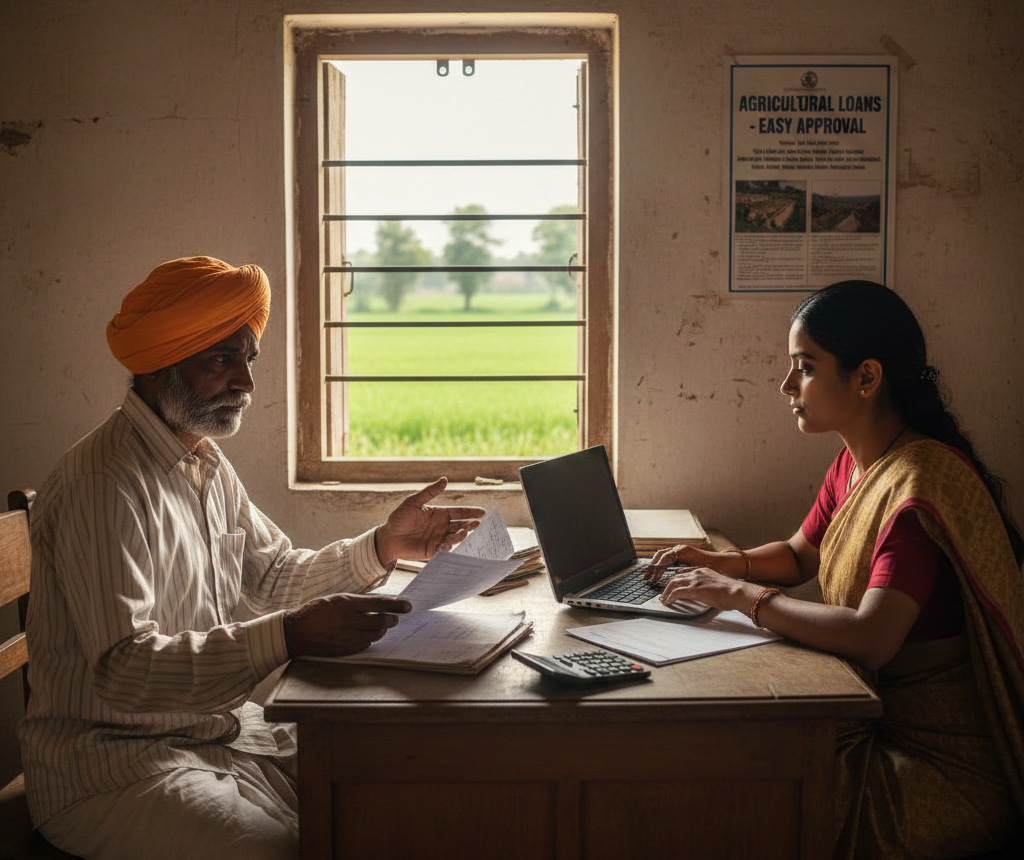
Top 6 Tips to Get Hassle-Free Agri Loans in India

February 12, 2026

India’s farms are growing smarter, markets are moving faster, and finance is evolving alongside them. Today, access to the right credit at the right time can shape everything, from crop decisions to trading opportunities and long-term expansion. As institutional lending continues to expand, loans in India are becoming more digital, structured, and aligned with real agricultural needs. The country’s agricultural credit flow is projected to cross ₹32.5 lakh crore in FY2025-26, signalling both strong policy momentum and rising demand for formal financing.

But while the numbers look promising, the ground reality often tells a different story. Many farmers and agri-entrepreneurs still find themselves navigating paperwork, approval delays, and confusing loan options. The gap isn’t always about availability; it’s often about awareness and approach. Whether you’re cultivating crops, trading commodities, or scaling an agri-business, knowing how to navigate the credit landscape can make all the difference.

loans in india

Here are six practical tips to help you secure hassle-free agri loans in India and make financing work in your favour.

  • Maintain clear financial and land records

One of the most important steps for smooth loan approvals is proper documentation. Lenders evaluate land ownership, crop patterns, and repayment history before approving loans in India.

Keep the following ready:

    • Updated land records or lease agreements
    • Bank statements and transaction history
    • Crop or business income proof
    • KYC documents
  • Build a strong credit profile

A strong credit history increases your chances of faster approvals and better interest rates. Over the past decade, institutional agri-credit has grown at an average of over 13% annually, showing that lenders are increasingly relying on formal credit data.

To strengthen your profile:

    • Repay existing loans on time
    • Avoid excessive borrowing
    • Maintain regular bank transactions
    • Use formal channels like the Kisan Credit Card or warehouse-based finance
  • Choose the right type of agri loan

Selecting the right financing product is crucial. Different needs require different types of loans, crop finance, equipment loans, working capital, or post-harvest funding. Applying for the wrong type of loan often leads to delays or rejection. Understanding whether you need short-term crop finance, warehouse-based funding, or long-term expansion capital can help you apply more efficiently and avoid unnecessary processing time

  • Leverage digital lending platforms

Technology is transforming agri-finance. Many states now offer digital loan processing through e-Kisan Credit Card and similar systems, significantly reducing approval timelines. Recent initiatives show farmers can receive loan approvals within minutes through digital verification processes. (The Times of India)

Digital lending platforms reduce:

    • Physical paperwork
    • Branch visits
    • Processing delays

business loan in india

  • Use collateral and value-chain financing

Providing collateral or linking loans to agricultural value chains improves approval chances. For example:

    • Stored crops can be used for warehouse financing
    • Equipment or property can support secured loans
    • Trade invoices can unlock working capital

With nearly 60% of agricultural lending still going toward short-term crop loans, there is a growing focus on investment and value-chain credit.

  • Work with specialised agri-finance institutions

While banks remain the backbone of rural lending, specialised NBFCs and agri-finance platforms are bridging the credit gap. Even though agricultural credit targets are rising, the sector still receives a smaller share of total bank lending than mandated, highlighting the need for focused lenders.

Choosing an agri-focused lender like Agriwise offers benefits such as:

    • Faster processing
    • Sector-specific underwriting
    • Flexible repayment aligned with crop cycles
    • Financing for allied activities like dairy, solar, and trading

How Agriwise supports hassle-free agri financing

For borrowers seeking simplified, sector-focused credit solutions, specialised platforms like Agriwise offer financing tailored to agricultural and agribusiness needs.

Agriwise offers:

  • Farmer Finance: Short-term loans for crop inputs and cultivation cycles
  • Warehouse Receipt Finance: Funding against stored produce to avoid distress sales
  • Loans Against Property (LAP): Secured financing for business expansion or working capital
  • Solar Finance: Loans for solar pumps and renewable energy investments

Conclusion

India’s agri-credit ecosystem is expanding rapidly. Government targets, digital platforms, and value-chain financing are making loans in India more accessible than ever before. With rising institutional lending and policy support, the focus is now shifting from just loan availability to ease, speed, and suitability.

For farmers and agri-businesses, the key lies in being prepared, choosing the right lender, and leveraging digital tools. Platforms like Agriwise are playing a crucial role by offering customised solutions, from farmer finance to warehouse receipt loans, designed specifically for agricultural needs. Through these tips and working with specialised lenders, borrowers can access hassle-free agri loans and invest confidently in growth, productivity, and long-term resilience.

FAQs

  • Who can apply for agri loans in India?
    Farmers, FPOs, agri-traders, processors, and agri-business owners can apply for agri loans in India. Eligibility usually depends on land records or business proof, income details, repayment capacity, and basic KYC documentation.
  • What documents are typically required for agri loans?
    Most lenders ask for identity and address proof, land ownership or lease records, bank statements, income details, and crop or business information. For value-chain financing, documents such as warehouse receipts or invoices may also be required.
  • How long does it take to get an agri loan approved?
    Approval timelines vary by lender and loan type. Digital applications and structured financing options can significantly reduce processing time, sometimes enabling faster approvals compared to traditional methods.
  • What types of agri loans are available in India?
    Common options include crop loans, working capital loans, warehouse receipt finance, loans against property, equipment financing, and solar or infrastructure loans. Choosing the right type based on your requirement can make the process smoother.
  • How can specialised agri-finance platforms like Agriwise help?
    Sector-focused lenders such as Agriwise offer tailored solutions aligned with agricultural cash flows and commodity cycles. They provide financing for farmers and agribusinesses through products such as farmer finance, warehouse receipt finance, invoice discounting, and secured loans, helping make loans in India more structured and accessible.
working capital

How Better Working Capital Can Change Your Agribusiness in 2026

January 02, 2026

Indian agribusiness is entering a pivotal phase of financial transformation. With agricultural credit forecasted to hit a record ₹32.5 lakh crore in FY26, up from ₹28.7 lakh crore in FY25, access to credit, especially working capital, is becoming more abundant and more critical than ever before. This surge in financing is helping farmers and agri-enterprises modernise operations, invest in advanced technologies, and withstand market volatility, laying the foundation for a resilient agribusiness sector in 2026.

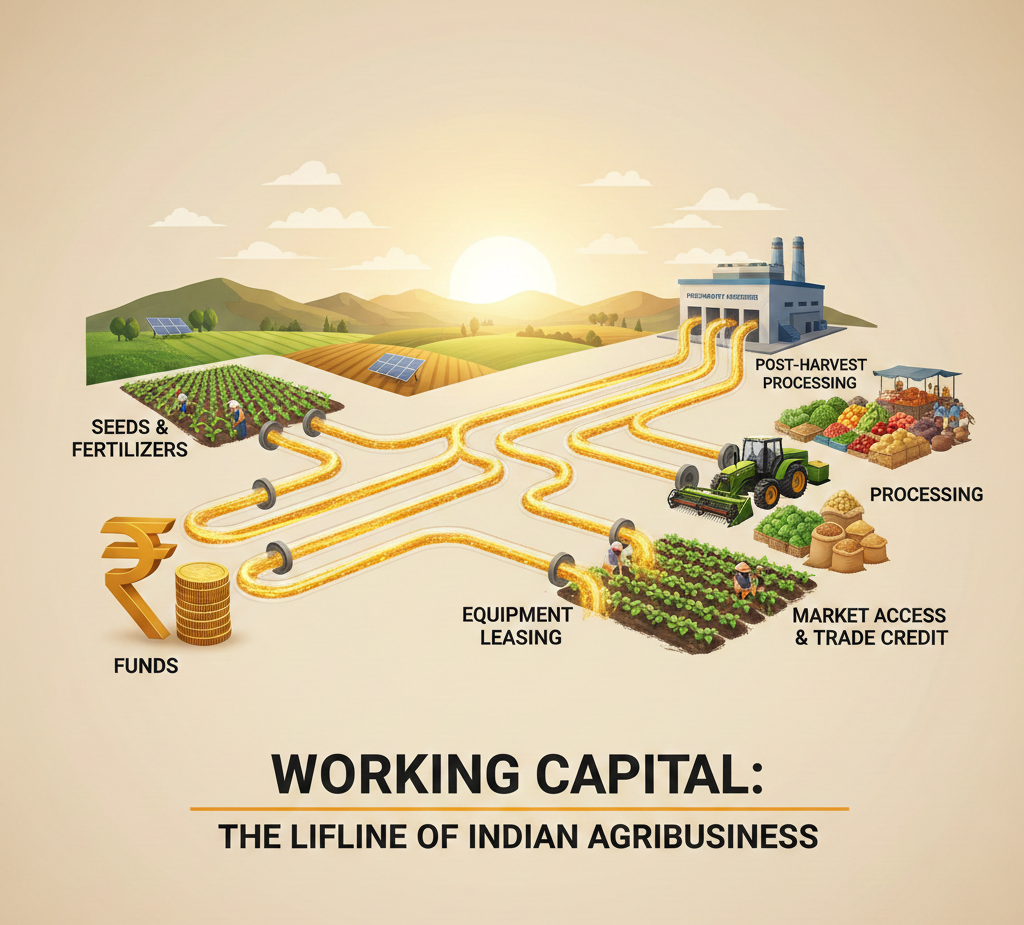
In this context, working capital isn’t just a financial metric but the lifeline that enables growth, innovation, and stability across agricultural value chains. From input procurement and labour costs to logistics and inventory, effective working-capital management determines how swiftly an agribusiness can respond to opportunities and challenges.

working capital loan

Importance of working capital

These are the funds available for everyday operations, which drive the engine of agribusiness. Unlike industrial sectors with predictable cash cycles, agriculture is highly seasonal. Expenses such as seeds, fertilisers, equipment hire, and workforce wages occur long before revenues from crop sales are realised. Without a smooth working capital flow, even high-potential enterprises can face delayed cash flows, squeezed profit margins, and limited growth.
For example, the Government of India’s Modified Interest Subvention Scheme (MISS) continues to support short-term loans through Kisan Credit Cards (KCCs), offering concessions explicitly aimed at working capital needs. Around 77 million KCCs are active, offering farmers access to subsidised credit at effective interest rates as low as 4 %, thereby enhancing short-term liquidity.

Despite these positive trends, credit distribution remains uneven across regions, and many agribusinesses still struggle to bridge cash flow gaps, underscoring the importance of strategic capital management.

Better working capital can transform agribusinesses in 2026

Here’s how improved access and management will reshape the sector in the year ahead:

  • Ensuring operational continuity and growth: This ensures that routine expenses, from seed purchases to harvesting logistics, are met without borrowing at high rates or disrupting production schedules. With sufficient capital, agribusinesses can plan ahead, participate in competitive markets, and negotiate bulk discounts with suppliers.
  • Fueling technology adoption and efficiency: In 2026, digital and precision farming tools are increasingly central to competitiveness. Technologies like soil sensors, drone monitoring, and automated irrigation improve yields and reduce costs. However, deploying these innovations often requires upfront investment. Adequate capital enables agribusinesses to adopt such technologies without compromising liquidity.
  • Supporting value-added and SME segments: Value-added players, from cold storage operators to food processors, face longer cash-conversion cycles due to inventory storage, grading, and quality clearance procedures. Tailored working capital solutions help these agribusiness SMEs cover operating costs and maintain production quality while navigating fluctuations in market demand.

cold storage

  • Enhancing market access and exports: India’s agri-exports are poised for expansion in 2026, backed by government initiatives and infrastructure support. Enterprises with strong working capital positions can better navigate export cycles, secure international contracts, and manage seasonal price fluctuations. Flexible capital also enables participation in futures markets, enhancing price discovery and risk management.
  • Building resilience to market and climate risks: Agriculture remains vulnerable to climatic unpredictability and price swings. Better capital provides a buffer against adverse weather events and crop failures, enabling agribusinesses to withstand shocks without compromising future productivity.

Agriwise supports working capital needs

At this juncture, Agriwise is reshaping how agribusinesses access finance. Agriwise specialises in tailored agricultural financing solutions that go beyond traditional credit products. They offer short-term working capital loans, term loans, and commodity-linked financing designed explicitly for agri-enterprises, enabling smoother cash flows and better financial planning.

Unlike generic lending options, Agriwise understands the unique cash flow cycles of the farm and allied sectors. By combining deep agricultural insights with flexible financing products, Agriwise empowers businesses to optimise working-capital utilisation, bridge seasonal gaps, and invest in growth opportunities. This kind of nuanced financing support is especially critical in 2026, as agribusinesses scale, innovate, and compete both domestically and globally.

Practical strategies for managing capital

To harness the full potential of working capital, agribusinesses should embrace a mix of financial discipline and smart tools:

  • Accurate cash-flow forecasting: Predict peaks and troughs in expenses and revenues to avoid liquidity crunches.
  • Digital lending platforms: Use fintech and agri-finance solutions that offer fast approval and tailored working-capital loans.
  • Optimised inventory management: Reduce excess stock and align purchases with market cycles.
  • Government credit programmes: Use initiatives like KCCs and interest subvention schemes to reduce borrowing costs.
  • Strong banking relationships: Maintain robust interactions with lenders to facilitate better credit access when needed.

The future of agribusiness in 2026

As India cements its position as a global agrarian powerhouse, effective working-capital management will differentiate successful agribusinesses from the rest. As financial inclusion increases and credit products become more tailored and accessible, the focus should shift from merely accessing funds to strategically managing them.

Working capital will not just support daily operations; it will fuel innovation, strengthen resilience, and unlock new markets. Agribusinesses that prioritise efficient capital practices in 2026 will be well-placed to lead India’s agricultural growth story, sustainably and profitably.

FAQs:

  • What is working capital in agribusiness, and why is it important?
    Working capital in agribusiness refers to the funds used for day-to-day operations such as buying inputs, paying labour, managing logistics, and storing produce. It is important because agriculture involves seasonal cash flows, and timely access to cash ensures uninterrupted operations and higher productivity.
  • How does better working capital improve agribusiness profitability?
    Better capital enables agribusinesses to procure quality inputs on time, reduce reliance on high-interest informal loans, and manage inventory more efficiently. This leads to improved yields, lower operational costs, and stronger margins over the production cycle.
  • What are the typical working capital challenges faced by agribusinesses?
    Agribusinesses often face delayed payments, long cash-conversion cycles, rising input costs, and seasonal income gaps. Limited access can restrict growth, delay technology adoption, and increase financial stress during critical periods.
  • How can agribusinesses improve working capital management in 2026?
    In 2026, agribusinesses can improve capital management by accurately forecasting cash flows, using digital and agri-focused financing platforms, optimising inventory levels, and leveraging government credit schemes for short-term agricultural finance.
  • How does Agriwise help agribusinesses meet their working capital needs?
    Agriwise provides customised financial solutions tailored to the agricultural sector, including short-term loans and commodity-linked financing. By understanding seasonal cycles and operational needs, Agriwise helps agribusinesses maintain liquidity, manage cash flows efficiently, and scale sustainably.

Disclaimer

The content published on this blog is provided solely for informational and educational purposes and is not intended as professional or legal advice. While we strive to ensure the accuracy and reliability of the information presented, Agriwise make no representations or warranties of any kind, express or implied, about the completeness, accuracy, suitability, or availability with respect to the blog content or the information, products, services, or related graphics contained in the blog for any purpose. Any reliance you place on such information is therefore strictly at your own risk. Readers are encouraged to consult qualified agricultural experts, agronomists, or relevant professionals before making any decisions based on the information provided herein. Agriwise, its authors, contributors, and affiliates shall not be held liable for any loss or damage, including without limitation, indirect or consequential loss or damage, or any loss or damage whatsoever arising from reliance on information contained in this blog. Through this blog, you may be able to link to other websites that are not under the control of Agriwise. We have no control over the nature, content, and availability of those sites and inclusion of any links does not necessarily imply a recommendation or endorsement of the views expressed within them. We reserve the right to modify, update, or remove blog content at any time without prior notice.

5 mistakes to avoid while checking your Loan Against Property eligibility

December 03, 2025

Taking a Loan Against Property (LAP) is one of the most cost-effective ways for farmers, agribusiness owners, MSMEs and SMEs to access large amounts of working capital. But many applicants lose time, money, or approval chances because they stumble over basic checks when assessing a loan against property eligibility. Below are 5 common mistakes and how to avoid them, so your application (and your business) stays on track.

Quick market snapshot: Why this matters?

The Indian loan against property market size reached USD 758.00 Billion in 2024. Looking forward, IMARC Group expects the market to reach USD 2,369.36 Billion by 2033, exhibiting a growth rate (CAGR) of 13.50% during 2025-2033. This growth means more lenders, more products, and more reasons to check eligibility carefully.

lap loan emi calculator

Mistake 1: Relying on a single rough EMI estimate

Many borrowers start with a vague monthly payment idea and proceed to apply. Using an accurate loan against property EMI calculator is essential because EMI, tenure, and interest rate determine affordability and LTV (loan-to-value) decisions. Free calculators that let you change interest rate, tenure and loan amount will show whether your cash flows truly support the loan. Agriwise offers a dedicated EMI calculator tailored for LAP customers. Use it before you apply to avoid surprises!

Fix: Run multiple scenarios on a loan against property EMI calculator (different tenures and rates) and save the outputs to share with your relationship manager.

Mistake 2: Ignoring the precise eligibility inputs

“Am I eligible?” is too broad. Lenders evaluate multiple variables — credit score, income, property type (residential/commercial/industrial), clear title, and age of the property. Don’t assume you’ll qualify because you own land. Use a loan against property eligibility calculator to get a data-driven read on likely outcomes. Remember that eligibility criteria for loan against property can differ widely between banks and NBFCs, especially for agricultural/ rural properties.

Fix: Collect documents (title deed, latest property tax receipt, income proofs, bank statements) and feed accurate numbers into a loan against property eligibility calculator before applying. Agriwise’s LAP guides agri-clients through property doc checks and provides an easy eligibility check process.

Mistake 3: Overestimating the property valuation or LTV

A common misstep is assuming a lender will accept the market value you see on listing sites or broker quotes. Lenders perform independent valuations and often offer conservative LTVs of 40–70%, depending on the property and lender risk. Assuming a higher LTV can leave you short of the funds you are  expected to have.

Fix: Ask prospective lenders for indicative LTV ranges and plan financing with conservative figures. Use your LAP loan EMI calculator with the lower loan amount to test affordability if LTV is reduced.

loan against property emi calculator


Mistake 4: Underestimating the impact of credit score and debt profile

The macro trend shows household debt rising and more formal loans being sanctioned through fintechs and NBFCs — meaning underwriting is getting data-driven and stricter in certain pockets. A weak credit history or multiple recent loans can increase your interest rate or reduce sanction amount. Don’t assume secured lending removes all credit scrutiny.

Fix: Pull your credit report, correct errors, and reduce outstanding high-cost unsecured debt before applying. If you need a lender who understands agri cash flow cycles, Agriwise’s LAP team often structures repayments aligned with crop cycles and cash inflows.

Mistake 5: Overlooking total costs beyond the EMI

EMI is just one part of the cost. Processing fees, valuation fees, legal charges, insurance, pre-payment penalties, and GST can add materially to borrowing costs. Comparing only the headline rate (or only the EMI) can mislead you into choosing a more expensive option.

Fix: Use a loan against property EMI calculator that allows you to add fees, or keep a separate fees worksheet. Ask lenders for a full break-up of charges and compute the effective cost. Agriwise’s platform provides a transparent fee summary alongside the EMI output so agribusiness customers can compare offers quickly.

Final checklist before you apply

  1. Run multiple scenarios on an accurate LAP loan EMI calculator and an eligibility calculator.
  2. Gather title documents and income proofs in advance.
  3. Confirm the likely LTV and valuation process with the lender.
  4. Clean up your credit profile and consolidate high-cost debt.
  5. Compare total costs (fees + EMI), not just headline interest.

loan against property eligibility

Why choose Agriwise for LAP checks?

Agriwise combines agri-sector expertise with tailored LAP solutions for farmers and agribusinesses. Their LAP offering understands seasonal cash flows and typical rural property documentation, and their online EMI calculator (explicitly designed for LAP customers) helps you model realistic EMIs quickly. Use Agriwise to run both your EMI scenarios and a guided eligibility check before you approach banks or NBFCs.

Staying methodical when checking a loan against property eligibility saves time, reduces costs, and increases your chance of approval. Run the right calculators, validate documents, and work with an agri-savvy lender like Agriwise, and your LAP will become a working-capital tool rather than an unexpected burden.

FAQs

  • What is loan against property eligibility, and why is it important?
    Loan Against Property (LAP) eligibility refers to the set of criteria that a borrower must meet to qualify for a loan by pledging their residential, commercial, or industrial property as collateral. These criteria may include the borrower’s income, credit score, repayment capacity, property value, property title clarity, and overall financial profile.
  • How can I check my loan against property eligibility accurately?
    The easiest way is to use a loan against property eligibility calculator. It evaluates factors like income, current EMIs, and property value to give a quick indication of your eligibility. Agriwise also guides applicants through document checks for accurate results.
  • Which tools help me estimate EMIs before applying for a LAP?
    You can use a loan against property emi calculator or a LAP loan emi calculator to estimate monthly payments based on interest rate, loan amount, and tenure. Agriwise offers a simple online EMI calculator designed specifically for LAP customers.
  • What documents do I need to meet the eligibility criteria for a loan against property?
    Typically, you need property papers (clear title deed), ID & address proof, bank statements, income documents, and latest property tax receipts. Lenders may ask for additional paperwork depending on the property and loan profile.
  • How does Agriwise help improve my chances of LAP approval?
    Agriwise provides a transparent eligibility-check flow, assists with property and income documentation, and offers customised LAP solutions suited to agricultural and rural borrowers. Its online EMI calculator also helps you fine-tune the right loan and repayment plan before applying.

Disclaimer

The content published on this blog is provided solely for informational and educational purposes and is not intended as professional or legal advice. While we strive to ensure the accuracy and reliability of the information presented, Agriwise make no representations or warranties of any kind, express or implied, about the completeness, accuracy, suitability, or availability with respect to the blog content or the information, products, services, or related graphics contained in the blog for any purpose. Any reliance you place on such information is therefore strictly at your own risk. Readers are encouraged to consult qualified agricultural experts, agronomists, or relevant professionals before making any decisions based on the information provided herein. Agriwise, its authors, contributors, and affiliates shall not be held liable for any loss or damage, including without limitation, indirect or consequential loss or damage, or any loss or damage whatsoever arising from reliance on information contained in this blog. Through this blog, you may be able to link to other websites that are not under the control of Agriwise. We have no control over the nature, content, and availability of those sites and inclusion of any links does not necessarily imply a recommendation or endorsement of the views expressed within them. We reserve the right to modify, update, or remove blog content at any time without prior notice.

How does solar finance work? A step-by-step guide for farmers

November 20, 2025

As more farms turn to clean energy, solar finance has become a vital tool that helps farmers install solar pumps, rooftop systems, and field-mounted arrays without large upfront costs. This guide breaks down how solar finance works in practical steps and highlights why it’s an attractive option for small and medium farmers in India today.

Why is solar finance important for farmers?

Solar finance provides the capital support needed to transition from expensive traditional power sources to clean solar energy. India’s transition to solar is accelerating. By 2025, the country’s utility-scale and distributed solar capacity crossed the 100+ GW mark, reflecting rapid adoption across sectors. In 2025, India continued to install solar pumps, with significant progress reported under the Pradhan Mantri Kisan Urja Suraksha evam Utthaan Mahabhiyan (PM-KUSUM) scheme. As of July 31, 2025, 8.53 lakh solar pumps were installed.
These shifts make solar finance not just an environmental choice but a smart economic decision: predictable energy bills, higher irrigation reliability, and, often, access to government subsidies or favourable loan schemes.

solar finance

How does solar finance work for a farmer?

  • Assess energy need and costs: Estimate the system size you need (pump horsepower or kW for a roof/field system), expected energy generation, and total system cost (equipment, installation, wiring). Many local vendors or solar installers will provide a free site assessment and a quotation.
  • Explore subsidies & grants: Central and state schemes frequently offer capital subsidies or incentives for agricultural solar (pump and feeder schemes, rooftop incentives). These subsidies can reduce the upfront cost and improve loan viability. Verify current schemes at the local nodal agency or state renewable energy department.
  • Choose a financing option: Solar finance for farmers typically comes in several forms: Farmers have multiple avenues to finance solar installations. Government programmes such as the PM-KUSUM scheme provide capital subsidies and facilitated credit support to lower the cost burden of adoption. In addition to these subsidised mechanisms, farmers may also access conventional bank financing, asset-specific equipment loans, or secured term loans offered by banks and NBFCs.

    1. Retail/consumer loans from banks and NBFCs (secured or unsecured, with tenors matching equipment life).
    2. Asset-backed loans collateralised by the solar system itself.
    3. Pay-As-You-Go / Lease / Energy-as-a-Service models, where a provider installs and owns the system — the farmer pays a predictable monthly fee tied to energy delivered.
    4. Blended finance where subsidy + concessional credit + commercial loan are combined to lower the effective cost. 
  • Loan application and documentation: Typical documents: KYC, land proof /7/12, farm electricity bill, quotation from installer, and subsidy sanction proof (if applicable). Lenders will assess repayment capacity, often using projected savings from fuel/electricity substitution and any additional farm income generated from reliable irrigation or cold-storage power.

  • Installation and inspection: After loan sanction and disbursal (sometimes partly to the vendor), the system is installed. Lenders or nodal agencies may require an inspection and performance guarantees. Modern finance models include remote monitoring to ensure generation meets promised levels.
  • Repayment & performance monitoring: Repayment schedules can be matched to crop cash flows (seasonal EMIs or grace periods). In meter-based or PAYG models, payments may be linked to generated energy or a flat monthly tariff. Many systems now offer remote telemetry so lenders and farmers can monitor generation and address issues fast.

Key data to consider

  • India’s large-scale and distributed solar capacity surged through 2025, making the technology widely available and competitive vs. diesel alternatives.
  • The solar irrigation rollout is sizeable; reports and company disclosures show tens of thousands of pump systems added in recent fiscal periods, underscoring demand from the agriculture sector.
  • Sustainable agriculture finance is increasingly channelled into climate-smart investments. Green finance reports show rising flows into agri-solar projects and related lending instruments.

How Agriwise supports farmers with solar finance?

Agriwise provides farmer-centric solar finance solutions designed for agriculture realities: flexible tenors that align with cropping cycles, options for equipment financing (pumps, panels, inverters) and tie-ups with verified installers to simplify procurement. Agriwise structures loans so that subsidy benefits and projected fuel/electricity savings are integrated into the repayment plan, reducing cash-flow stress for farmers.

Quick tips for farmers considering solar finance

  • Get multiple quotes; compare warranties and expected energy yield.
  • Check subsidy eligibility first; it varies by state.
  • Align loan tenure with expected equipment life 
  • Consider monitoring systems, which reduce downtime and protect your investment.

Adopting solar through smart solar finance can lower operating costs, improve irrigation reliability, and strengthen farm resilience. With the right financing partner (like Agriwise) and careful planning, farmers can switch to clean energy with minimal strain on cash flow — turning sunlight into a dependable farm asset.

Disclaimer

The content published on this blog is provided solely for informational and educational purposes and is not intended as professional or legal advice. While we strive to ensure the accuracy and reliability of the information presented, Agriwise make no representations or warranties of any kind, express or implied, about the completeness, accuracy, suitability, or availability with respect to the blog content or the information, products, services, or related graphics contained in the blog for any purpose. Any reliance you place on such information is therefore strictly at your own risk. Readers are encouraged to consult qualified agricultural experts, agronomists, or relevant professionals before making any decisions based on the information provided herein. Agriwise, its authors, contributors, and affiliates shall not be held liable for any loss or damage, including without limitation, indirect or consequential loss or damage, or any loss or damage whatsoever arising from reliance on information contained in this blog. Through this blog, you may be able to link to other websites that are not under the control of Agriwise. We have no control over the nature, content, and availability of those sites and inclusion of any links does not necessarily imply a recommendation or endorsement of the views expressed within them. We reserve the right to modify, update, or remove blog content at any time without prior notice.

Collateral-free loan options for MSMEs in the Indian agri value chain

October 05, 2025

For MSMEs operating in the agricultural value chain—whether input suppliers, aggregators, processing units, cold storage operators, or rural logistics providers—access to credit without requiring collateral is a game changer. Collateral requirements often act as a barrier for smaller agribusinesses that lack land title or real estate. In 2025, a growing number of collateral-free loan schemes and guarantee-based instruments are opening the door to more inclusive finance across agribusiness segments.

Why collateral-free loan matters for agri MSMEs?

Agriculture and its allied activities remain capital-intensive and seasonally cyclical. In India alone, the total farm credit target for FY 2025–26 is projected at around ₹31–32 lakh crore. Yet, many agri-value MSMEs struggle to convert growth potential into scale because they can’t meet collateral demands. A collateral-free loan reduces entry barriers and promotes innovation, especially in areas such as post-harvest handling, food processing, cold chains, farm machinery leasing, and rural aggregation.

collateral-free loan

Further, the intensifying push for financial inclusion and rural development is prompting regulators and the government to expand guarantee schemes and concessional credit. For example, as of April 1, 2025, the Government of India has enabled collateral-free loans of up to ₹10 crore under certain categories, with guarantee coverage of up to 90%. This move signals a strategic tilt toward enabling MSME financing without the friction of security liens.

Key collateral-free loan schemes and programs in 2025

  1. Credit Guarantee Schemes (CGTMSE / MSME Guarantee Funds): The Credit Guarantee Fund Trust for Micro and Small Enterprises (CGTMSE) enables unsecured term or working capital loans up to ₹1 crore per borrowing unit. For agri processors or cold storage operators seeking expansion, CGTMSE-backed loans can be a strong option.

  2. Collateral-free agricultural credit (RBI / KCC / MISS): In December 2024, the Reserve Bank of India raised the limit for collateral-free agricultural loans from ₹1.6 lakh to ₹2 lakh per borrower, effective January 2025. Similarly, the MISS (Minor Irrigation and Allied Support Scheme) limit was enhanced from ₹3 lakh to ₹5 lakh, enabling small-scale agri entrepreneurs to access funds for pumps, drip irrigation, or allied projects.

  3. MUDRA loans / Unsecured business loans: Under the Pradhan Mantri MUDRA Yojana (PMMY), micro enterprises can receive unsecured loans up to ₹10 lakh. This suits smaller MSMEs in packaging, logistics, and rural processing.

  4. Joint Liability Groups (JLGs) and SHGs: Group lending models continue to support rural enterprises by leveraging shared responsibility instead of collateral. MSMEs tied to Farmer Producer Organisations (FPOs) can use JLG structures to access unsecured loans collectively.

  5. Scheme-based enterprise development loans: Several government MSME development programs provide unsecured loans up to ₹3 lakh for micro enterprises along with capacity-building and infrastructure support. 


The Agriwise advantage

While government and institutional schemes are widening access to collateral-free loan, MSMEs in the agri value chain often need customised lending solutions that reflect the realities of agriculture. This is where Agriwise Finserv, the NBFC arm of StarAgri, steps in:

  • Farmer Scorecard & AgriBhumi integration: Lending decisions are backed by satellite-verified land intelligence and credit profiling, ensuring that even smallholder farmers and MSMEs get fair access to finance.

  • Quick turnaround: With tech-driven processes, Agriwise ensures faster approvals and disbursements, a vital edge in time-sensitive agri cycles.

  • Supply chain financing: Agriwise supports not just farmers but also input suppliers, aggregators, and processors, enabling smooth flow of working capital across the agricultural value chain.

By combining multiple loan products with data-backed assessments, Agriwise is empowering MSMEs and smallholders to scale sustainably without being excluded from formal finance.

Challenges & risks to mitigate

  • Higher interest rates: Unsecured loans can be priced higher due to risk exposure.

  • Guarantee fees: Some schemes add a cost layer in the form of guarantee fees.

  • Loan size limitations: Many unsecured options are capped, requiring blended approaches for larger needs. 
  • Awareness gaps: Rural MSMEs often remain unaware of these schemes and rely heavily on intermediaries. 


Conclusion

A collateral-free loan is emerging as a powerful enabler for MSMEs in India’s agri value chain. With policy reforms, guarantee coverage, and fintech-led innovations, 2025 marks a turning point for unsecured agri financing.

For MSMEs, the right strategy is to blend institutional schemes with sector-specialised lenders like Agriwise. By doing so, they can gain access to timely, collateral-free working capital and trade finance—unlocking new avenues for scaling operations, strengthening value chains, and driving rural economic growth.

Disclaimer

The content published on this blog is provided solely for informational and educational purposes and is not intended as professional or legal advice. While we strive to ensure the accuracy and reliability of the information presented, Agriwise make no representations or warranties of any kind, express or implied, about the completeness, accuracy, suitability, or availability with respect to the blog content or the information, products, services, or related graphics contained in the blog for any purpose. Any reliance you place on such information is therefore strictly at your own risk. Readers are encouraged to consult qualified agricultural experts, agronomists, or relevant professionals before making any decisions based on the information provided herein. Agriwise, its authors, contributors, and affiliates shall not be held liable for any loss or damage, including without limitation, indirect or consequential loss or damage, or any loss or damage whatsoever arising from reliance on information contained in this blog. Through this blog, you may be able to link to other websites that are not under the control of Agriwise. We have no control over the nature, content, and availability of those sites and inclusion of any links does not necessarily imply a recommendation or endorsement of the views expressed within them. We reserve the right to modify, update, or remove blog content at any time without prior notice.

How does warehouse receipt finance help farmers unlock working capital?

September 24, 2025

In India’s agricultural economy, cash flow challenges are one of the biggest barriers for farmers, especially smallholders, in accessing inputs, waiting for good market prices, and avoiding distress sales. Warehouse receipt finance (WHR finance) has emerged as a powerful tool to enable farmers to convert stored produce into working capital, improve bargaining power, and reduce risk.
But how does warehouse receipt finance work? Let’s explore the current status in India, benefits and challenges, and how Agriwise is helping farmers access commodity finance via warehouse receipt systems.

What is warehouse receipt finance?

Warehouse receipt finance refers to a financial arrangement where farmers deposit their agricultural produce in approved warehouses and receive a warehouse receipt (physical or electronic) that acts as collateral to obtain a loan or loan‐equivalent financing. Because the produce is stored under regulated conditions, the receipt assures both the lender and borrower about quality, quantity, and storage integrity.

In India, with the advent of e-NWR (electronic Negotiable Warehouse Receipts), warehouse receipt finance India has become more formalised, efficient, traceable, and scalable.

According to data published on the WDRA portal, the country’s active regulated warehousing capacity as of the end of March 2025 is approximately 44.8 million tonnes. In 2023-24, India produced ~330 million tonnes of food grains, but only about 1.24 million tonnes have been financed using warehousing / e-NWR instruments.

warehouse receipt finance

How does warehouse receipt finance help farmers?

Here are the ways in which WHR finance (often a subset of wider commodity finance for farmers) can make a difference:

  • Avoiding distress sales & price timing: Farmers often have to sell produce immediately after harvest when supply is high and prices are low. By using WHR finance, they can store produce under good conditions, obtain liquidity via the receipt, and sell when market conditions improve.
  • Higher bargaining power: With the ability to hold produce, farmers aren’t forced sellers. They can wait for better demand, possibly export markets, better MSP, or private buyers who pay premiums for quality. The formal system of such finance in India (primarily through e-NWR) improves trust in the quality and condition.
  • Reduced post-harvest losses: Warehouses registered under WDRA and collateral managers ensure quality, pest control, good storage practices. When produce is stored properly, spoilage reduces, so less loss, better quality, which fetches higher price. WHR finance makes storing financially viable.
  • Improved access to formal finance: Receipt acts as collateral; banks, NBFCs more willing to lend against regulated receipts. This is especially critical for small/marginal farmers who often lack land or other strong collateral. Commodity finance for farmers can be more inclusive via WHR finance.
  • Better cash flow & working capital: Input purchases (seeds, fertilisers, labour), paying workers, transportation—all need working capital. By converting stored produce into cash via credit, farmers can plan, invest in inputs, improve yield, rather than relying on informal (often more expensive) borrowing.
  • Risk mitigation (price, weather, market): Storage plus delayed selling helps farmers mitigate risk of price drop. Also, some financial schemes are linked with insurance or regulated storage, so the risk of spoilage or theft is lower.

loan against warehouse receipts

What needs to improve?

While warehouse receipt finance has strong potential, several challenges hinder its full deployment:

  • Low awareness and adoption among small farmers about e-NWR and WHR finance mechanism.
  • Insufficient number of registered/regulatable warehouses, especially close to production centres. Logistics cost is high; many warehouses do not meet regulatory or quality standards.
  • Operational costs, documentation, and collateral valuation complexities; lenders may perceive risk due to storage, quality, warehousing fraud.
  • Price volatility and shelf life constraints of some commodities: some perish quickly, so storage + loan tenure may not match.
  • Regulatory & policy barriers: though WDRA is pushing regulation, more clarity, standardised processes, better infrastructure, and stronger guarantee schemes are required.

Agriwise & its role in facilitating warehouse receipt finance

Agriwise, as part of StarAgri’s platform ecosystem, plays a pivotal role in bridging the gap between farmers, warehouses, and financiers. Here’s how Agriwise helps:

  • Offering warehouse receipt financing services: Agriwise Finserv provides financing to farmers by accepting electronic warehouse receipts (e-NWRs) or other approved warehouse receipts as collateral, enabling access to working capital without forcing immediate sale.
  • Linking with registered warehouses & collateral managers: Agriwise ensures that warehouses used meet regulatory requirements (e.g. WDRA registration), which raises lender confidence and assures quality of stored commodities.
  • Leveraging commodity finance for farmers: Through its network and partnerships, Agriwise facilitates commodity finance for farmers, not just via loans but also via advisory and market linkages, helping farmers decide when to sell for best returns.
  • Technology & transparency: Use of digital platforms, real-time tracking, and valuation tools helps in credible issuance of warehouse receipts. Transparency in storage conditions, quality checks, and valuations improves lender and farmer trust.
  • Education & capacity building: Agriwise provides training, information & awareness to farmers about the benefits of warehouse receipt finance, documentation required, storage quality, and risk mitigation. These reduce friction in adoption.

warehouse receipt financing process

Policy & institutional support in India

To support and scale up warehouse receipt finance, the following institutional & policy supports are important (some already underway):

  • WDRA is regulating warehouses to make them eligible for e-NWR and building a framework for negotiable receipts.
  • Government guarantee schemes provides over 50% loan‐to‐value and applies credit guarantee for e-NWR based pledge financing.
  • Efforts to expand warehousing network: India aims to reduce post-harvest losses via scientific storage. Over 100,000 warehouses identified or being brought into regulatory fold.
  • MSP increases and stable procurement policies allow farmers to be more confident of selling if they wait; storage plus finance is more effective under such stable procurement frameworks.

What’s the best farmers can do?

Farmers looking to use warehouse receipt finance should consider:

  • WDRA warehouses: Using warehouses registered with WDRA or recognised collateral managers, so receipts are valid and lenders accept them.
  • Understanding loan terms: loan-to-value ratio, tenure (often limited by the shelf life of the commodity), interest rates, repayment schedule.
  • Ensuring proper quality: moisture, grading, packaging; as quality defects reduce value.
  • Monitoring storage costs and fees: warehousing and handling costs can eat into profits.
  • Timing the market: balancing storage costs vs price rise; sometimes selling earlier may be better, in other cases waiting yields more.
  • Using Agriwise or similar service providers: for advice, tech platforms, and connections to financiers.

warehouse receipt financing

Conclusion

Warehouse receipt finance is a key instrument in unlocking working capital for farmers in India, enabling them to store produce, access formal credit, and sell under favourable conditions. While uptake remains modest relative to the scale of India’s agricultural production, policy momentum, regulatory frameworks like WDRA, and service providers such as Agriwise are helping overcome obstacles. For commodity finance for farmers to truly reach its potential, awareness, infrastructure, transparency, and trust are critical.

As Agriwise continues to invest in building capacities, integrating technology, and facilitating credible warehousing and finance linkages, more farmers will benefit from warehouse receipt finance, unlocking capital, improving incomes, and building resilience in India’s agricultural sector.

Disclaimer

The content published on this blog is provided solely for informational and educational purposes and is not intended as professional or legal advice. While we strive to ensure the accuracy and reliability of the information presented, Agriwise make no representations or warranties of any kind, express or implied, about the completeness, accuracy, suitability, or availability with respect to the blog content or the information, products, services, or related graphics contained in the blog for any purpose. Any reliance you place on such information is therefore strictly at your own risk. Readers are encouraged to consult qualified agricultural experts, agronomists, or relevant professionals before making any decisions based on the information provided herein. Agriwise, its authors, contributors, and affiliates shall not be held liable for any loss or damage, including without limitation, indirect or consequential loss or damage, or any loss or damage whatsoever arising from reliance on information contained in this blog. Through this blog, you may be able to link to other websites that are not under the control of Agriwise. We have no control over the nature, content, and availability of those sites and inclusion of any links does not necessarily imply a recommendation or endorsement of the views expressed within them. We reserve the right to modify, update, or remove blog content at any time without prior notice.