
Tag Archives: farmer loans

farmer loan interest rates

What Factors Determine Farmer Loan Interest Rates in India?

September 17, 2026

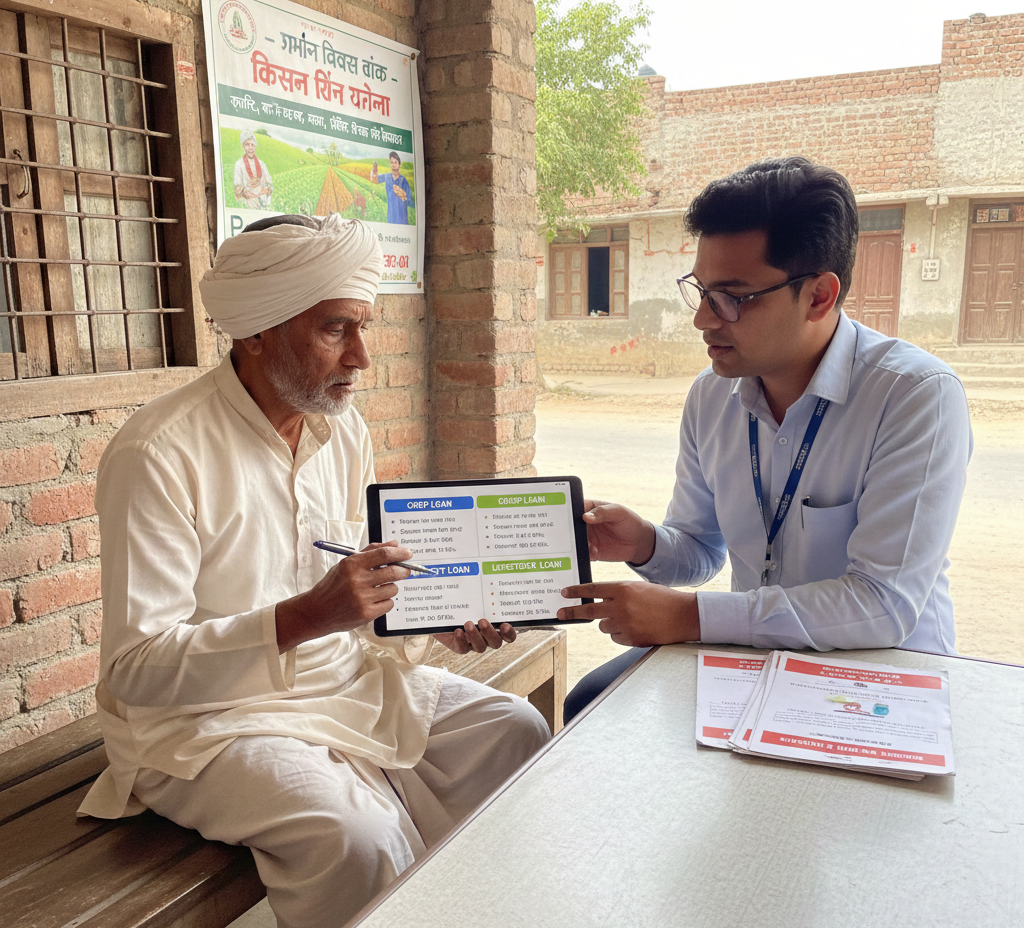
Two farmers apply for agricultural finance. Their farms may be in the same district. They may even grow the same crop. Yet the interest rates or overall financing terms offered to them can differ.

Why?

Because farmer loan interest rates are rarely determined by a single factor. Lenders look at the type of loan, borrower profile, repayment capacity, collateral, tenure, credit history, and the risks associated with the financing requirement.

Understanding these factors can help farmers look beyond one question: “What is the interest rate?” and ask the more useful one: “What determines the rate I am being offered?”

First, there is no single farmer loan rate

Agricultural finance covers many different needs. A short-term crop loan, equipment loan, warehouse receipt finance facility and property-backed business loan do not carry identical risks or structures. Consequently, their pricing can differ.

Government-supported programmes can make certain categories of agricultural credit considerably cheaper.
For example, under the Modified Interest Subvention Scheme, eligible short-term Kisan Credit Card agricultural loans of up to ₹3 lakh have been available at 7% annually, with a 3% Prompt Repayment Incentive reducing the effective cost to 4% for farmers who repay on time. Beyond subsidised schemes, however, farmer loan interest rates depend on lender-specific pricing and borrower risk.

  • The Purpose of the Loan

What are you borrowing for?

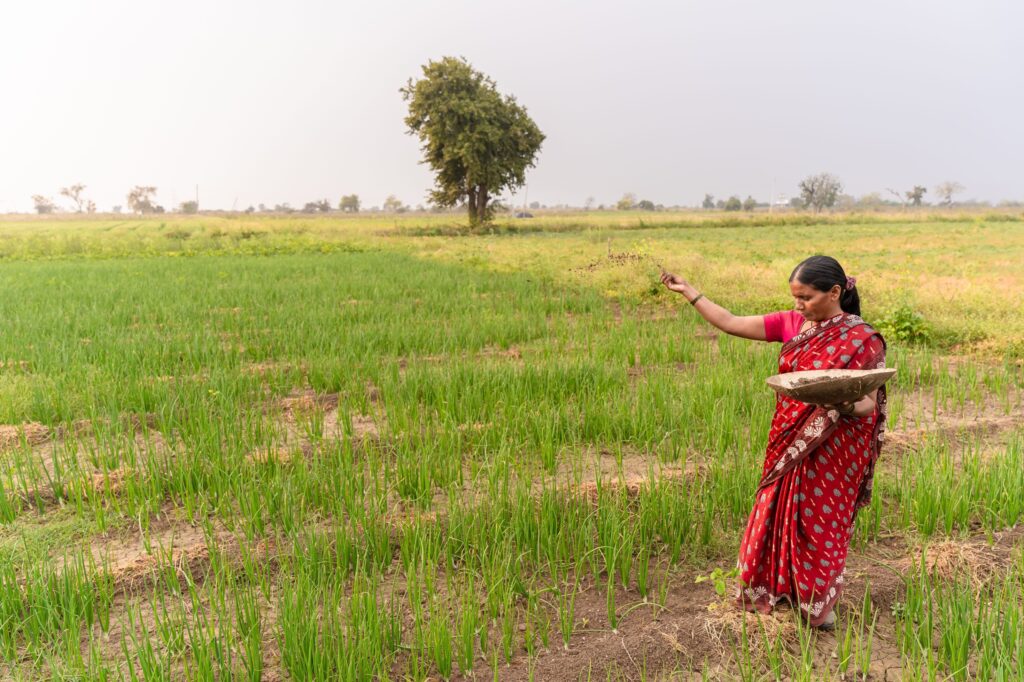
Buying seeds for the coming season creates a very different financing requirement from purchasing machinery or expanding an agricultural business. Short-term working-capital requirements may be assessed around seasonal cash flows, while longer-term financing needs may involve a different repayment structure and risk assessment.

The clearer the purpose, the easier it becomes to identify an appropriate financing product.
low interest farm loans

  • Credit History and Repayment Behaviour

Past borrowing behaviour can influence future borrowing costs.

A strong repayment history indicates that the borrower has previously handled credit responsibly. Delayed payments, defaults or excessive outstanding debt may signal greater lending risk. This is why maintaining a healthy credit profile matters even in agriculture.

  • Repayment Capacity

A lender needs to answer a straightforward question: Can the borrower realistically repay this loan?

For agricultural borrowers, that assessment may consider income, cropping patterns, business cash flows, existing liabilities and the seasonal nature of earnings. Agriculture does not generate income like a monthly salary. Good agricultural lending therefore needs to understand when cash actually enters the borrower’s hands.

  • Whether the Loan is Secured/Collateral backed loan

Collateral can materially influence lending risk.

A secured facility may be backed by property, agricultural inventory or another acceptable asset. Because the lender has security against the financing, secured lending may be evaluated differently from unsecured credit.

Warehouse Receipt Finance is an interesting example. Instead of immediately selling produce after harvest, eligible borrowers can store commodities in an approved warehouse and use the warehouse receipt to seek financing against that inventory.

  • Loan Amount and Tenure (Short/medium/long term)

How much you borrow and for how long matters.

A ₹1 lakh seasonal requirement is fundamentally different from a multi-year, higher-value loan. Longer tenures expose lenders to risk for a greater period, while larger amounts require closer assessment of the borrower’s financial position and repayment capacity.

farmer loan interest

  • External Interest-Rate Benchmarks and Lender Policies

Borrower characteristics are only part of the picture.

Banks and NBFCs price loans within the broader financial environment. Benchmark lending rates, cost of funds, internal credit policies and risk premiums can therefore influence the final rate offered. That is why agricultural lending rates can change even when the farmer’s own circumstances remain broadly the same.

Agricultural credit is getting bigger and more diverse

Formal agricultural lending is becoming an increasingly important part of India’s rural economy. The policy framework requires applicable banks to direct at least 18% of Adjusted Net Bank Credit or equivalent exposure towards agriculture, including a 10% sub-target for small and marginal farmers.
As agricultural businesses become more connected with warehousing, processing, renewable energy and supply chains, the financing requirement is also becoming more specialised.

Agriwise’s role in this

Agriwise approaches agricultural finance around different borrower requirements rather than treating every need as the same loan.

Its portfolio includes Farmer Financing, Warehouse Receipt Finance, Loan Against Property, Supply Chain Finance and Customised Working Capital Loans. Agriwise has disbursed ₹2,500+ crore across 5,300+ customers and works with leading Indian banking partners.

For example, its Warehouse Receipt Finance offering provides short-term working capital against agricultural stocks stored in warehouses, with financing of up to ₹10 crore and LTV of up to 75%.

Look beyond the headline rate

The lowest advertised interest rate is not automatically the best financing decision. Farmers should also understand tenure, repayment frequency, processing charges, collateral requirements, prepayment conditions and the total cost of borrowing.

Ultimately, Farmer Loan Interest Rates reflect both the financial market and the borrower behind the application. Understanding what lenders evaluate gives farmers something more valuable than simply knowing a number. It helps them approach agricultural credit better prepared.

FAQs

  • What determines Farmer Loan Interest Rates in India?
    Rates can depend on the loan type, amount, tenure, collateral, credit profile, repayment capacity, lender policy and applicable government support.
  • Does credit history affect agricultural loan rates?
    Yes. Repayment history and existing debt can form part of a lender’s assessment of the borrower’s overall credit risk.
  • Are secured agricultural loans cheaper than unsecured loans?
    They may be priced differently because acceptable collateral can reduce lender risk, but actual rates depend on the lender and borrower profile.
  • What is Warehouse Receipt Finance?
    It allows eligible borrowers to obtain working capital against agricultural commodities stored in recognised warehouses instead of selling the produce immediately.
  • What agricultural finance products does Agriwise offer?
    Agriwise offers Farmer Financing, Warehouse Receipt Finance, Loan Against Property, Supply Chain Finance and Customised Working Capital Loans.
farmer finance

Farmer Finance: A Complete Guide to Loans, Credit, and Financial Planning

August 13, 2026

Farming runs on cycles, but money doesn’t always show up when needed. Seeds and fertilisers need to be paid for at the start of the season; income only arrives at the end of it, and even then, prices aren’t guaranteed. This mismatch between when farmers spend and when they earn is one of the oldest problems in agriculture and also one of the most solvable, given the right financial tools.

We will walk you through the main types of farmer finance available in India today, what they’re actually used for, and how thinking about them together, rather than one loan at a time, can make a real difference to a farm’s financial stability.

Why farmer finance looks different from other lending

Agricultural income is seasonal and unpredictable. Weather, pest cycles, and market price swings all sit outside a farmer’s control. That’s why farm finance has evolved its own set of instruments, built around flexibility: revolving credit lines instead of fixed EMIs, loans against stored produce instead of just fixed assets, and interest structures that reward timely repayment.

The core pillars of farmer finance

  • Crop loans and the Kisan Credit Card (KCC): The KCC remains the backbone of institutional farm credit in India. It functions less like a traditional loan and more like a revolving overdraft. Farmers draw funds as needed for cultivation and post-harvest expenses, rather than reapplying every season. As of 2026, the scheme has over 7.72 crore operational cards nationwide, with total outstanding credit touching roughly ₹10.2 lakh crore. Recent updates have also raised the collateral-free borrowing limit to ₹2 lakh, up from ₹1.6 lakh, specifically to benefit tenant and marginal farmers.
  • Warehouse receipt finance: Rather than selling produce immediately after harvest, farmers can store it in an accredited warehouse and borrow against the stock using a warehouse receipt as collateral. This avoids distress sales and lets farmers wait for better prices while still accessing working capital. Loans are typically extended against a significant share of the produce’s assessed market value.
  • Investment and term loans: For longer-horizon needs like machinery, drip irrigation systems, greenhouses, or setting up allied activities like dairy or poultry, investment loans provide multi-year credit rather than a single-season facility. These are the loans that fund capacity growth rather than just keeping the current season running.

farm land loans

  • Invoice and bill discounting: For farmers and agribusinesses selling through longer payment cycles, invoice discounting converts pending receivables into immediate cash, smoothing out the gap between delivering produce and actually being paid for it.
  • Loan against property (LAP): For larger, longer-term capital needs such as expanding a farm business, diversifying into allied activities, or funding major infrastructure, a loan against property lets farmers and agribusinesses unlock the value of owned property to access higher-ticket financing than typical crop or working capital loans allow.

What’s changed in the credit landscape lately

India’s institutional agricultural credit flow is on a strong upward trajectory. NABARD projects that it will exceed ₹32.5 lakh crore for FY 2025–26. Digital infrastructure is catching up too: the Kisan Rin Portal, launched in 2023, now enables end-to-end digital loan applications and real-time tracking of interest subventions, cutting down the paperwork that used to slow disbursement.

Warehouse receipt financing, meanwhile, is still underused relative to its potential of roughly 330 million tonnes of foodgrain India produced in a recent year; only a small fraction was financed this way, pointing to real headroom for wider adoption.

Building a financial plan, not just taking a loan

The real upgrade in farmer finance isn’t just more credit, but more combinations of credit. A farmer relying solely on a crop loan is still exposed to the price risk of selling right after harvest. Layering in warehouse receipt finance changes that by adding investment credit on top supports longer-term productivity gains rather than just covering this season’s costs.

Thinking about farm finance holistically, crop loans for immediate needs, warehouse financing for price timing, and investment loans for growth creates a far more resilient structure than treating each loan as a one-off transaction.

farm loans

How Agriwise supports this

Agriwise offers a full suite of financing tailored to Indian agriculture: Secured Business Loans for working capital and expansion, Warehouse Receipt Finance to unlock liquidity from stored produce, Invoice Bill Discounting for smoother cash flow, and Farmer Financing for sustainable investment. The goal is to help farmers and agribusinesses move beyond single-purpose borrowing and build a financing mix suited to how their operations actually run through the year.

Final thought

Good farm financial planning isn’t about avoiding debt because credit is often exactly what’s needed to grow. It’s about matching the right instrument to the right need, and not defaulting to a distress sale simply because it’s the only lever available at that moment. As India’s credit infrastructure keeps modernising, farmers who understand and combine these tools are in a much stronger position than those relying on any single one.

FAQs

  • What’s the difference between a crop loan and a warehouse receipt loan?
    A crop loan funds cultivation costs upfront; a warehouse receipt loan is taken against already-harvested and stored produce, letting farmers delay selling.
  • Is the Kisan Credit Card only for crop loans?
    No. It can also cover post-harvest expenses and, depending on the bank, allied agricultural activities.
  • Do I need to be a large landholder to access these financing options?
    No. Several of these instruments, including KCC and warehouse receipt finance, are specifically structured to be accessible to small and marginal farmers.
  • What documents are typically needed to apply for farmer finance?
    Requirements vary by lender and instrument, but generally include land or tenancy records, identity and address proof, and, for warehouse receipt finance, the receipt itself as proof of stored produce.
  • Can a farmer combine more than one type of financing at the same time?
    Yes. In fact, many farmers use a mix, such as a KCC for seasonal cultivation costs alongside warehouse receipt finance for post-harvest liquidity, rather than relying on a single instrument.

Top Government Loan Schemes for Farmers in India (2026 Guide)

July 30, 2026

If you’re a farmer trying to figure out where to get affordable credit this season, you’re not short on options. You might be short on clarity.

Between the Kisan Credit Card, PM-Kisan, crop insurance, and half a dozen state-level schemes, it’s easy to lose track of what you actually qualify for. This guide breaks down the government loan schemes and support schemes that matter most in 2026, in plain terms, so you can make an informed decision instead of a rushed one.

  • Kisan Credit Card (KCC)

The KCC remains the single most important credit tool for Indian farmers. It works like a revolving credit line rather than a one-time loan, so you draw and repay according to your crop cycle instead of reapplying every season. Under the Modified Interest Subvention Scheme (MISS), the Union Budget 2025-26 raised the subsidised loan ceiling from ₹3 lakh to ₹5 lakh, and Budget 2026 has kept this framework unchanged, giving farmers continuity going into the year. The base interest rate is 7%, but a 2% interest subvention plus a 3% prompt repayment incentive can bring your effective cost down to just 4% per annum if you repay on time. Collateral-free borrowing is also now available up to ₹2 lakh, up from ₹1.6 lakh earlier.

One detail worth flagging: Aadhaar linking with your bank account is mandatory to claim the subvention, and repaying even a day late can cost you the full 3% benefit. It is a small detail that trips up the most farmers.

  • PM-Kisan Samman Nidhi

This isn’t a loan, but it’s worth understanding alongside your credit options because it strengthens your overall repayment capacity. PM-Kisan provides ₹6,000 a year to eligible landholding farmer families, paid in three installments of ₹2,000 each via direct bank transfer. The 23rd instalment, released in June 2026, reached over 9.44 crore farmers with a payout of ₹18,880 crore, taking cumulative disbursements past ₹4.46 lakh crore since the scheme launched in 2019. PM-Kisan beneficiaries are also given priority when applying for a new KCC, so the two schemes work well together.

loans india

  • Pradhan Mantri Fasal Bima Yojana (PMFBY)

Taking on credit for a crop season is a lot easier to justify when that crop is insured. PMFBY, the world’s largest crop insurance scheme, protects against yield losses from natural calamities across Kharif and Rabi seasons, with the central and state governments absorbing a large share of the premium so the burden on farmers stays low. In West Bengal alone, the 2026-27 rollout aims to cover close to 1.10 crore farmers across roughly 30 lakh hectares (Goodreturns), a scale that shows how central this scheme is to de-risking farm credit.

  • Fisheries and Allied Activity Credit Limits

If dairy, fisheries, or beekeeping is part of your income, don’t overlook this: the credit limit for fisheries and allied activities under MISS was raised from ₹2 lakh to ₹5 lakh in 2025-26, matching the crop loan ceiling. Many farmers still assume KCC is only for crop loans but it isn’t.

  • Digital Access Through the Kisan Rin Portal

The Kisan Rin Portal (KRP) and Jan Samarth Portal now allow end-to-end digital applications and real-time tracking of your interest subvention claims. For banks, it has cut delays in processing; for farmers, it means fewer branch visits and faster clarity on where your application stands.

Making the Right Choice

None of these schemes cancels each other out. Most farmers benefit from stacking them: a KCC for working capital, PM-Kisan for an income cushion, and PMFBY to protect the season against weather risk. The key is timing your application correctly and keeping your KYC and Aadhaar linkage current, since that single step decides whether you get the subsidised rate or the base rate.

How Agriwise Supports Your Application

Navigating paperwork and bank timelines is often the most frustrating part of accessing farm credit, and that’s where Agriwise steps in. As the financing arm built for the agricultural ecosystem, Agriwise helps farmers identify the government loan schemes they qualify for, assists with KCC-linked applications, and offers equipment and input financing structured around a crop cycle rather than a rigid EMI calendar.

Government loan schemes exist to make farming financially sustainable, but only if you know how to use them. Start with the KCC, layer in PM-Kisan and PMFBY, and keep your documentation up to date. That combination alone puts most farmers in a far stronger position than going it alone.

FAQs

  • What is the maximum loan amount under KCC in 2026?
    Farmers can avail up to ₹5 lakh under the Modified Interest Subvention Scheme (MISS), a limit raised from ₹3 lakh in Budget 2025-26 and unchanged in Budget 2026.
  • What is the effective interest rate on a Kisan Credit Card loan?
    The base rate is 7%, but with a 2% interest subvention and 3% prompt repayment incentive, timely repayers pay an effective rate of just 4% per annum.
  • Is PM-Kisan a loan or a grant?
    It’s not a loan. It’s direct income support of ₹6,000 a year, paid in three instalments, meant to supplement a farmer’s overall financial stability.
  • Can fishermen and dairy farmers apply for KCC too?
    Yes. The credit limit for fisheries and allied activities was raised to ₹5 lakh in 2025-26, matching the crop loan ceiling. Many farmers overlook this.
  • What’s the biggest reason farmers miss out on subsidised interest rates?
    Not linking Aadhaar to their bank account, or repaying even a day late. Both directly affect eligibility for the subvention benefit.
agri finance

10 Things Every Farmer Should Know About Agri Finance

July 23, 2026

Money worries and farming go hand in hand more often than they should. Whether it’s buying seeds before sowing season or holding onto produce until prices improve, timely access to credit can be the difference between a good season and a stressful one. Yet agri finance remains one of the most misunderstood parts of a farmer’s journey. Here are 10 things worth knowing before you take your next loan.

  • Agri finance is bigger than just crop loans
    Most farmers think of agri finance as the seasonal crop loan from a bank. In reality, it covers a much wider range. Warehouse receipt financing, loans against property, equipment and solar financing, and even working capital support for agri-businesses and FPOs. Knowing the full menu helps you pick what actually fits your need.
  • India’s agri credit flow has grown massively
    This isn’t a small, stagnant sector. Ground-level credit disbursed to Indian agriculture is set to touch Rs 32.50 lakh crore in FY 2025-26, more than four times the Rs 8 lakh crore disbursed in FY 2014-15, according to IANS. That’s over a decade of consistent, roughly 13% annual growth in the rural credit ecosystem.
  • Rural banking infrastructure is expanding too
    Access is improving alongside the credit itself. Rural bank branches grew over 35% to reach 56,193 by July 2025, and regional rural banks now operate more than 22,000 branches across 700 districts, meaning formal credit is reaching further into the Indian geographies.
  • Formal credit is cheaper than informal lending
    This one matters more than farmers often realise. Informal moneylenders typically charge anywhere from 24% to 60% interest, compared to the 12-18% range charged by agri-focused NBFCs. Over a full season, that gap can mean the difference between profit and debt.

  • Warehouse Receipt Finance can save you from distress sales
    If you’ve ever sold your harvest early just because you needed cash, warehouse receipt finance is worth understanding. It lets you store your produce in an approved warehouse and borrow against it, so you’re not forced to sell the moment prices dip right after harvest.
  • Loan Against Property isn’t just for big expansion
    While Agri LAP is often used for larger infrastructure or diversification projects, it’s also a practical option for funding equipment upgrades, land development, or allied ventures like dairy or poultry.
  • Solar and Equipment financing are growing fast
    With input and power costs rising, more farmers are turning to solar finance to cut long-term operational expenses. It is a sign that agri finance today goes beyond survival lending into genuinely productive investment.
  • Your land & farming data can work in your favour
    Digital credit assessment is changing how lenders evaluate farmers. Satellite-verified land intelligence and data-backed credit scoring mean even smallholder farmers with limited paperwork can now build a credible profile for faster loan approvals, rather than relying purely on collateral or lengthy documentation.
  • Rural consumption confidence is rising
    According to NABARD’s Rural Economic Conditions and Sentiments Survey (May 2026), about 77.2% of rural households reported higher consumption levels, reflecting a rise in purchasing power that shows deepening reach of formal rural finance.
  • Choosing the right partner matters as much as the loan itself
    A finance partner who understands farming cycles, commodity price swings, and post-harvest realities will structure your loan very differently than a generic lender. That contextual understanding often determines whether the loan actually helps you or adds pressure at the wrong time.

loans india

How Agriwise fits into this picture

Agriwise Finserv, the RBI-registered NBFC arm of the StarAgri Group, is built specifically around these realities. It offers a full suite of agri-focused lending products: Warehouse Receipt Finance, Agri Loan Against Property, Solar Finance, and Invoice Discounting/Supply Chain Finance for agri-MSMEs, designed to match how farming income actually flows through the year.

Agriwise has partnered with leading banks and financial institutions to widen access to capital, and draws on data from StarAgri’s broader ecosystem, including satellite-backed land intelligence through AgriBhumi, to assess creditworthiness fairly, even for smallholder farmers without extensive paperwork.

And because Agriwise operates within StarAgri’s warehousing and collateral management network, it also brings practical, on-ground understanding of storage, commodity value, and market timing, not just numbers on a loan application.

The Bottom Line

Agri finance is about borrowing the right kind of money, at the right time, from someone who understands your farming cycle as well as your balance sheet. With India’s formal credit ecosystem expanding rapidly, there’s never been a better time for farmers to move away from informal lenders and explore structured, transparent options like those offered by Agriwise, built for agriculture’s real needs. 

FAQs

  • What is warehouse receipt finance and how does it help farmers?
    It lets farmers store their produce in an approved warehouse and borrow money against it, so they aren’t forced to sell right after harvest when prices are typically lowest.
  • How is agri finance different from a regular personal loan?
    Agri finance is structured around farming cycles, harvest timelines, and commodity price patterns, rather than fixed monthly repayment schedules that don’t account for seasonal income.
  • Can smallholder farmers with limited documentation get agri loans?
    Increasingly, yes. Digital credit assessment tools, including satellite-verified land data, are helping lenders evaluate smallholder farmers fairly, even without extensive paperwork.
  • Why is formal agri finance better than borrowing from informal lenders?
    Informal lenders often charge 24-60% interest, compared to 10-18% from agri-focused NBFCs. That is a difference that can significantly affect a farmer’s profitability over a season.
  • What kind of agri finance products does Agriwise offer?
    Agriwise offers Warehouse Receipt Finance, Agri Loan Against Property, and Invoice Discounting/Supply Chain Finance for agri-MSMEs, among other structured lending solutions.

Top 7 Agri Business Loans to Grow Your Farm or FPO

February 26, 2026

What does it really take to scale an agri venture today? Better seeds? Smarter technology? Stronger market access?
Yes, but behind all of that sits something equally powerful: structured finance.

India’s agricultural credit flow is expected to cross ₹32.5 lakh crore in FY 2025–26, reflecting the government’s continued push to formalise and expand agri financing. Today, agri businesses are no longer restricted to crop loans alone. It includes working capital, value-chain solutions, technology-linked credit, and collateral-free options that help farms and FPOs grow with confidence.

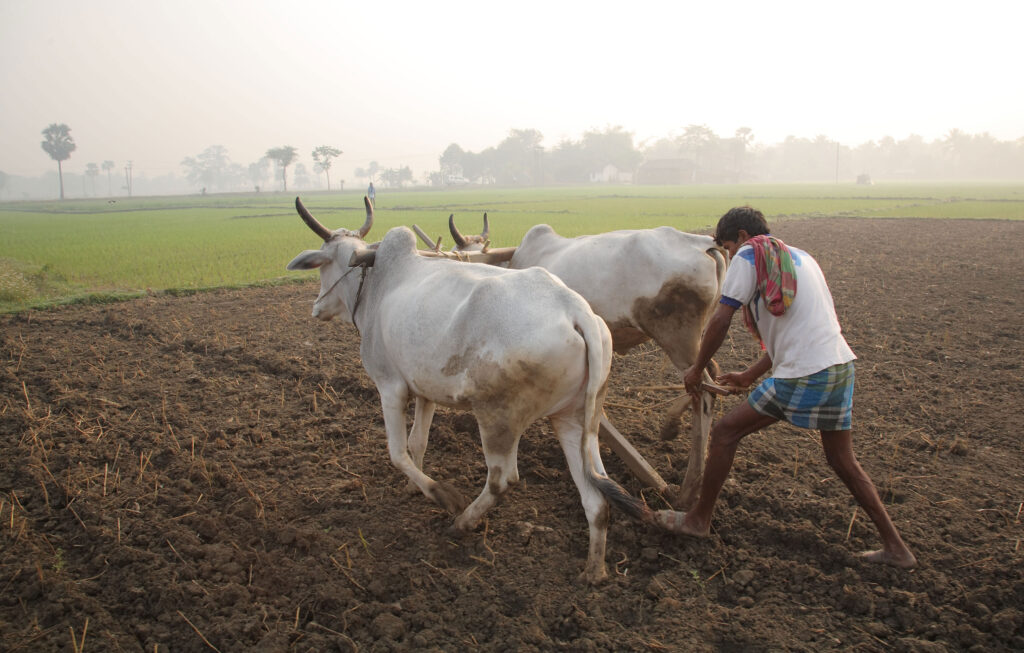
Ploughing with cattle in West Bengal

If you’re building an agri business, whether as a progressive farmer or an FPO leader, here are the top 7 loan options that can help you grow smarter and faster.

  • Kisan Credit Card (KCC): The Kisan Credit Card (KCC) is one of the oldest and most widely used credit products in Indian agriculture. It offers farmers and agri businesses a revolving credit limit for crop inputs, allied activities, and working capital needs.
    As of 2025, operative KCC loans exceeded ₹10 lakh crore (~₹10.05 lakh crore), benefiting ~77.2 million (7.72 crore) farmers in India (Business Standard) After the 2025 Union Budget, the loan limit under KCC was increased from ₹3 lakh to ₹5 lakh, making it more useful for medium and larger cropping cycles. (Business Today)
  • Warehouse Receipt Finance: Stored crops shouldn’t mean idle capital. With warehouse receipt finance, farmers and FPOs can use stored commodities as collateral to secure loans. This not only improves liquidity but also allows them to hold stock for better market prices.
  • Term loans for infrastructure & expansion: For long-term growth, many agri businesses require funding for physical infrastructure, such as cold storage, drying units, and grading and processing facilities.
    Term loans from commercial banks and cooperative lenders support these investments. They are especially critical for scaling up FPO operations and shifting from commodity trading to value addition.

  • Invoice Discounting: Agri businesses often face delayed payments from buyers, which ties up working capital. Invoice discounting lets businesses unlock funds tied in receivables by using pending invoices as loan collateral.
    This financing option is increasingly offered by digital lenders and fintech platforms, cutting down processing times and reducing cash flow bottlenecks.
  • Collateral-free fintech loans: Fintech lenders are playing a growing role in India’s rural credit landscape. By using alternative credit scoring and digital underwriting, many fintechs are expanding access to agri loans for small farmers, traders, and FPOs.
    National data shows fintech players disbursed over 10.9 crore loans totaling ₹1,06,548 crore in FY 2024–25 — a strong indicator of their role in deepening credit access. (The Economic Times) Additionally, the RBI has raised the limit for collateral-free agricultural loans to ₹2 lakh, reducing barriers for marginal borrowers. (adda247)
  • Loans Against Property (LAP): When farms or FPOs look to scale into processing, export, or value addition, larger structured loans may be needed. Loans Against Property (LAP) allow borrowers to use commercial or residential property as collateral to unlock funds at competitive rates.
  • Technology & innovation loans: The Reserve Bank of India is now pushing to include technology-linked expenses, such as soil-testing tools, weather analytics, and organic certification, within loan eligibility norms. (Business Standard)
    These emerging credit products aim to support tech adoption in agriculture, a vital need as data-driven inputs and precision farming become mainstream.

Agriwise offerings: Tailored financing for your agri business

At Agriwise, we believe financing should match the operational realities and goals of an agri business, not the other way around. That’s why our suite of loan solutions is designed for flexibility, seasonality, and real value creation.

Here’s what Agriwise offers:

  • Warehouse Receipt Finance – Unlock capital from stored stock at competitive rates
  • Invoice Bill Discounting – Improve trade cash flows with faster receivables funding
  • Loans Against Property (LAP) – Structured expansion capital
  • Farmer Finance – Working capital assistance tailored for crop cycles
  • Solar & Sustainable Energy Loans – Support for renewable and cost-saving investments

Agriwise acts as a growth partner, not just a lender, helping you leverage the right finance product at the right time to unlock opportunities across your agri value chain.

Conclusion

For any modern agri business, whether a family farm, a medium-scale trader, or an ambitious FPO, access to the right loan at the right time can change the growth trajectory. With the evolving landscape of government support, bank products, and fintech innovation, there are more avenues than ever before to finance working capital, manage risks, and invest in future capacity.

The question now isn’t just “Can I get credit?
It’s “Which loan will help my agri business grow the fastest?

And with tailored solutions from partners like Agriwise, finding answers is easier 🙂

FAQs

  • What are the best loan options for starting or expanding an agri business in India?
    Some of the most popular options include Kisan Credit Card (KCC), warehouse receipt finance, infrastructure term loans, invoice discounting, collateral-free fintech loans, and loans against property for large-scale expansion.
  • Can FPOs apply for agri business loans?
    Yes, Farmer Producer Organisations (FPOs) are eligible for multiple financing options, including working capital loans, warehouse receipt finance, infrastructure loans under government schemes, and fintech-led collateral-free lending.
  • Are there collateral-free loan options available for agri businesses?
    Yes. As per recent RBI guidelines, collateral-free agricultural loans are available up to ₹2 lakh. Additionally, several fintech lenders offer unsecured or partially secured loans based on digital underwriting models.
  • How does warehouse receipt finance help an agri business?
    It allows farmers or FPOs to borrow against stored produce rather than sell immediately after harvest. This improves liquidity and enables better price realisation in volatile markets.
  • How can Agriwise support my agri business growth?
    Agriwise offers customised financing solutions such as warehouse receipt finance, invoice bill discounting, loans against property, farmer finance, and solar finance, all aligned with seasonal cycles and real agri trade requirements.

Disclaimer

The content published on this blog is provided solely for informational and educational purposes and is not intended as professional or legal advice. While we strive to ensure the accuracy and reliability of the information presented, Agriwise make no representations or warranties of any kind, express or implied, about the completeness, accuracy, suitability, or availability with respect to the blog content or the information, products, services, or related graphics contained in the blog for any purpose. Any reliance you place on such information is therefore strictly at your own risk. Readers are encouraged to consult qualified agricultural experts, agronomists, or relevant professionals before making any decisions based on the information provided herein. Agriwise, its authors, contributors, and affiliates shall not be held liable for any loss or damage, including without limitation, indirect or consequential loss or damage, or any loss or damage whatsoever arising from reliance on information contained in this blog. Through this blog, you may be able to link to other websites that are not under the control of Agriwise. We have no control over the nature, content, and availability of those sites and inclusion of any links does not necessarily imply a recommendation or endorsement of the views expressed within them. We reserve the right to modify, update, or remove blog content at any time without prior notice.

8 Things Farmers Check Before Choosing The Right Agri Finance Partner

November 26, 2025

Choosing the right agri finance partner can shape the entire farming journey from timely sowing to profitable harvesting. As of 2025, India’s agricultural credit ecosystem has grown significantly, with institutional farm credit crossing ₹18 lakh crore annually and Kisan Credit Card (KCC) coverage extending to over 7.7 crore farmers. With more formal lenders entering rural markets, farmers now have options, but the right choice depends on careful evaluation.

But the question is, what should farmers assess before selecting an agri finance partner? How specialised institutions like Agriwise simplify access to structured, farmer-first financial solutions?

The best finance partner for farmers does more than disburse funds. It aligns financial products with crop cycles, input needs, market volatility and long-term farm sustainability. With rising input costs, increased demand for mechanisation, and climate-linked risks, the need for customised financing is stronger than ever. Farmers should look for partners who understand agricultural seasonality, offer flexible repayment structures, and support them through the entire credit lifecycle, not just at disbursement.

finance partner

Key factors to check before selecting the right agri finance partner

  • Sector expertise and agricultural understanding: Your finance partner should have proven experience in agricultural lending. This includes familiarity with crop cycles, regional risks, MSP trends, price volatility and post-harvest realities. Institutions specialising in agri finance are better equipped to evaluate farm-level risk and provide context-specific loan solutions.
  • Range of financial products offered: A dependable agri finance partner should provide diversified loan options catering to different farm needs, including:
    • Short-term working capital
    • Equipment and infrastructure loans
    • Crop cultivation financing
    • Post-harvest and storage-linked credit
      This is where Agriwise stands out as an agri-focused NBFC offering tailored solutions such as:
    • Warehouse Receipt Finance Enables farmers to unlock liquidity by using stored produce as collateral, helping them avoid distress sales.
    • Loan Against Property (Agri LAP) – Supports larger funding requirements for agri expansion, infrastructure, or diversification.
    • Solar Finance – Helps farmers adopt renewable energy solutions, reducing operational costs and increasing sustainability.
    • Invoice Discounting / Supply Chain Finance – Provides working capital support to agri MSMEs and farmers dealing with bulk buyers and aggregators.
  • Transparency in cost and terms: Every farmer should clearly understand the total borrowing cost. Before finalising your partner, ensure transparency in:
    • Interest rates
    • Processing fees
    • Prepayment charges
    • Insurance premiums
    • Penal clauses
      Ask for a complete repayment schedule and an effective annual cost breakdown. A transparent partner builds long-term trust and enables better financial planning.
  • Speed and timing of disbursement: Agriculture is time-sensitive. Delayed funding can disrupt sowing or harvest plans. A good agri finance partner ensures quick processing, simplified documentation, and digitally enabled approvals so funds reach farmers exactly when needed. Leading agri finance institutions now leverage alternative data, satellite insights, and transaction histories to accelerate credit decisions while maintaining strong compliance.
  • Collateral flexibility and security options: Not all farmers prefer land-based collateral. Modern agri finance partners provide alternatives such as warehouse receipts, invoice-backed loans or asset-based lending. Understanding evaluation processes, stock inspection norms and release terms is critical to avoid future bottlenecks.
    Agriwise’s Warehouse Receipt Finance model enables farmers to use stored produce as security, ensuring better price realisation and liquidity management.

finance business partner

  • Integration with risk mitigation tools: A strong finance partner integrates insurance solutions, crop covers and advisory services to mitigate risks. This includes guidance on crop insurance, credit protection products and emergency support during unforeseen events like climate shocks or market disruptions.
  • Digital accessibility and farmer support: Look for finance partners offering mobile-based loan tracking, multilingual support, real-time alerts and local field assistance. These features reduce reliance on paperwork and make financial management more farmer-friendly.
    Agriwise combines financial services with farmer-centric support, ensuring simplified access and continuous guidance throughout the loan lifecycle.
  • Compliance and credibility: Always verify that your finance partner follows RBI and NBFC regulatory standards, maintains grievance redressal mechanisms and has a credible operating history. This ensures stability and accountability of your financial engagement.

Why Agriwise is a reliable agri finance partner for farmers?

Agriwise is part of the StarAgri Group, one of India’s leading agri-service providers with warehousing, collateral management, and market linkage expertise. This allows Agriwise to understand farmers’ real challenges and offer practical financial solutions tailored to their needs.
Agriwise focuses on empowering farmers and agri MSMEs by improving access to structured credit. Its offerings are designed to bridge the gap between formal finance and on-ground agricultural needs. By combining technology-driven credit assessment with sector expertise, Agriwise ensures that farmers receive customised financial solutions across cultivation, storage and expansion stages.
As a specialised agri finance partner, Agriwise supports smoother cash flow, enables infrastructure investment and promotes sustainable farming practices through renewable energy financing. Agriwise has dedicated RMs, periodic follow-ups, and grievance resolution to ensure farmers receive continuous support throughout the loan cycle.

partnership loan

Final words

Selecting the right agri finance partner is a strategic decision that impacts profitability, resilience and long-term farm growth. With India’s agricultural financing ecosystem evolving rapidly, farmers now have the opportunity to align with partners who offer transparency, flexibility and agricultural understanding.
Whether you need funding for crop cycles, solar adoption, storage or expansion, the right finance partner will act as a growth enabler — not just a lender. By evaluating expertise, product diversity and service quality, farmers can secure financial stability and drive sustainable agricultural success.

FAQs:

  1. What type of loan is best for small farmers?
    Small farmers usually benefit from short-term working capital loans such as KCC or crop cultivation finance. These offer flexible repayment aligned with seasonal income.
  2. How can farmers reduce the cost of borrowing?
    Farmers can lower costs by choosing interest subvention schemes, maintaining good repayment history and comparing total loan costs across finance partners. Transparency in fees also helps avoid hidden charges.
  3. What documents are required to apply with a finance partner?
    Basic documents include Aadhaar, PAN, land records or lease papers, bank statements and crop details. Some loans may also require warehouse receipts or proof of income.
  4. Is warehouse receipt finance suitable for seasonal crops?
    Yes, it allows farmers to pledge stored produce and access funds without selling at low post-harvest prices, supporting better cash flow management.
  5. How do I know if a finance partner is trustworthy and RBI-compliant?
    Check if the lender is RBI-registered, offers transparent terms and has a clear grievance process. A strong track record in agri-lending is also a good indicator.
  6. Can farmers apply for multiple types of loans simultaneously?
    Yes, multiple loans are possible if repayment capacity allows. A responsible finance partner will assess overall exposure for sustainable borrowing.

Disclaimer

The content published on this blog is provided solely for informational and educational purposes and is not intended as professional or legal advice. While we strive to ensure the accuracy and reliability of the information presented, Agriwise make no representations or warranties of any kind, express or implied, about the completeness, accuracy, suitability, or availability with respect to the blog content or the information, products, services, or related graphics contained in the blog for any purpose. Any reliance you place on such information is therefore strictly at your own risk. Readers are encouraged to consult qualified agricultural experts, agronomists, or relevant professionals before making any decisions based on the information provided herein. Agriwise, its authors, contributors, and affiliates shall not be held liable for any loss or damage, including without limitation, indirect or consequential loss or damage, or any loss or damage whatsoever arising from reliance on information contained in this blog. Through this blog, you may be able to link to other websites that are not under the control of Agriwise. We have no control over the nature, content, and availability of those sites and inclusion of any links does not necessarily imply a recommendation or endorsement of the views expressed within them. We reserve the right to modify, update, or remove blog content at any time without prior notice.

Solar loans for agriculture & MSMEs: Pay less, save more

September 11, 2025

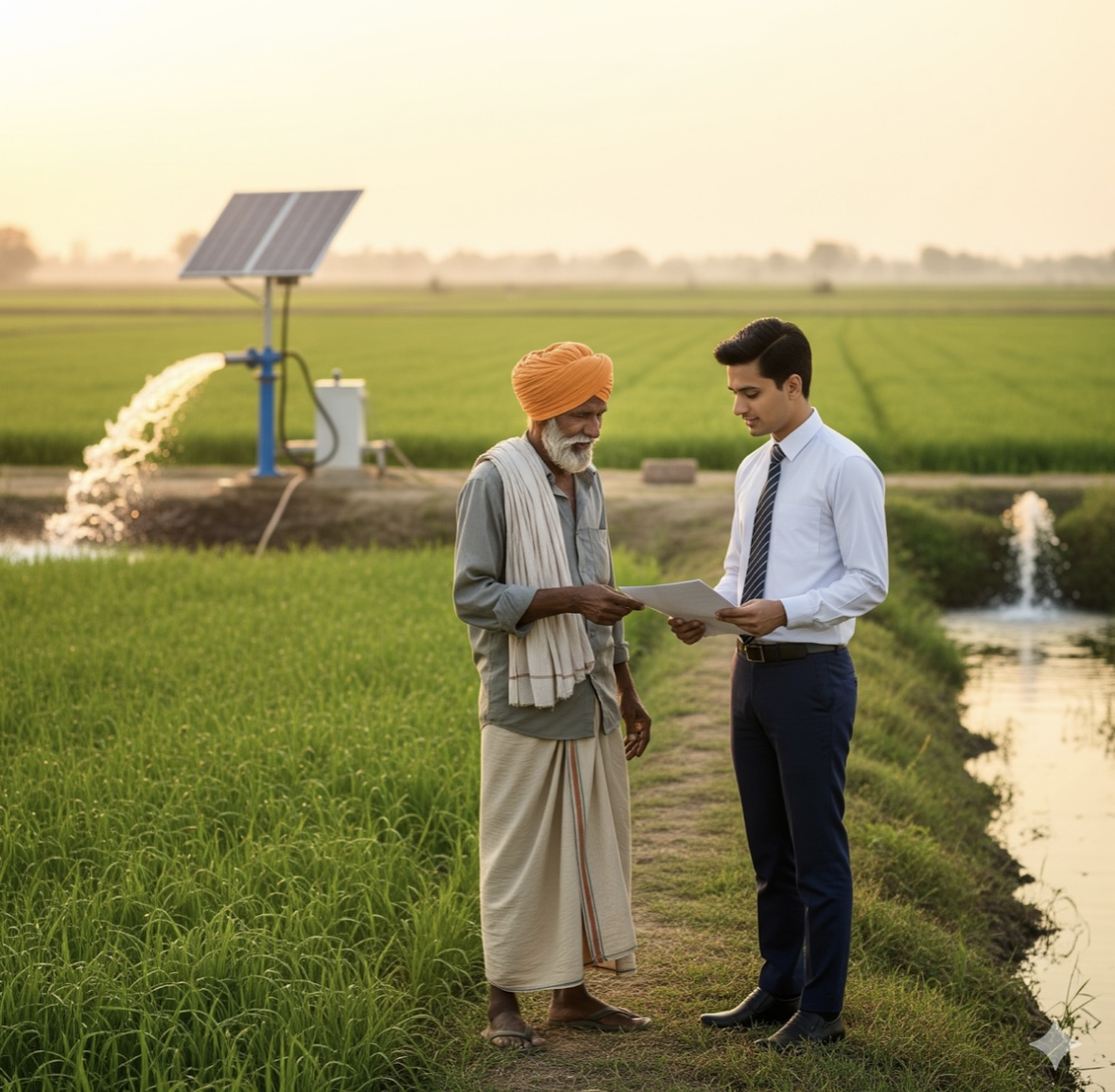
Agriculture and MSMEs across India are turning to renewable energy to cut costs, increase productivity, and achieve sustainability. A solar loan allows farmers and small businesses to invest in solar energy systems—like rooftop solar, irrigation pumps, and other installations—without the hefty upfront cost. Thanks to favorable interest rates, subsidies, and flexible repayment structures, these solar loans are reshaping the financial landscape for agriculture and MSMEs in 2025.

Why choose a solar loan?

  • Huge cost savings: With rising electricity tariffs and unpredictable diesel prices, switching to solar via a solar loan can slash monthly energy bills by nearly half for farms and businesses.
  • Access to subsidies and schemes: Government-backed Solar Loan Schemes in India—such as the Pradhan Mantri Kisan Urja Suraksha evam Utthaan Mahabhiyan (PM-KUSUM)—offer attractive subsidies for farmers installing solar pumps. Likewise, MSMEs can access Solar Loan Subsidy India programs for rooftop and off-grid solar systems.
  • Rapid return on investment: The payback period often ranges from 3 to 5 years thanks to lower utility costs and high solar irradiation, especially in regions like central and southern India.

solar loans

Types of solar loans available

  • Solar loans for agriculture: Agricultural producers can finance solar-powered irrigation systems through the solar irrigation pump loan. These loans are frequently bundled with schemes like PM-KUSUM and other agricultural solar financing initiatives. Farmers benefit from subsidized interest rates and better loan terms under solar loan scheme India offerings.
  • Solar loan for farmers India: Specifically tailored for India’s farming community, these packages support installation of solar arrays to power operations—reducing dependence on grid electricity and diesel. The combination of subsidy, credit-linked support, and financing makes farmers solar loan India an attractive option.
  • MSME solar loan & solar financing MSME: Small enterprises can access MSME solar loan or solar financing MSME products to install rooftop or ground-mounted solar systems. Financing terms typically cover up to 90% of project costs, with loans spread over 7–10 years. Businesses can use this to lighten their electricity burden and enhance profitability.
  • Rooftop solar loans & solar panel loan India: Rooftop solar adoption is soaring—and rooftop system loans powered by solar panel loan India or solar power loan India make installation more affordable. These loans help businesses and households structure payments that align with lower electricity bills, making clean energy installations more accessible.

solar financing

Industry figures in 2025

As of April 2025, India’s installed solar capacity stands at 107.94 GW_AC, generating 144 TWh of electricity—up from 116 TWh in 2024. The National Solar Mission target of 100 GW was surpassed in January 2025. For agriculture, the RBI raised the collateral-free loan limit from ₹1.6 lakh to ₹2 lakh to improve access to credit.

On the household front, the Pradhan Mantri Surya Ghar Muft Bijli Yojana, launched in 2024 with a budget of ₹75,021 crore, will provide 1 crore households with rooftop solar and 300 free units of electricity per month. In addition, collateral-free rooftop loans up to ₹2 lakh at a subsidized 6.75% interest rate are available for systems up to 3 kW. Finally, the GST on solar devices has been cut from 12% to 5%, lowering project costs by nearly 5%.

Agriwise solar loans

When it comes to tailored financial support, Agriwise loans are designed with the farming and MSME ecosystem in mind. For solar loans, we offer:

  • Competitive interest rates
  • Flexible repayment terms up to 10 years
  • Assistance with subsidy processing, including PM-KUSUM and state schemes
  • Expert guidance on required approvals, vendor selection, and installation monitoring

Whether you’re a farmer seeking a solar irrigation pump loan, or an MSME looking for a rooftop solar loan, Agriwise ensures that you get the best match between financing, subsidy, and delivery. Our streamlined process saves you both time and effort—so you can concentrate on cultivating growth.

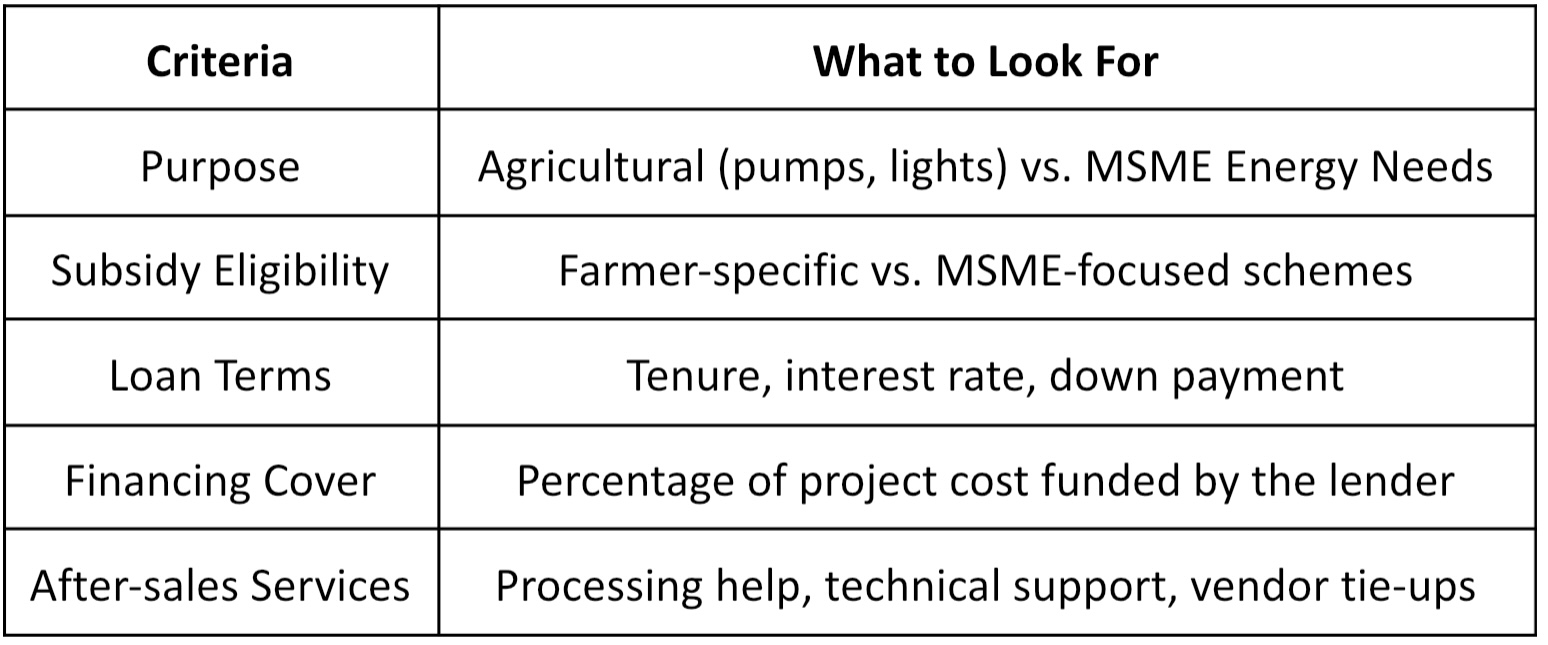
How to choose the right solar loan option?

Conclusion: Pay less, save more

A solar loan provides a powerful lever to pay less for energy and save more for your enterprise—whether you’re a farmer leveraging farmers solar loan India or a small business financing rooftop arrays through MSME solar loan programs. With the aid of solar loan MSME India, solar loan scheme India, and solar loan subsidy India, investing in solar has never been more financially prudent.

Let Agriwise guide you through agricultural solar financing and ensure you seize the full potential of solar loan for farmers India or solar financing MSME offerings. Going solar is not just an environmentally smart move—it’s a financially savvy strategy for long-term prosperity.

Disclaimer

The content published on this blog is provided solely for informational and educational purposes and is not intended as professional or legal advice. While we strive to ensure the accuracy and reliability of the information presented, Agriwise make no representations or warranties of any kind, express or implied, about the completeness, accuracy, suitability, or availability with respect to the blog content or the information, products, services, or related graphics contained in the blog for any purpose. Any reliance you place on such information is therefore strictly at your own risk. Readers are encouraged to consult qualified agricultural experts, agronomists, or relevant professionals before making any decisions based on the information provided herein. Agriwise, its authors, contributors, and affiliates shall not be held liable for any loss or damage, including without limitation, indirect or consequential loss or damage, or any loss or damage whatsoever arising from reliance on information contained in this blog. Through this blog, you may be able to link to other websites that are not under the control of Agriwise. We have no control over the nature, content, and availability of those sites and inclusion of any links does not necessarily imply a recommendation or endorsement of the views expressed within them. We reserve the right to modify, update, or remove blog content at any time without prior notice.