

Tag Archives: indian farmer

agri finance

10 Things Every Farmer Should Know About Agri Finance

July 22, 2026

Money worries and farming go hand in hand more often than they should. Whether it’s buying seeds before sowing season or holding onto produce until prices improve, timely access to credit can be the difference between a good season and a stressful one. Yet agri finance remains one of the most misunderstood parts of a farmer’s journey. Here are ten things worth knowing before you take your next loan.

  • Agri finance is bigger than just crop loans
    Most farmers think of agri finance as the seasonal crop loan from a bank. In reality, it covers a much wider range. Warehouse receipt financing, loans against property, equipment and solar financing, and even working capital support for agri-businesses and FPOs. Knowing the full menu helps you pick what actually fits your need.
  • India’s agri credit flow has grown massively
    This isn’t a small, stagnant sector. Ground-level credit disbursed to Indian agriculture is set to touch Rs 32.50 lakh crore in FY 2025-26, more than four times the Rs 8 lakh crore disbursed in FY 2014-15, according to the IANS. That’s over a decade of consistent, roughly 13% annual growth in the rural credit ecosystem.
  • Rural banking infrastructure is expanding too
    Access is improving alongside the credit itself. Rural bank branches grew over 35% to reach 56,193 by July 2025, and regional rural banks now operate more than 22,000 branches across 700 districts, meaning formal credit is reaching further into the Indian geographies.
  • Formal credit is cheaper than informal lending
    This one matters more than farmers often realise. Informal moneylenders typically charge anywhere from 24% to 60% interest, compared to the 12-18% range charged by agri-focused NBFCs. Over a full season, that gap can mean the difference between profit and debt.
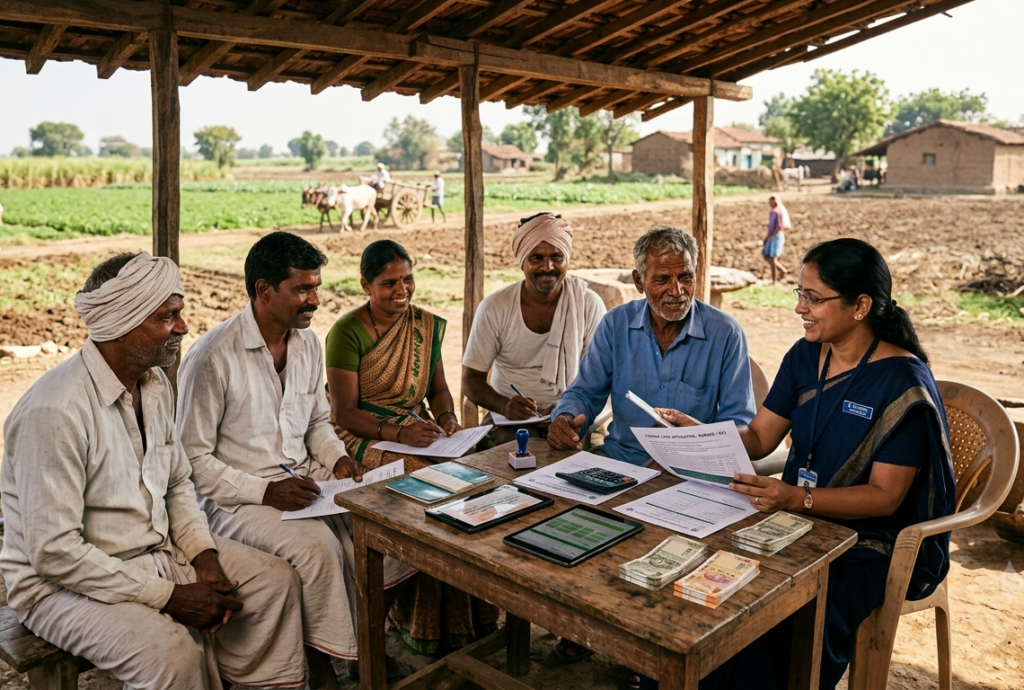
rural financing

  • Warehouse Receipt Finance can save you from distress sales
    If you’ve ever sold your harvest early just because you needed cash, warehouse receipt finance is worth understanding. It lets you store your produce in an approved warehouse and borrow against it, so you’re not forced to sell the moment prices dip right after harvest.
  • Loan Against Property isn’t just for big expansion
    While Agri LAP is often used for larger infrastructure or diversification projects, it’s also a practical option for funding equipment upgrades, land development, or allied ventures like dairy or poultry.
  • Solar and Equipment financing are growing fast
    With input and power costs rising, more farmers are turning to solar finance to cut long-term operational expenses. It is a sign that agri finance today goes beyond survival lending into genuinely productive investment.
  • Your land & farming data can work in your favour
    Digital credit assessment is changing how lenders evaluate farmers. Satellite-verified land intelligence and data-backed credit scoring mean even smallholder farmers with limited paperwork can now build a credible profile for faster loan approvals, rather than relying purely on collateral or lengthy documentation.
  • Rural consumption confidence is rising
    According to NABARD’s Rural Economic Conditions and Sentiments Survey (May 2026), about 77.2% of rural households reported higher consumption levels, reflecting a rise in purchasing power that shows deepening reach of formal rural finance.
  • Choosing the right partner matters as much as the loan itself
    A finance partner who understands farming cycles, commodity price swings, and post-harvest realities will structure your loan very differently than a generic lender. That contextual understanding often determines whether the loan actually helps you or adds pressure at the wrong time.

agricultural loans

How Agriwise fits into this picture

Agriwise Finserv, the RBI-registered NBFC arm of the StarAgri Group, is built specifically around these realities. It offers a full suite of agri-focused lending products: Warehouse Receipt Finance, Agri Loan Against Property, Solar Finance, and Invoice Discounting/Supply Chain Finance for agri-MSMEs, designed to match how farming income actually flows through the year.

Agriwise has partnered with leading banks and financial institutions to widen access to capital, and draws on data from StarAgri’s broader ecosystem, including satellite-backed land intelligence through AgriBhumi, to assess creditworthiness fairly, even for smallholder farmers without extensive paperwork.

And because Agriwise operates within StarAgri’s warehousing and collateral management network, it also brings practical, on-ground understanding of storage, commodity value, and market timing, not just numbers on a loan application.

The Bottom Line

Agri finance is about borrowing the right kind of money, at the right time, from someone who understands your farming cycle as well as your balance sheet. With India’s formal credit ecosystem expanding rapidly, there’s never been a better time for farmers to move away from informal lenders and explore structured, transparent options like those offered by Agriwise, built for agriculture’s real needs. 

FAQs

  • What is warehouse receipt finance and how does it help farmers?
    It lets farmers store their produce in an approved warehouse and borrow money against it, so they aren’t forced to sell right after harvest when prices are typically lowest.
  • How is agri finance different from a regular personal loan?
    Agri finance is structured around farming cycles, harvest timelines, and commodity price patterns, rather than fixed monthly repayment schedules that don’t account for seasonal income.
  • Can smallholder farmers with limited documentation get agri loans?
    Increasingly, yes. Digital credit assessment tools, including satellite-verified land data, are helping lenders evaluate smallholder farmers fairly, even without extensive paperwork.
  • Why is formal agri finance better than borrowing from informal lenders?
    Informal lenders often charge 24-60% interest, compared to 10-18% from agri-focused NBFCs. That is a difference that can significantly affect a farmer’s profitability over a season.
  • What kind of agri finance products does Agriwise offer?
    Agriwise offers Warehouse Receipt Finance, Agri Loan Against Property, and Invoice Discounting/Supply Chain Finance for agri-MSMEs, among other structured lending solutions.

Top government schemes for farmers: What to know before applying for credit?

July 03, 2025

Agriculture remains the backbone of India’s economy, employing over 50% of the nation’s workforce and contributing nearly 18% to the country’s GDP. Yet, farmers—especially smallholders—often face severe financial constraints in accessing quality inputs, mechanisation, storage facilities, and post-harvest services. Recognising this, the Indian government has rolled out several targeted initiatives to provide timely and affordable credit to the farming community. From subsidised loans to direct benefit transfers, these government schemes for farmers are designed to improve financial inclusion and build long-term resilience in the agriculture sector.
However, to fully utilise these benefits, farmers must understand the eligibility requirements, application process, and documentation involved. What are the top credit-linked schemes, and what do farmers need to know before applying—empowering them to make informed choices that support their growth and well-being? Let’s understand that!

government schemes for farmers

  1. Kisan Credit Card Schemes (KCC schemes): According to the Press Information Bureau, operative KCC accounts have disbursed over ₹10.05 lakh crore as of December 2024, benefiting 7.72 crore farmers. The government’s Modified Interest Subvention Scheme (MISS) supports short-term loans up to ₹5 lakh at reduced rates—1.5% subsidy to banks, plus a prompt repayment incentive of 3%, effectively lowering the interest rate to 4%.
    Additionally, collateral-free loans of up to ₹2 lakh (soon rising to ₹2 lakh after the RBI raised the collateral-free limit from ₹1.6 lakh to ₹2 lakh in late 2024) ensure smallholder farmers receive hassle-free credit.
  2. PM Kisan Samman Nidhi (PM-KISAN): Launched in February 2019, PM-KISAN provides ₹6,000/year in three installments to landholding farmers. While not a credit scheme per se, this cash transfer enhances liquidity and supports the rural agricultural economy. A substantial beneficiary base—over 12 crore farmers—makes it a key government scheme for welfare for farmers.

  3. Agricultural Infrastructure Fund (AIF): Introduced in 2020 with a ₹1 lakh crore corpus, AIF finances agri-infrastructure like cold stores, warehouses, and processing units. According to the Press Information Bureau, ₹47,575 crore has been sanctioned across 74,508 projects as of August 2024—supporting 6,623 warehouses, 688 cold stores, and 21 silos, which adds 500 LMT storage capacity. Farmers, FPOs, cooperatives, and panchayats are eligible to apply. Enhanced credit guarantee coverage via NABARD’s guarantee trust reduces lender risk.

  4. NABARD Refinancing & Rural Agri MSME Funding: NABARD, established in 1982, plays a dual role in direct financing and refinancing to partner banks, facilitating rural credit. It supports agri-MSMEs through capital subsidy and credit-linked capital subsidy schemes, enabling infrastructure development, organic input manufacturing, dairy entrepreneurship, and more. State-level initiatives, such as Mukhya Mantri Krishak Samridhi Yojana in Uttar Pradesh, also channel NABARD refinancing through cooperative banks to reach smallholders.

  5. PM-KUSUM & Green Energy Schemes: Under PM-KUSUM, farmers receive up to 60% subsidy for installing solar pumps and developing community solar projects. This furthers energy security, lowers diesel dependence, and offers additional income through surplus electricity sales. AIF’s synergy with the PM-KUSUM Component-A further enhances funding options.

  6. Additional Support—Crop Insurance & Godown Subsidies: Insurance under the PMFBY (Pradhan Mantri Fasal Bima Yojana) provides comprehensive coverage against crop loss and post-harvest damage. Gramin Bhandaran Yojana offers capital subsidies for building or renovating rural godowns, increasing farmers’ ability to store produce, avoid distress sale, and access MSP or e-NAM.

Before You Apply: Key Considerations

  • Eligibility criteria: Read scheme-specific norms, including farm size, cropping pattern, and FPO status.
  • Documentation: Aadhar, land records, bank account, income/farmer certificates are essential.
  • Scheme integration: You can simultaneously access various government schemes and subsidies for farmers in India, including KCC, PM-KISAN, PM-KUSUM, PMFBY, and AIF.
  • Interest subvention: Prompt repayment is often necessary to maximise benefits; KCC requires timely repayment for full subsidy.
  • Collateral requirements: Failure to meet subsidies or exceeding thresholds may necessitate collateral.

How Agriwise Is Helping Farmers?

Agriwise Finserv is StarAgri’s specialised financing arm, offering flexible, tech-driven agri and MSME finance solutions that support Indian farmers, FPOs, agri-input retailers, and value chain participants by providing transparent, tech-driven finance solutions. Their product suite includes:

  • Secured Business Loan (Loan Against Property or LAP)
  • Warehouse receipt financing (Commodity finance)
  • Invoice Bill Discounting (Supply Chain Finance)
  • Farmer financing & Solar financing

By partnering with over 25 Indian banks and refining processes through digital platforms, Agriwise ensures faster disbursements and efficient access to credit. They are bridging gaps in rural agri-MSME funding and enabling farmers to fully leverage government-sponsored schemes.

Conclusion

The landscape of government schemes for farmers in India is robust—from welfare programmes like PM-KISAN and PMFBY to credit-led schemes like KCC, AIF, and NABARD-backed infrastructure financing. 

To maximise benefits:

  • Choose schemes aligned with your farming needs.
  • Prepare accurate documentation.
  • Leverage interest subsidies and insurance.
  • Integrate the scheme benefits.
  • Utilise structured financing partners, such as Agriwise, for improved access and process efficiency.

With ₹10+ lakh crore KCC disbursals, ₹47,575 crore AIF support, and thousands of cold stores and warehouses sanctioned, these Government schemes and subsidies for farmers in India are transforming the rural economy. The key is awareness, diligence, and smart financial planning—empowered by institutions like Agriwise.