
Tag Archives: NBFC loans

financial planning

How farmers can do successful financial planning before cost spikes hit

January 28, 2026

In agriculture, uncertainty is the only certainty.

From unpredictable weather patterns to fluctuating input costs and volatile commodity prices, farmers worldwide face financial pressures every season. In India, particularly, farmers are witnessing input costs rising faster than their income, a trend that puts profit margins under significant strain. Effective financial planning can make the difference between thriving and merely surviving when costs spike.

Let’s understand why and what farmers can do to plan their finances better!

Why financial planning matters in modern agriculture

Rising input costs, including seeds, fertilisers, pesticides, labour, and fuel, are among the top concerns for farmers globally. In a 2024 McKinsey farmer survey, about 48% of farmers cited increased input prices as the leading risk to profitability over the next two years, with volatility in commodity prices also gaining prominence. Overall perceived increases in costs averaged around 13%.
In India, agricultural income growth has lagged behind rural inflation, leaving farmers facing the double challenge of higher costs without commensurate income growth. Data from the Commission for Agricultural Costs and Prices (CACP) shows that while profits have risen in nominal terms, profit margins as a percentage of costs have fallen. This economic squeeze makes financial planning indispensable, not optional.

wealth management

Step‑by‑step guide to financial planning for farmers

  • Start with a detailed budget: The foundation of any sound financial planning is a comprehensive budget. Break your farm’s expenses into categories: fixed costs (lease, insurance, loan EMIs), variable costs (inputs like seeds and fertilisers), and seasonal expenses (labour during peak sowing or harvesting). Tools like Excel or simple farm management apps can help track and compare planned versus actual expenses regularly. Mapping out your costs allows you to identify areas where spending can be tightened and prepares you for seasonal price spikes.
  • Build cash flow forecasts: A cash flow forecast estimates your expected income and expenses throughout the farming cycle. Seasonal cash flow patterns help anticipate months when funds might be tight. Use past mandi rates, contracts, and crop yield data to realistically estimate revenues. Having this roadmap lets you identify shortfalls early and arrange financing, such as formal credit or dealer financing.
  • Diversify revenue sources: Don’t depend on a single crop or income stream. Diversification can be a powerful tool in your financial planning strategy. Many farmers are exploring allied activities such as livestock, high‑value horticulture, agritourism, or value‑added products to spread risk and improve resilience against volatile crop prices.
  • Leverage insurance and credit products: Insurance products, such as crop insurance, help mitigate losses from weather shocks, while structured credit instruments, such as Kisan Credit Cards (KCC), provide short‑term working capital. A well‑planned credit strategy ensures liquidity during peak expenses without compromising profitability. Prioritise locking in favourable terms early and maintain good credit practices to lower interest burdens.

financial advisors

  • Plan for emergencies: Agriculture is vulnerable to risks beyond your control, such as cyclones, unseasonal rainfall, pest outbreaks, or labour shortages. It’s prudent to set aside an emergency fund equal to 5–10% of your annual budget. Including this buffer in your financial planning not only protects you during crises but also reduces the need for high‑cost borrowing.
  • Review and adjust regularly: Markets change, and so should your financial plans. Review your financial plan at least quarterly, or more frequently if input prices swing dramatically, and adjust your strategies accordingly. Timely monitoring helps you refine your projections and implement corrective actions before small issues become big problems.

The role of data and technology

Forward‑looking farmers are increasingly using technology to inform financial planning decisions. Real‑time data on weather, soil health, input prices, and market demand helps reduce guesswork and refine cost estimates. Digital tools can also automate budget tracking and alerts when expenditures exceed planned thresholds. Investment in tech might seem costly initially, but the long‑term benefits in cost control and productivity can be substantial.

Agriwise: Supporting farmers with smarter financial solutions

At Agriwise, we understand that robust financial planning is substantial for a sustainable farming business. To help farmers prepare for cost spikes and manage cash flows efficiently, Agriwise offers specialised financial solutions:

  • Loans Against Property (LAP): Unlock funds by leveraging owned assets to meet financial needs.
  • Warehouse Receipt Finance: Use stored agri produce as collateral to access working capital.
  • Farmer Finance: Flexible credit tailored to crop cycles and seasonal requirements.
  • Solar Finance: Support investments in renewable energy for farms to reduce operational costs.

financial planning and analysis

Conclusion

Cost volatility is an inevitable part of agriculture, but financial hardship doesn’t have to be. Successful financial planning empowers farmers to anticipate challenges, optimise spending, diversify income streams, and build resilience against market and environmental risks. With clear budgets, smart use of credit and insurance, and regular plan reviews, farmers can not only survive cost spikes but also thrive amidst them.
By partnering with Agriwise and embracing proactive financial management, farmers unlock greater control over their economic destinies, turning risk into measured opportunity.

FAQs

  • What is financial planning for farmers, and why is it important?
    Financial planning for farmers involves budgeting, forecasting cash flows, and managing credit and expenses to ensure profitability despite cost fluctuations. It helps farmers anticipate cost spikes, optimise spending, and maintain sustainable operations.
  • How can farmers prepare for rising input costs, such as seeds, fertilisers, and labour?
    Farmers can prepare by creating a detailed budget, maintaining an emergency fund, diversifying income sources, and leveraging credit or financing options to manage peak costs effectively.
  • What role does technology play in financial planning for farmers?
    Technology provides real-time data on weather, soil health, input prices, and market trends, helping farmers make informed decisions, track expenses, and proactively adjust financial plans.
  • How can Agriwise services help farmers with financial planning?
    Agriwise offers financial solutions, including Loans Against Property (LAP), Warehouse Receipt Finance, Farmer Finance, and Solar Finance, helping farmers access funds, manage cash flow, and plan for seasonal cost spikes efficiently.
  • How often should farmers review and update their financial plan?
    Farmers should review their financial plan at least quarterly, or whenever there are significant changes in input costs, market prices, or crop conditions, to ensure timely adjustments and avoid financial stress.

Disclaimer

The content published on this blog is provided solely for informational and educational purposes and is not intended as professional or legal advice. While we strive to ensure the accuracy and reliability of the information presented, Agriwise make no representations or warranties of any kind, express or implied, about the completeness, accuracy, suitability, or availability with respect to the blog content or the information, products, services, or related graphics contained in the blog for any purpose. Any reliance you place on such information is therefore strictly at your own risk. Readers are encouraged to consult qualified agricultural experts, agronomists, or relevant professionals before making any decisions based on the information provided herein. Agriwise, its authors, contributors, and affiliates shall not be held liable for any loss or damage, including without limitation, indirect or consequential loss or damage, or any loss or damage whatsoever arising from reliance on information contained in this blog. Through this blog, you may be able to link to other websites that are not under the control of Agriwise. We have no control over the nature, content, and availability of those sites and inclusion of any links does not necessarily imply a recommendation or endorsement of the views expressed within them. We reserve the right to modify, update, or remove blog content at any time without prior notice.


Green finance in agriculture: The next big leap for sustainable growth

November 07, 2025

As India strives to boost agricultural output while protecting the environment, a new force is quietly reshaping the sector—green finance. Could the future of farming lie not just in better seeds or machinery, but in smarter, eco-friendly funding?

With agriculture contributing nearly 18% to India’s GDP and supporting over 40% of the workforce, the potential impact of sustainable agri finance is enormous. From renewable energy adoption to climate-resilient farming, green finance is opening doors to opportunities farmers never imagined. Green finance, with investment flows directed toward environmentally friendly and climate-resilient initiatives, is transforming the way the sector produces, manages, and sustains growth.

green finance

Understanding green finance in agriculture

Fundamentally, green finance in agriculture refers to financial instruments and investments that promote sustainable agricultural practices, reduce carbon emissions, and enhance resource efficiency. It includes credit support for renewable energy adoption, efficient irrigation systems, low-emission machinery, organic farming, and waste management solutions.

In India, the focus on sustainable agri finance has gained momentum following policy initiatives such as the National Mission on Sustainable Agriculture (NMSA) and the Pradhan Mantri Kisan Urja Suraksha evam Utthaan Mahabhiyan (PM-KUSUM). These programs aim to encourage farmers to adopt renewable technologies like solar-powered irrigation and climate-resilient crop practices—key areas where green finance plays a pivotal role.

Why green finance matters for India’s agricultural future?

Traditional agricultural credit models often overlook environmental sustainability. However, the rising frequency of climate shocks—droughts, floods, and erratic rainfall—has underscored the urgent need for climate-smart agriculture in India. According to the World Bank, climate change could reduce India’s agricultural income by up to 25% by 2050 if adaptive and sustainable measures are not adopted.

Green finance bridges this gap by offering innovative credit structures and risk mitigation mechanisms that enable farmers and agri-enterprises to invest in sustainable technologies. From solar financing in India for water pumps to carbon-neutral warehousing and biofertilizer production, green finance acts as both a growth driver and a climate safeguard.

green loan

Market momentum and growing investments

The green finance ecosystem in India is witnessing rapid growth. As of December 2024, India’s cumulative aligned green/social/sustainability (GSS+) debt issuance stood at USD 55.9 billion, up 186% since 2021. Green bonds accounted for around 83 % of this volume.

While the agriculture‑specific breakdown for green finance is less frequently available, the broader momentum in sustainable capital flows is a strong signal for opportunity in the agri‑space. The development of India’s draft climate taxonomy and regulatory frameworks is expected to channel more capital into green agricultural activities in coming years.

Role of Agriwise & other NBFCs

Non-Banking Financial Companies (NBFCs) are playing a crucial role in driving green finance in agriculture by bridging last-mile credit access. Agriwise, for instance, has been actively promoting sustainable agri finance solutions tailored for farmers, agribusinesses, and supply chain partners.

Through Agriwise loans, farmers can access structured financial products to invest in renewable technologies, efficient irrigation systems, and sustainable farm inputs. The company’s focus on digitized lending and agri-data analytics allows it to assess borrower risk more accurately, ensuring faster and more transparent loan approvals.

Such technology-driven financing models are pivotal in empowering farmers to shift toward climate-smart agriculture in India without facing the traditional credit barriers of collateral-heavy systems.

green fintech

Green finance and renewable energy in agriculture

One of the most compelling applications of green finance in agriculture is in renewable energy adoption. Farms and rural agri‑units in India still rely heavily on diesel‑based irrigation pumps, contributing both to high fossil‑fuel costs and greenhouse‑gas emissions. Transitioning to solar‑powered alternatives via solar financing in India is not only cost‑effective for farmers but also pivotal for climate mitigation.

The government’s ambition — including targets such as installation of 10 GW of solar capacity through agricultural applications by 2030 — underscores the potential scale of opportunity. While specific agriculture‑loans data is limited, the broader driver is clear: renewable‑enabled farms benefit from reduced energy cost, reduced risk of fuel‑price shocks and improved sustainability.

Challenges and the road ahead

Despite its promise, green finance in agriculture faces several challenges—limited awareness among farmers, lack of standardized green credit frameworks, and the perception of high implementation costs. However, with increasing public-private partnerships, carbon credit opportunities, and the rise of ESG (Environmental, Social, and Governance) investing, the momentum is shifting positively.

To scale impact, policymakers and financial institutions must integrate sustainability metrics into credit assessment models. Simultaneously, digital platforms like Agriwise can continue leveraging data-driven tools to promote transparency and inclusivity in green lending.

Conclusion: The future of sustainable agri finance

The integration of green finance into India’s agricultural ecosystem is not just an environmental necessity—it is an economic imperative. By unlocking access to capital for sustainable practices, the sector can enhance productivity, build resilience against climate change, and ensure long-term profitability. As initiatives around sustainable agri finance, renewable energy, and climate-smart agriculture in India continue to evolve, the role of innovative financiers like Agriwise becomes increasingly vital. With tailored Agriwise loans and forward-looking credit models, India’s farmers can be at the forefront of the next big leap—toward a greener, more resilient agricultural future.

Disclaimer

The content published on this blog is provided solely for informational and educational purposes and is not intended as professional or legal advice. While we strive to ensure the accuracy and reliability of the information presented, Agriwise make no representations or warranties of any kind, express or implied, about the completeness, accuracy, suitability, or availability with respect to the blog content or the information, products, services, or related graphics contained in the blog for any purpose. Any reliance you place on such information is therefore strictly at your own risk. Readers are encouraged to consult qualified agricultural experts, agronomists, or relevant professionals before making any decisions based on the information provided herein. Agriwise, its authors, contributors, and affiliates shall not be held liable for any loss or damage, including without limitation, indirect or consequential loss or damage, or any loss or damage whatsoever arising from reliance on information contained in this blog. Through this blog, you may be able to link to other websites that are not under the control of Agriwise. We have no control over the nature, content, and availability of those sites and inclusion of any links does not necessarily imply a recommendation or endorsement of the views expressed within them. We reserve the right to modify, update, or remove blog content at any time without prior notice.

The role of NBFCs in shaping rural credit access

October 16, 2025

Access to reliable rural credit is vital for India’s agricultural productivity, rural livelihoods, and inclusive growth. In areas where commercial banks are scarce, Non-Bank Financial Companies (NBFCs) are rapidly emerging as critical providers of credit, adapting their models to meet the unique challenges of remote and small-scale borrowers.

Why NBFCs matter for rural credit?

NBFCs offer flexibility, speed, and product innovation tailored to the needs of farmers and rural micro-entrepreneurs. Because of their lighter infrastructure and ability to work through field agents, partner organisations (such as Farmer Producer Organisations or Self Help Groups), and use alternate data, NBFCs reduce transaction costs and delays — two major obstacles for many seeking rural credit from traditional banks. For instance, in FY 2024–25, fintech NBFCs sanctioned approximately 10.9 crore personal loans amounting to ₹1,06,548 crore, a scale that has brought formal financial access to many who previously depended on informal sources.

rural credit

NBFCs + Microfinance: A credit accelerator

Microfinance NBFCs (NBFC-MFIs) are a fundamental source for supplying credit to small borrowers. As of 30 June 2025, the microfinance industry’s outstanding portfolio stood at about ₹3.07 lakh crore, supporting some 10 crore active loans with around 6 crore unique borrowers — many in rural areas with limited formal credit options. Moreover, in FY 2024–25, nearly 80% of microfinance loan books of NBFCs were from rural India, indicating a strong shift toward serving underserved borrowers.

Product innovation & improved quality of rural credit

NBFCs are not just increasing reach — they are improving the type of rural credit on offer. Examples of innovations include small-ticket credit for crop inputs, loans against warehouse receipts, pump-set financing, seasonal working capital aligned with harvest cycles, and two-wheeler financing for last-mile connectivity. NBFCs are also shortening approval times through remote onboarding and leveraging mobile or digital payments.

Partnership models are also key: NBFCs are co-lending with banks, entering into ATL (Agri Term Loan), WHR , FPO Financing, Cattle Financing with agri-firms, and working with FPOs/SHGs to build trust and reduce risk. These models help tailor credit products in rural areas that reflect local crop cycles, rainfall variability, and seasonal incomes.

rural farm credit

The broader context: Institutional credit & NBFC opportunity

Institutional credit to agriculture has more than doubled since 2014-15. For 2024-25, the official target for agri-credit was set in the range of ₹25-28 lakh crore, showing that government policy recognises the need for scale. NBFCs and MFIs are well-positioned to complement this push by reaching borrowers in areas with limited bank presence.

In regions where banks are sparse, NBFCs drive credit access; for example, the fintech NBFCs’ disbursals of over ₹1,06,548 crore via 10.9 crore personal loans in FY 2024-25 have helped many rural households move into the formal financial system.

Challenges & regulatory considerations

Scaling rural credit via NBFCs is not without challenges. Rural lending is exposed to climatic risks, commodity price fluctuations, and uncertainty in repayment cycles. NBFCs often face higher funding costs than banks, which may raise interest rates for borrowers. Ensuring consumer protection and transparent terms is essential, particularly for new borrowers with limited financial literacy.

Regulators have begun addressing these through co-lending guidelines, district-level credit plans (PLPs), and efforts to extend grievance redressal channels in rural areas. The goal is to ensure that rural credit remains accessible, affordable, and does not lead to overindebtedness.

The way forward: Scaling responsible rural credit

To build on the gains so far, NBFCs should:

  • Deepen partnerships with NABARD, banks, FPOs, and SHGs for last-mile delivery.
  • Use data-driven underwriting (e.g., using satellite imagery, payment histories, supply chain flows) to better assess risk in rural settings.
  • Offer bundled services — insurance, crop advisory, and digital payment/income smoothing tools — to improve borrower resilience.
  • Align loan tenors and repayment schedules with seasonal rural income flows so that credit is not burdensome during lean periods.

With rural areas contributing about 80% of NBFC microfinance loan books in FY 2024-25, and with the microfinance portfolio outstanding at ₹3.07 lakh crore supporting 10 crore loans, NBFCs are clearly playing an expanding role in formalising rural credit delivery. If these efforts are guided by responsible lending, NBFCs like Agriwise Finserv can help transform how rural India accesses finance — enabling innovation, investment, and sustainable growth.

Disclaimer

The content published on this blog is provided solely for informational and educational purposes and is not intended as professional or legal advice. While we strive to ensure the accuracy and reliability of the information presented, Agriwise make no representations or warranties of any kind, express or implied, about the completeness, accuracy, suitability, or availability with respect to the blog content or the information, products, services, or related graphics contained in the blog for any purpose. Any reliance you place on such information is therefore strictly at your own risk. Readers are encouraged to consult qualified agricultural experts, agronomists, or relevant professionals before making any decisions based on the information provided herein. Agriwise, its authors, contributors, and affiliates shall not be held liable for any loss or damage, including without limitation, indirect or consequential loss or damage, or any loss or damage whatsoever arising from reliance on information contained in this blog. Through this blog, you may be able to link to other websites that are not under the control of Agriwise. We have no control over the nature, content, and availability of those sites and inclusion of any links does not necessarily imply a recommendation or endorsement of the views expressed within them. We reserve the right to modify, update, or remove blog content at any time without prior notice.

The rise of sustainable agriculture finance in India

October 09, 2025

Sustainable agriculture is no longer a niche aspiration — it’s becoming central to how India funds its food future. As climate risks, soil degradation, and market shocks intensify, financiers, policymakers, and farmers are shifting capital toward practices that increase productivity while protecting ecosystems. This transition is evident in the rise of green debt markets, the expansion of agricultural credit, and the introduction of new public schemes designed to support climate-resilient farming.

Why is sustainable agriculture finance necessary now?

India’s farm sector supports nearly half the workforce but faces mounting stress from extreme weather and input-cost inflation. Financing models that reward water-efficient irrigation, regenerative soil management, agroforestry, and renewable energy on farms reduce long-term risk for both lenders and producers. Between FY2020-21 and FY2021-22, tracked financial flows into activities the Climate Policy Initiative classifies under sustainable agriculture averaged about ₹22,393 billion (≈USD 301 billion) per year, a clear sign that both public and private money are already moving into sustainability-aligned uses.

sustainable agriculture

Public support + Private capital: A blended push

Public budgets and banks remain the backbone of agricultural finance in India, but the composition is evolving. Government budget allocations and public sector undertakings supplied roughly one-third of those sustainable agriculture flows in the CPI study, while commercial financial institutions provided the lion’s share of private debt. This mix matters: public programmes de-risk new technologies, enabling private lenders to scale loans for solar pumps, precision inputs, and storage that reduce post-harvest losses.

At the same time, India’s broader green debt market is growing. As of December 2024, India’s cumulative aligned green, social, and sustainability (GSS+) debt reached approximately USD 55.9 billion, marking a rapid expansion that creates opportunities for climate-smart agri projects to tap into institutional investors seeking impact, as mentioned in the Climate Bonds Initiative’s 2024 report.

Agricultural credit at scale and shifting in quality

Access to credit is improving in absolute terms: ground-level agriculture credit hit about ₹19.28 lakh crore by December 31, 2024, against a FY25 target of ₹27.5 lakh crore, demonstrating banks’ willingness to provide large volumes of farm finance. While much of this remains short-term crop loans, regulators and development banks are nudging a portion of flows toward longer-term, sustainability-oriented lending such as watershed investments, on-farm renewable energy, and warehouse upgrades that enable better price realisation for farmers.

NABARD and other development institutions play a central role: their credit planning and refinance windows help scale innovations at the last mile, pairing technical assistance with concessional finance to make sustainable agriculture practices bankable.

Policy levers accelerating sustainable agriculture finance!

Two policy trends are particularly catalytic!

First, India’s draft climate finance taxonomy provides a framework to classify and direct capital toward low-emission and adaptation activities — including many agri investments — thereby reducing greenwashing and clarifying which projects qualify for “green” finance.

Second, recent budgetary increases and targeted schemes for climate-resilient agriculture signal sustained public intent to subsidise transition costs for smallholders. Together, these measures improve investor confidence and create standardised pipelines for sustainable agriculture projects.

Agriwise: Enabling sustainable agriculture through green finance

Agriwise is leading this transition with enabling farmers and agri-enterprises to access finance that supports eco-friendly practices. The company offers solar loans that empower farmers to transition from diesel-based irrigation to renewable energy, thereby significantly reducing fuel costs and carbon emissions.
Beyond solar financing, Agriwise provides structured warehouse receipt finance and customised working capital solutions for agribusinesses adopting sustainable models. By aligning credit products with long-term sustainability goals, Agriwise ensures that farmers not only secure capital but also build climate resilience. Its approach demonstrates how financial innovation can make sustainable agriculture both profitable and scalable across India’s diverse agri value chains.

Challenges & where opportunity lies!

Despite momentum, gaps remain. The CPI analysis highlights that domestic commercial banks account for most private sustainable agriculture finance due to priority-sector lending obligations, which can mask genuine market-driven investments and leave project-level green finance underdeveloped. Data limitations also make it hard to track the exact end-use of many loans, complicating impact measurement. Overcoming these hurdles — through stronger reporting standards, blended finance instruments, and aggregation vehicles for smallholder projects — would unlock institutional capital on a larger scale.

What does this mean for lenders?

For agribusinesses and lenders, the practical steps are clear: (1) structure products that link credit terms to measurable sustainability outcomes (soil health, water savings, emissions reduction); (2) use blended capital to lower first-loss risks for pilots; and (3) invest in data and verification to prove impact. For farmers, access to affordable loans for drip irrigation, bio-inputs, on-farm solar, and quality storage can raise yields and buffer climate shocks — making sustainable agriculture both a resilience strategy and a business proposition.

Conclusion

India’s shift toward sustainable agriculture finance is already underway, as evidenced by substantial tracked flows, expanding green debt markets, and rising agricultural credit targets. The next phase will require standardisation, better measurement, and creative finance structures that align farmer incentives with long-term ecosystem health. If policymakers, lenders, and agribusinesses coordinate effectively, sustainable agriculture can transition from a policy slogan to a mainstream investment that secures incomes, food supplies, and the environment for decades to come.

Disclaimer

The content published on this blog is provided solely for informational and educational purposes and is not intended as professional or legal advice. While we strive to ensure the accuracy and reliability of the information presented, Agriwise make no representations or warranties of any kind, express or implied, about the completeness, accuracy, suitability, or availability with respect to the blog content or the information, products, services, or related graphics contained in the blog for any purpose. Any reliance you place on such information is therefore strictly at your own risk. Readers are encouraged to consult qualified agricultural experts, agronomists, or relevant professionals before making any decisions based on the information provided herein. Agriwise, its authors, contributors, and affiliates shall not be held liable for any loss or damage, including without limitation, indirect or consequential loss or damage, or any loss or damage whatsoever arising from reliance on information contained in this blog. Through this blog, you may be able to link to other websites that are not under the control of Agriwise. We have no control over the nature, content, and availability of those sites and inclusion of any links does not necessarily imply a recommendation or endorsement of the views expressed within them. We reserve the right to modify, update, or remove blog content at any time without prior notice.

Collateral-free loan options for MSMEs in the Indian agri value chain

October 05, 2025

For MSMEs operating in the agricultural value chain—whether input suppliers, aggregators, processing units, cold storage operators, or rural logistics providers—access to credit without requiring collateral is a game changer. Collateral requirements often act as a barrier for smaller agribusinesses that lack land title or real estate. In 2025, a growing number of collateral-free loan schemes and guarantee-based instruments are opening the door to more inclusive finance across agribusiness segments.

Why collateral-free loan matters for agri MSMEs?

Agriculture and its allied activities remain capital-intensive and seasonally cyclical. In India alone, the total farm credit target for FY 2025–26 is projected at around ₹31–32 lakh crore. Yet, many agri-value MSMEs struggle to convert growth potential into scale because they can’t meet collateral demands. A collateral-free loan reduces entry barriers and promotes innovation, especially in areas such as post-harvest handling, food processing, cold chains, farm machinery leasing, and rural aggregation.

collateral-free loan

Further, the intensifying push for financial inclusion and rural development is prompting regulators and the government to expand guarantee schemes and concessional credit. For example, as of April 1, 2025, the Government of India has enabled collateral-free loans of up to ₹10 crore under certain categories, with guarantee coverage of up to 90%. This move signals a strategic tilt toward enabling MSME financing without the friction of security liens.

Key collateral-free loan schemes and programs in 2025

  1. Credit Guarantee Schemes (CGTMSE / MSME Guarantee Funds): The Credit Guarantee Fund Trust for Micro and Small Enterprises (CGTMSE) enables unsecured term or working capital loans up to ₹1 crore per borrowing unit. For agri processors or cold storage operators seeking expansion, CGTMSE-backed loans can be a strong option.

  2. Collateral-free agricultural credit (RBI / KCC / MISS): In December 2024, the Reserve Bank of India raised the limit for collateral-free agricultural loans from ₹1.6 lakh to ₹2 lakh per borrower, effective January 2025. Similarly, the MISS (Minor Irrigation and Allied Support Scheme) limit was enhanced from ₹3 lakh to ₹5 lakh, enabling small-scale agri entrepreneurs to access funds for pumps, drip irrigation, or allied projects.

  3. MUDRA loans / Unsecured business loans: Under the Pradhan Mantri MUDRA Yojana (PMMY), micro enterprises can receive unsecured loans up to ₹10 lakh. This suits smaller MSMEs in packaging, logistics, and rural processing.

  4. Joint Liability Groups (JLGs) and SHGs: Group lending models continue to support rural enterprises by leveraging shared responsibility instead of collateral. MSMEs tied to Farmer Producer Organisations (FPOs) can use JLG structures to access unsecured loans collectively.

  5. Scheme-based enterprise development loans: Several government MSME development programs provide unsecured loans up to ₹3 lakh for micro enterprises along with capacity-building and infrastructure support. 


The Agriwise advantage

While government and institutional schemes are widening access to collateral-free loan, MSMEs in the agri value chain often need customised lending solutions that reflect the realities of agriculture. This is where Agriwise Finserv, the NBFC arm of StarAgri, steps in:

  • Farmer Scorecard & AgriBhumi integration: Lending decisions are backed by satellite-verified land intelligence and credit profiling, ensuring that even smallholder farmers and MSMEs get fair access to finance.

  • Quick turnaround: With tech-driven processes, Agriwise ensures faster approvals and disbursements, a vital edge in time-sensitive agri cycles.

  • Supply chain financing: Agriwise supports not just farmers but also input suppliers, aggregators, and processors, enabling smooth flow of working capital across the agricultural value chain.

By combining multiple loan products with data-backed assessments, Agriwise is empowering MSMEs and smallholders to scale sustainably without being excluded from formal finance.

Challenges & risks to mitigate

  • Higher interest rates: Unsecured loans can be priced higher due to risk exposure.

  • Guarantee fees: Some schemes add a cost layer in the form of guarantee fees.

  • Loan size limitations: Many unsecured options are capped, requiring blended approaches for larger needs. 
  • Awareness gaps: Rural MSMEs often remain unaware of these schemes and rely heavily on intermediaries. 


Conclusion

A collateral-free loan is emerging as a powerful enabler for MSMEs in India’s agri value chain. With policy reforms, guarantee coverage, and fintech-led innovations, 2025 marks a turning point for unsecured agri financing.

For MSMEs, the right strategy is to blend institutional schemes with sector-specialised lenders like Agriwise. By doing so, they can gain access to timely, collateral-free working capital and trade finance—unlocking new avenues for scaling operations, strengthening value chains, and driving rural economic growth.

Disclaimer

The content published on this blog is provided solely for informational and educational purposes and is not intended as professional or legal advice. While we strive to ensure the accuracy and reliability of the information presented, Agriwise make no representations or warranties of any kind, express or implied, about the completeness, accuracy, suitability, or availability with respect to the blog content or the information, products, services, or related graphics contained in the blog for any purpose. Any reliance you place on such information is therefore strictly at your own risk. Readers are encouraged to consult qualified agricultural experts, agronomists, or relevant professionals before making any decisions based on the information provided herein. Agriwise, its authors, contributors, and affiliates shall not be held liable for any loss or damage, including without limitation, indirect or consequential loss or damage, or any loss or damage whatsoever arising from reliance on information contained in this blog. Through this blog, you may be able to link to other websites that are not under the control of Agriwise. We have no control over the nature, content, and availability of those sites and inclusion of any links does not necessarily imply a recommendation or endorsement of the views expressed within them. We reserve the right to modify, update, or remove blog content at any time without prior notice.

A complete guide to agriculture loan options for farmers in 2025

August 07, 2025

In 2025, securing the right agriculture loan will be crucial for Indian farmers to thrive. From crop loan schemes to MSME finance, solar loan for farmers, and agri business loan options, this guide from Agriwise helps you navigate the best agriculture loan options in India.

Agriculture loan landscape: Key figures & trends

In FY 2024‑25, formal farm credit in India rose to ₹28.98 lakh crore, with projections to exceed ₹31.5 lakh crore in FY 2025‑26—over ₹32 lakh crore per NABARD forecasts. Over 60% of this is short-term crop loan schemes financing seasonal needs, with the rest supporting investment in machinery, infrastructure, and allied sectors. In addition, short-term credit has nearly doubled since 2014‑15, and the share of small and marginal farmers accessing agriculture loans has grown to 76% in 2023‑24 according to PIB.

As per Farmonaut, projected average agriculture loan interest rate in India for 2025 is approximately 8.2% p.a.—down from around 8.7% in 2023—with effective rates as low as 4% for prompt repayment under interest subvention schemes.

agriculture loan

Top Types of Agriculture Loan Options

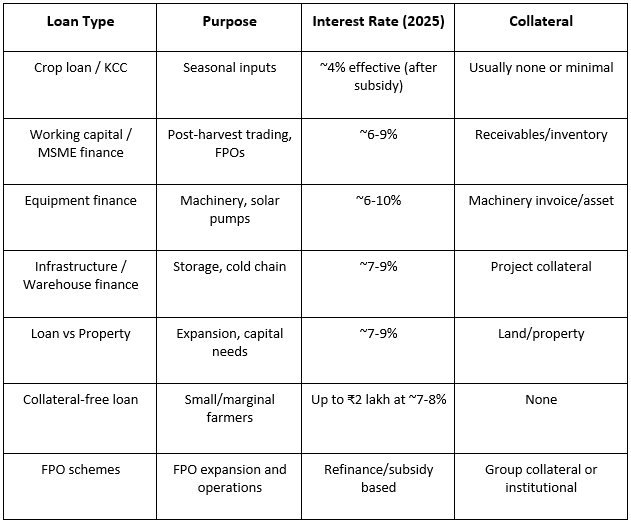
  • Crop loan schemes / Farmer loan 2025: Under NABARD–GoI interest subvention, crop loans up to ₹3 lakh are extended at 7% nominal interest, and farmers repaying promptly may get an extra 3% discount—bringing the effective rate to just 4%. Kisan Credit Cards (KCC) provide working capital credit for seeds, fertilisers, labour, with repayment aligned to harvest cycles. These are top agri finance tools for short‑term needs.
  • Farm equipment finance & Agri business loan: Long‑term farm equipment finance supports buying tractors, drip irrigation, solar pumps, or machinery—with tenures of 3–7 years and interest rates in the range of 6%–10% depending on collateral and green technology focus. For larger ventures, agri business loan options are available from banks like HDFC or ICICI with rates from 9%–11%, requiring business plans and a bit of collateral.
  • Agri‑infra, warehouse finance & working capital loan for farmers: Under NABARD’s AMI sub-scheme, a credit-linked facility offers a subsidy of 25–33% for projects such as warehouses, cold-storage, and market infrastructure—supported via warehouse finance options for small and medium-scale infrastructure borrowers. Working capital loan for farmers via MSME credit lines help with post‑harvest costs, sorting, packaging, or distribution.
  • Collateral‑free agri loan & MSME loan for agriculture: Thanks to RBI’s policy, small and marginal farmers can access collateral free agri loan up to ₹2 lakh (recently raised from ₹1.6 lakh), via banks or small finance banks. For agri‑based micro, small and medium enterprises like FPOs or food‑processing firms, MSME loan for agriculture and invoice discounting for agri MSMEs provide credit tied to receivables and inventory. NABARD’s NABSAMRUDDHI and NABKISAN schemes support MSME finance and FPO loan schemes with targeted support.
  • Loan against property for farmers & solar loan for farmers: Term loans backed by real estate—loan against property for farmers—are available at 7‑9% interest rates, supporting working capital or expansion. Similarly, solar loan for farmers helps install solar pumps or panels, often with concessional rates and refinance support from NABARD, aiming to reduce energy costs and promote sustainability.
  • FPO loan scheme & government loan for farmers: NABARD and government‑backed FPO loan scheme targets Farmer Producer Organisations, giving upto 100% refinance and grant support. Various state governments—e.g., UP’s Rs 5,000 crore subsidised scheme—provide government loan for farmers with special interest subsidies (~3%) to modernise cold storage and farm infrastructure.

Choosing the Right Agriculture Loan in 2025

Role of NABARD schemes 2025 & Agriwise services

NABARD Schemes 2025 such as STCRC, LTRCF, AMI sub‑scheme, dairy lending, KCC refinance and agro‑infrastructure refinance underpin most agriculture loan options—ensuring subsidised rates, refinance support, and grants.

At Agriwise, we offer end‑to‑end assistance in identifying the best loan for farmers in India—from applying for KCC crop loans, MSME loan for agriculture, FPO loan scheme, solar loans, and connecting you with lenders offering farm equipment finance, collateral‑free options, working capital loans, or even loan against property. We help you compare by interest rate, tenure, and eligibility to ensure you get the optimal credit solution.

Tips to Secure Best Agriculture Loan 2025

  1. Choose the right category—short‑term crop loan, MSME finance, solar loan, infrastructure, etc.
  2. Repay promptly to access better agriculture loan interest rate such as the 3% prompt repayment incentive.
  3. Join JLGs (Joint Liability Groups) or FPOs for easier access to collateral‑free or group‑supported loans.
  4. Use bankable business plans for agri business loan or equipment finance.
  5. Access government or NABARD schemes via Agriwise to streamline application and documentation.

Conclusion

In 2025, agriculture loan options in India span crop loans, working capital, equipment finance, agri‑infrastructure support, solar financing, collateral‑free credit, and FPO/MSME schemes. Interest rates range from as low as 4% for crop loans to around 9‑11% for business/investment loans, powered by government and NABARD interventions. With over ₹31–32 lakh crore in total farm credit expected in FY 2025‑26, farmers have unprecedented access to formal credit channels.

Whether you’re a smallholder seeking collateral-free agri loan, an FPO exploring invoice discounting for agri MSMEs, or a solar‑pump owner evaluating a solar loan for farmers, Agriwise can guide you through the process—from matching schemes to application support. Maximise your productivity and growth with the best agriculture loan strategy to empower your farming future.

Disclaimer

The content published on this blog is provided solely for informational and educational purposes and is not intended as professional or legal advice. While we strive to ensure the accuracy and reliability of the information presented, Agriwise make no representations or warranties of any kind, express or implied, about the completeness, accuracy, suitability, or availability with respect to the blog content or the information, products, services, or related graphics contained in the blog for any purpose. Any reliance you place on such information is therefore strictly at your own risk. Readers are encouraged to consult qualified agricultural experts, agronomists, or relevant professionals before making any decisions based on the information provided herein. Agriwise, its authors, contributors, and affiliates shall not be held liable for any loss or damage, including without limitation, indirect or consequential loss or damage, or any loss or damage whatsoever arising from reliance on information contained in this blog. Through this blog, you may be able to link to other websites that are not under the control of Agriwise. We have no control over the nature, content, and availability of those sites and inclusion of any links does not necessarily imply a recommendation or endorsement of the views expressed within them. We reserve the right to modify, update, or remove blog content at any time without prior notice.