
Tag Archives: Solar loans

What are the best finance options for Indian farmers in 2025?

December 10, 2025

As Indian agriculture modernises, choosing the right finance options determines whether a farmer merely survives or grows. In FY2024–25, institutional agricultural credit disbursements rose sharply, reaching around ₹28.7 lakh crore against the government target, reflecting stronger formal lending to the sector. Against the prior year’s ₹25.48 lakh crore disbursed in FY2023–24, this shows rising access to credit in rural India. 

In this article, we see 4 practical finance options that are proving most useful to Indian farmers in 2025.

  • Loan Against Property (LAP): Loan Against Property is a secured lending option in which land or residential/commercial property is pledged to obtain a larger ticket loan. LAP suits farmers who need substantial funds for land improvement, mechanisation, or the establishment of cold storage. Use LAP when planned investments promise multi-year returns (e.g., warehouse or drip irrigation installations).
  • Warehouse Receipt Financing (WRF): Warehouse Receipt Financing converts stored produce under accredited warehouses into collateral to borrow against, enabling farmers or aggregators to avoid distress sales at harvest. WRF is ideal for commodity traders, farmer-producer organisations (FPOs), and farmers with access to certified warehousing — it preserves price upside and improves cash flow.

finance options


  • Invoice / Supply chain Finance: Invoice financing (including factoring) helps farmers, aggregators and agri-SMEs turn receivables into immediate cash by discounting invoices from processors or buyers. This is best for those integrated into off-take contracts (dairy, vegetables, contract farming) and for enterprises that supply inputs or buy and sell commodities.
  • Solar Loans: Solarisation (pump sets, rooftops, cold-chain) is growing as a dual-purpose solution: lower electricity cost and potential revenue from surplus sale. Rooftop and agricultural solar financing is now widely available through banks, NBFCs and government-subsidised schemes, making solar loans attractive for long-term savings. India’s rooftop and distributed solar deployment continues to expand, strengthening the case for targeted solar finance.

Picking the correct finance option: A simple decision guide

  • Short-term working capital (seasonal inputs): consider WRF or invoice finance.
  • Large, long-term investments (warehouses, machinery): consider LAP or term loans.
  • Energy cost reduction / cold chain: choose solar loans with subsidy layering.
  • For assured buyer contracts: invoice finance may be the fastest.

2025 is a better year to access formal agri credit

Policy focus and rising lender appetite have expanded the availability of credit. Institutional disbursements rose to ₹28.7 lakh crore (FY2024–25), reflecting stronger outreach and diverse product offerings from banks, NBFCs and fintechs, a positive backdrop for farmers seeking customised finance solutions.
types of financial options

Agriwise helps farmers choose the right finance options

At Agriwise, we advise farmers and agri-enterprises on finding the right finance options for each stage of their farming cycle. Our services include:

  • Assessment of cash flow and funding needs to match LAP, WRF, invoice finance or solar loan structures.
  • Assistance with documentary requirements, warehouse/receipt linking, and subsidy layering for solar projects.
  • Facilitation of partnerships with banks and NBFCs for competitive rates and quick disbursements.

We combine field-level understanding with lender network access so farmers and FPOs can deploy capital faster and more safely.

Conclusion

“Best” depends on the purpose: short-term liquidity is best addressed with WRF or invoice finance, while infrastructure and high-ticket investments often require LAP. Solar loans are increasingly strategic — they lower recurring costs and may open new revenue lines. Given rising institutional disbursement and improved product diversity in 2025, farmers have more finance options than before — choosing the right one starts with defining the objective, tenure and acceptable collateral.

FAQs:

  • What are the most useful finance options available to farmers in 2025?
    The top finance options include Loan Against Property (LAP), Warehouse Receipt Financing (WRF), Invoice Financing, and Solar Loans—each serving different capital needs.
  • How does Warehouse Receipt Financing help farmers?
    WRF allows farmers to store their produce in accredited warehouses and borrow against it, helping them avoid distress sales and wait for better market prices.
  • When should a farmer choose a Loan Against Property (LAP)?
    LAP is ideal for high-value, long-term investments such as land development, machinery purchase, or building agri infrastructure.
  • Is invoice financing suitable for small farmers?
    Yes, especially for those supplying to processors, FPOs or agri companies. It offers quick liquidity without needing land as collateral.
  • Why are solar loans becoming popular for farmers?
    Solar loans reduce energy costs, improve irrigation reliability, and can generate additional income through surplus power sales.
  • How does Agriwise help farmers with financing?
    Agriwise guides farmers in selecting the right finance option, supports documentation, and connects them with lending partners for fast approvals.

Disclaimer

The content published on this blog is provided solely for informational and educational purposes and is not intended as professional or legal advice. While we strive to ensure the accuracy and reliability of the information presented, Agriwise make no representations or warranties of any kind, express or implied, about the completeness, accuracy, suitability, or availability with respect to the blog content or the information, products, services, or related graphics contained in the blog for any purpose. Any reliance you place on such information is therefore strictly at your own risk. Readers are encouraged to consult qualified agricultural experts, agronomists, or relevant professionals before making any decisions based on the information provided herein. Agriwise, its authors, contributors, and affiliates shall not be held liable for any loss or damage, including without limitation, indirect or consequential loss or damage, or any loss or damage whatsoever arising from reliance on information contained in this blog. Through this blog, you may be able to link to other websites that are not under the control of Agriwise. We have no control over the nature, content, and availability of those sites and inclusion of any links does not necessarily imply a recommendation or endorsement of the views expressed within them. We reserve the right to modify, update, or remove blog content at any time without prior notice.

How does solar finance work? A step-by-step guide for farmers

November 20, 2025

As more farms turn to clean energy, solar finance has become a vital tool that helps farmers install solar pumps, rooftop systems, and field-mounted arrays without large upfront costs. This guide breaks down how solar finance works in practical steps and highlights why it’s an attractive option for small and medium farmers in India today.

Why is solar finance important for farmers?

Solar finance provides the capital support needed to transition from expensive traditional power sources to clean solar energy. India’s transition to solar is accelerating. By 2025, the country’s utility-scale and distributed solar capacity crossed the 100+ GW mark, reflecting rapid adoption across sectors. In 2025, India continued to install solar pumps, with significant progress reported under the Pradhan Mantri Kisan Urja Suraksha evam Utthaan Mahabhiyan (PM-KUSUM) scheme. As of July 31, 2025, 8.53 lakh solar pumps were installed.
These shifts make solar finance not just an environmental choice but a smart economic decision: predictable energy bills, higher irrigation reliability, and, often, access to government subsidies or favourable loan schemes.

solar finance

How does solar finance work for a farmer?

  • Assess energy need and costs: Estimate the system size you need (pump horsepower or kW for a roof/field system), expected energy generation, and total system cost (equipment, installation, wiring). Many local vendors or solar installers will provide a free site assessment and a quotation.
  • Explore subsidies & grants: Central and state schemes frequently offer capital subsidies or incentives for agricultural solar (pump and feeder schemes, rooftop incentives). These subsidies can reduce the upfront cost and improve loan viability. Verify current schemes at the local nodal agency or state renewable energy department.
  • Choose a financing option: Solar finance for farmers typically comes in several forms: Farmers have multiple avenues to finance solar installations. Government programmes such as the PM-KUSUM scheme provide capital subsidies and facilitated credit support to lower the cost burden of adoption. In addition to these subsidised mechanisms, farmers may also access conventional bank financing, asset-specific equipment loans, or secured term loans offered by banks and NBFCs.

    1. Retail/consumer loans from banks and NBFCs (secured or unsecured, with tenors matching equipment life).
    2. Asset-backed loans collateralised by the solar system itself.
    3. Pay-As-You-Go / Lease / Energy-as-a-Service models, where a provider installs and owns the system — the farmer pays a predictable monthly fee tied to energy delivered.
    4. Blended finance where subsidy + concessional credit + commercial loan are combined to lower the effective cost. 
  • Loan application and documentation: Typical documents: KYC, land proof /7/12, farm electricity bill, quotation from installer, and subsidy sanction proof (if applicable). Lenders will assess repayment capacity, often using projected savings from fuel/electricity substitution and any additional farm income generated from reliable irrigation or cold-storage power.

  • Installation and inspection: After loan sanction and disbursal (sometimes partly to the vendor), the system is installed. Lenders or nodal agencies may require an inspection and performance guarantees. Modern finance models include remote monitoring to ensure generation meets promised levels.
  • Repayment & performance monitoring: Repayment schedules can be matched to crop cash flows (seasonal EMIs or grace periods). In meter-based or PAYG models, payments may be linked to generated energy or a flat monthly tariff. Many systems now offer remote telemetry so lenders and farmers can monitor generation and address issues fast.

Key data to consider

  • India’s large-scale and distributed solar capacity surged through 2025, making the technology widely available and competitive vs. diesel alternatives.
  • The solar irrigation rollout is sizeable; reports and company disclosures show tens of thousands of pump systems added in recent fiscal periods, underscoring demand from the agriculture sector.
  • Sustainable agriculture finance is increasingly channelled into climate-smart investments. Green finance reports show rising flows into agri-solar projects and related lending instruments.

How Agriwise supports farmers with solar finance?

Agriwise provides farmer-centric solar finance solutions designed for agriculture realities: flexible tenors that align with cropping cycles, options for equipment financing (pumps, panels, inverters) and tie-ups with verified installers to simplify procurement. Agriwise structures loans so that subsidy benefits and projected fuel/electricity savings are integrated into the repayment plan, reducing cash-flow stress for farmers.

Quick tips for farmers considering solar finance

  • Get multiple quotes; compare warranties and expected energy yield.
  • Check subsidy eligibility first; it varies by state.
  • Align loan tenure with expected equipment life 
  • Consider monitoring systems, which reduce downtime and protect your investment.

Adopting solar through smart solar finance can lower operating costs, improve irrigation reliability, and strengthen farm resilience. With the right financing partner (like Agriwise) and careful planning, farmers can switch to clean energy with minimal strain on cash flow — turning sunlight into a dependable farm asset.

Disclaimer

The content published on this blog is provided solely for informational and educational purposes and is not intended as professional or legal advice. While we strive to ensure the accuracy and reliability of the information presented, Agriwise make no representations or warranties of any kind, express or implied, about the completeness, accuracy, suitability, or availability with respect to the blog content or the information, products, services, or related graphics contained in the blog for any purpose. Any reliance you place on such information is therefore strictly at your own risk. Readers are encouraged to consult qualified agricultural experts, agronomists, or relevant professionals before making any decisions based on the information provided herein. Agriwise, its authors, contributors, and affiliates shall not be held liable for any loss or damage, including without limitation, indirect or consequential loss or damage, or any loss or damage whatsoever arising from reliance on information contained in this blog. Through this blog, you may be able to link to other websites that are not under the control of Agriwise. We have no control over the nature, content, and availability of those sites and inclusion of any links does not necessarily imply a recommendation or endorsement of the views expressed within them. We reserve the right to modify, update, or remove blog content at any time without prior notice.

Solar loans for agriculture & MSMEs: Pay less, save more

September 11, 2025

Agriculture and MSMEs across India are turning to renewable energy to cut costs, increase productivity, and achieve sustainability. A solar loan allows farmers and small businesses to invest in solar energy systems—like rooftop solar, irrigation pumps, and other installations—without the hefty upfront cost. Thanks to favorable interest rates, subsidies, and flexible repayment structures, these solar loans are reshaping the financial landscape for agriculture and MSMEs in 2025.

Why choose a solar loan?

  • Huge cost savings: With rising electricity tariffs and unpredictable diesel prices, switching to solar via a solar loan can slash monthly energy bills by nearly half for farms and businesses.
  • Access to subsidies and schemes: Government-backed Solar Loan Schemes in India—such as the Pradhan Mantri Kisan Urja Suraksha evam Utthaan Mahabhiyan (PM-KUSUM)—offer attractive subsidies for farmers installing solar pumps. Likewise, MSMEs can access Solar Loan Subsidy India programs for rooftop and off-grid solar systems.
  • Rapid return on investment: The payback period often ranges from 3 to 5 years thanks to lower utility costs and high solar irradiation, especially in regions like central and southern India.

solar loans

Types of solar loans available

  • Solar loans for agriculture: Agricultural producers can finance solar-powered irrigation systems through the solar irrigation pump loan. These loans are frequently bundled with schemes like PM-KUSUM and other agricultural solar financing initiatives. Farmers benefit from subsidized interest rates and better loan terms under solar loan scheme India offerings.
  • Solar loan for farmers India: Specifically tailored for India’s farming community, these packages support installation of solar arrays to power operations—reducing dependence on grid electricity and diesel. The combination of subsidy, credit-linked support, and financing makes farmers solar loan India an attractive option.
  • MSME solar loan & solar financing MSME: Small enterprises can access MSME solar loan or solar financing MSME products to install rooftop or ground-mounted solar systems. Financing terms typically cover up to 90% of project costs, with loans spread over 7–10 years. Businesses can use this to lighten their electricity burden and enhance profitability.
  • Rooftop solar loans & solar panel loan India: Rooftop solar adoption is soaring—and rooftop system loans powered by solar panel loan India or solar power loan India make installation more affordable. These loans help businesses and households structure payments that align with lower electricity bills, making clean energy installations more accessible.

solar financing

Industry figures in 2025

As of April 2025, India’s installed solar capacity stands at 107.94 GW_AC, generating 144 TWh of electricity—up from 116 TWh in 2024. The National Solar Mission target of 100 GW was surpassed in January 2025. For agriculture, the RBI raised the collateral-free loan limit from ₹1.6 lakh to ₹2 lakh to improve access to credit.

On the household front, the Pradhan Mantri Surya Ghar Muft Bijli Yojana, launched in 2024 with a budget of ₹75,021 crore, will provide 1 crore households with rooftop solar and 300 free units of electricity per month. In addition, collateral-free rooftop loans up to ₹2 lakh at a subsidized 6.75% interest rate are available for systems up to 3 kW. Finally, the GST on solar devices has been cut from 12% to 5%, lowering project costs by nearly 5%.

Agriwise solar loans

When it comes to tailored financial support, Agriwise loans are designed with the farming and MSME ecosystem in mind. For solar loans, we offer:

  • Competitive interest rates
  • Flexible repayment terms up to 10 years
  • Assistance with subsidy processing, including PM-KUSUM and state schemes
  • Expert guidance on required approvals, vendor selection, and installation monitoring

Whether you’re a farmer seeking a solar irrigation pump loan, or an MSME looking for a rooftop solar loan, Agriwise ensures that you get the best match between financing, subsidy, and delivery. Our streamlined process saves you both time and effort—so you can concentrate on cultivating growth.

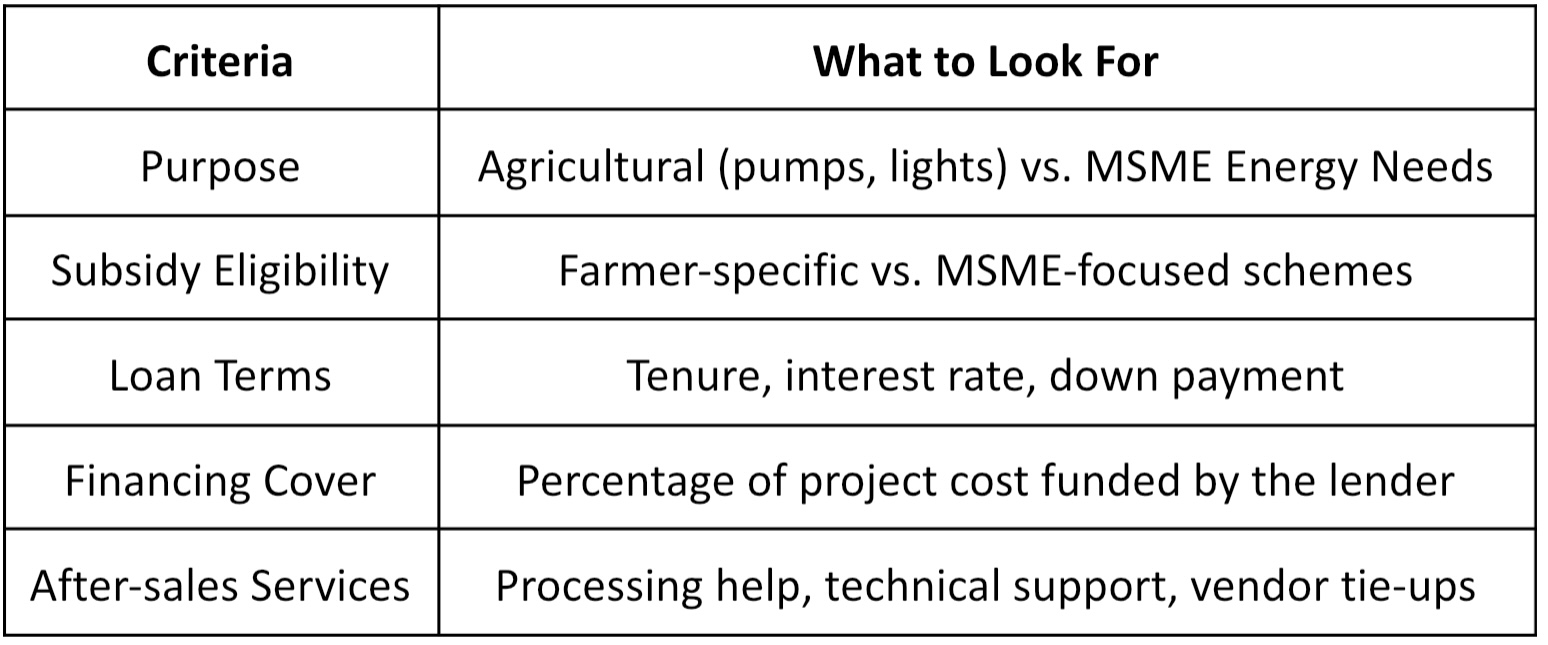
How to choose the right solar loan option?

Conclusion: Pay less, save more

A solar loan provides a powerful lever to pay less for energy and save more for your enterprise—whether you’re a farmer leveraging farmers solar loan India or a small business financing rooftop arrays through MSME solar loan programs. With the aid of solar loan MSME India, solar loan scheme India, and solar loan subsidy India, investing in solar has never been more financially prudent.

Let Agriwise guide you through agricultural solar financing and ensure you seize the full potential of solar loan for farmers India or solar financing MSME offerings. Going solar is not just an environmentally smart move—it’s a financially savvy strategy for long-term prosperity.

Disclaimer

The content published on this blog is provided solely for informational and educational purposes and is not intended as professional or legal advice. While we strive to ensure the accuracy and reliability of the information presented, Agriwise make no representations or warranties of any kind, express or implied, about the completeness, accuracy, suitability, or availability with respect to the blog content or the information, products, services, or related graphics contained in the blog for any purpose. Any reliance you place on such information is therefore strictly at your own risk. Readers are encouraged to consult qualified agricultural experts, agronomists, or relevant professionals before making any decisions based on the information provided herein. Agriwise, its authors, contributors, and affiliates shall not be held liable for any loss or damage, including without limitation, indirect or consequential loss or damage, or any loss or damage whatsoever arising from reliance on information contained in this blog. Through this blog, you may be able to link to other websites that are not under the control of Agriwise. We have no control over the nature, content, and availability of those sites and inclusion of any links does not necessarily imply a recommendation or endorsement of the views expressed within them. We reserve the right to modify, update, or remove blog content at any time without prior notice.