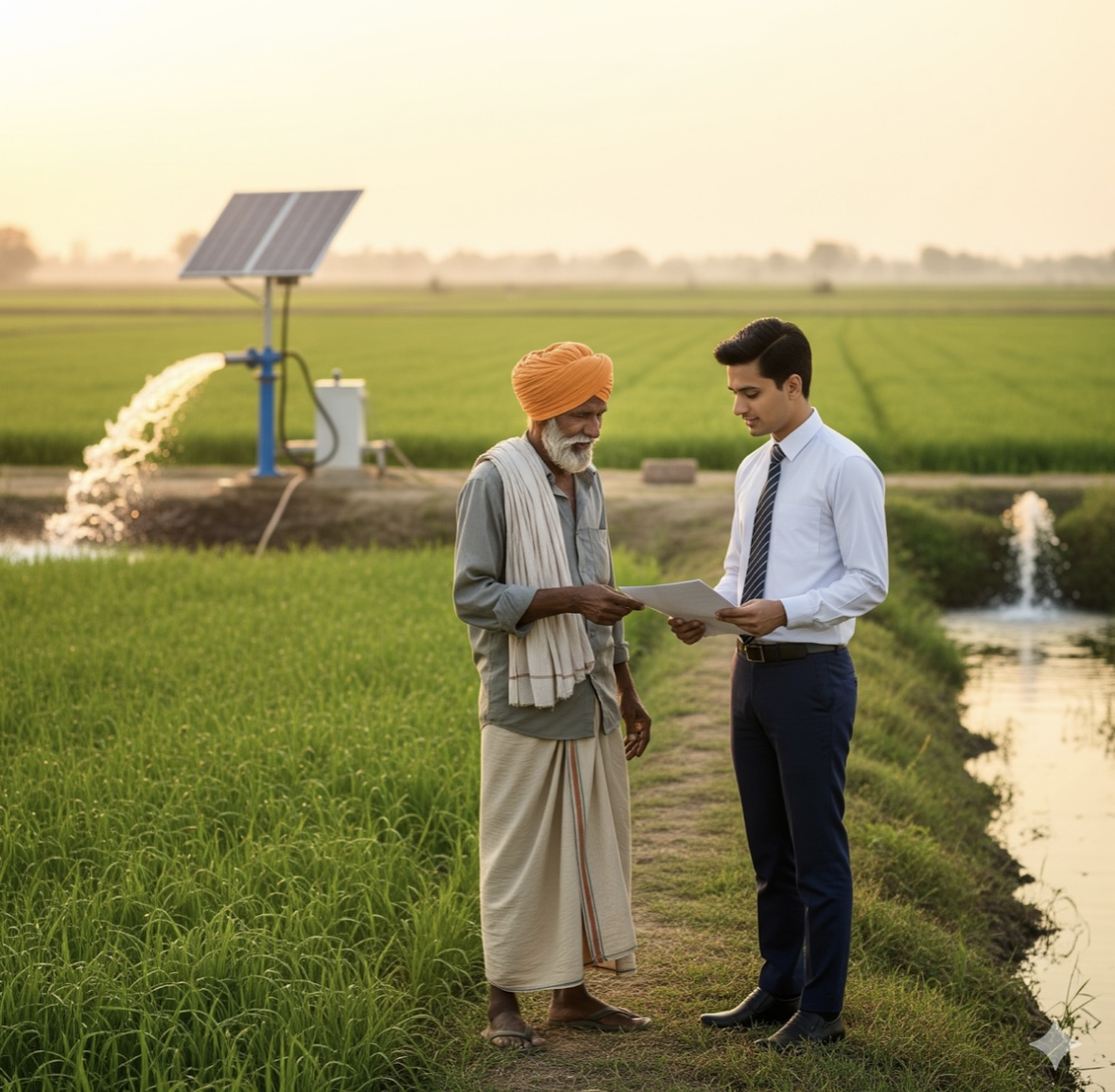

Adopting solar irrigation is not just an eco-friendly choice but a practical way for farmers to reduce diesel and electricity costs, ensure reliable irrigation, and access attractive government subsidies and finance. India’s solar water pump market was valued at USD 112.68 million in 2024 and continues to grow rapidly.
Looking forward, it is expected that the market will reach USD 221.54 Million by 2033, exhibiting a growth rate (CAGR) of 7.20% during 2025-2033. Under the PM-KUSUM programme, Component-B alone targets ~14 lakh standalone solar pumps, with over 9 lakh pumps already installed nationwide by late 2025.
But what is a solar pump loan, and what are its benefits, subsidy options, and eligibility? Let’s find out.

What is a solar pump loan?
A solar loan is a green energy financing solution offered by banks and NBFCs to help individuals and businesses install solar panels. The loan can be repaid easily through affordable monthly instalments (EMIs).
A solar pump loan is a term loan or equipment finance specifically designed for purchasing and installing solar-powered irrigation pumps. Loans typically cover the pump, solar panels, mounting, electrical systems, and installation charges. Farmers can repay via EMIs over 3–10 years, often with the government subsidy deducted upfront or credited through the lender.
Key benefits of a solar pump
- Lower operating cost — eliminates recurring diesel bills and reduces electricity dependence.
- Energy independence & reliability — daytime irrigation is possible even in remote or off-grid locations.
- Higher cropping flexibility — consistent water supply allows better crop planning and yields.
- Subsidies & concessional finance — central (PM-KUSUM) and state schemes significantly lower upfront costs, while lenders provide farmer-friendly repayment options.
Subsidies & scheme highlights (2025)
- PM-KUSUM (Component-B & C) offers central financial assistance for standalone pumps and solarisation of existing pumps. Farmers may receive substantial support, depending on pump capacity, state top-ups, and beneficiary category.
- State schemes — Several states provide additional subsidies (30%–90%) to small and marginal farmers. Eligibility criteria and processing differ by state, so checking local horticulture or renewable energy departments is essential.

Who is eligible?
Eligibility typically includes:
- Farmers or farmer-producer organisations (FPOs) owning/operating land.
- Pump capacity limits (PM-KUSUM Component-B supports up to ~7.5 HP; state limits vary).
- No pending statutory disqualifications; documents required include land records, Aadhaar, bank details, and local approvals.
- Lenders may check credit history and repayment capacity; some NBFCs offer loans with minimal collateral for smaller amounts.
Banks and NBFCs provide agricultural loans under PM-KUSUM, with margins around 10% of pump cost, loan amounts ranging from ₹25,000 to ₹10 lakh, and flexible repayment tenors up to 10 years. Some banks/NBFCs offer 7–10 years & loan amount more than 10 lakhs depending on:
- Project viability
- Cash flows / savings from solar
- Subsidy structure (PM-KUSUM / state schemes)
Agriwise solar loan options (2025)
Agriwise offers flexible solar finance solutions designed to make solar adoption affordable and accessible. Farmers, MSMEs, and other businesses can either purchase a solar power system outright or cover installation costs upfront and repay over time.
- Target customers: Farmers, MSMEs, and individuals looking to install solar power systems.
- Loan purpose: Purchase and installation of solar irrigation pumps or other solar power setups.
- Mounting options: Roof mounts, ground mounts, or shed/tin mounts.
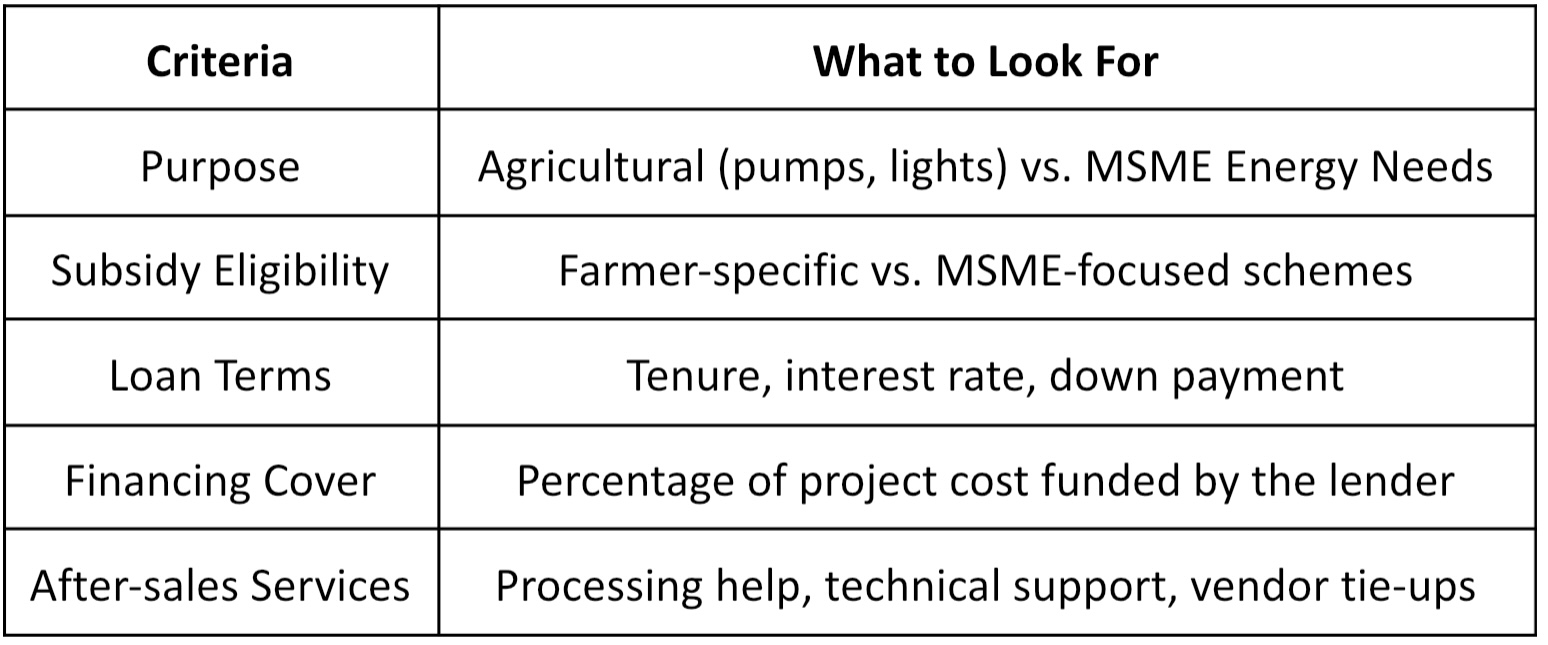
- Loan range & tenor: Loans are available for a wide range of amounts, with repayment tenors tailored to suit customer needs. Options exist with or without collateral, offering flexibility based on financing requirements.
- EMI planning: Agriwise provides an EMI calculator to help borrowers estimate repayments after expected subsidies, enabling easy financial planning.
Checklist before applying
- Confirm eligible subsidy rates for your state and pump capacity.
- Obtain multiple vendor quotes and verify compliance with MNRE-approved pump and solar component lists.
- Prepare land records, Aadhaar, bank statements, and proof of cultivation.
- Clarify whether the lender finances the net amount after subsidy or full cost with later adjustment.
- Ask for detailed EMI schedules, including any moratorium or prepayment options.
Conclusion
Solar pump adoption is growing rapidly, with national targets and state programmes accelerating installations in 2025. With structured loans, subsidy support, and tools like Agriwise’s EMI calculator, farmers can transition to reliable, low-cost irrigation while minimizing financial stress. Exploring Agriwise’s solar loan options ensures a smooth path from application to commissioning and subsidy release.
FAQs
- What is a solar pump loan?
A solar pump loan helps farmers finance the purchase and installation of solar-powered irrigation pumps, with repayment through easy EMIs. - Which subsidies are available for solar pumps in 2025?
Farmers can avail subsidies under the PM-KUSUM scheme, along with additional state-level subsidies depending on location and eligibility. - Who can apply for a solar pump loan?
Individual farmers, FPOs, MSMEs, and land-owning cultivators can apply, subject to scheme and lender criteria. - What types of solar pump installations are supported?
Loans can be used for ground-mounted, rooftop, or shed/tin-mounted solar pump systems. - How does Agriwise help with solar pump financing?
Agriwise provides tailored loans, subsidy assistance, and an EMI calculator to help farmers plan repayments easily.
Disclaimer
The content published on this blog is provided solely for informational and educational purposes and is not intended as professional or legal advice. While we strive to ensure the accuracy and reliability of the information presented, Agriwise make no representations or warranties of any kind, express or implied, about the completeness, accuracy, suitability, or availability with respect to the blog content or the information, products, services, or related graphics contained in the blog for any purpose. Any reliance you place on such information is therefore strictly at your own risk. Readers are encouraged to consult qualified agricultural experts, agronomists, or relevant professionals before making any decisions based on the information provided herein. Agriwise, its authors, contributors, and affiliates shall not be held liable for any loss or damage, including without limitation, indirect or consequential loss or damage, or any loss or damage whatsoever arising from reliance on information contained in this blog. Through this blog, you may be able to link to other websites that are not under the control of Agriwise. We have no control over the nature, content, and availability of those sites and inclusion of any links does not necessarily imply a recommendation or endorsement of the views expressed within them. We reserve the right to modify, update, or remove blog content at any time without prior notice.