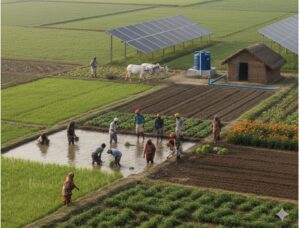

As India strives to boost agricultural output while protecting the environment, a new force is quietly reshaping the sector—green finance. Could the future of farming lie not just in better seeds or machinery, but in smarter, eco-friendly funding?
With agriculture contributing nearly 18% to India’s GDP and supporting over 40% of the workforce, the potential impact of sustainable agri finance is enormous. From renewable energy adoption to climate-resilient farming, green finance is opening doors to opportunities farmers never imagined. Green finance, with investment flows directed toward environmentally friendly and climate-resilient initiatives, is transforming the way the sector produces, manages, and sustains growth.

Understanding green finance in agriculture
Fundamentally, green finance in agriculture refers to financial instruments and investments that promote sustainable agricultural practices, reduce carbon emissions, and enhance resource efficiency. It includes credit support for renewable energy adoption, efficient irrigation systems, low-emission machinery, organic farming, and waste management solutions.
In India, the focus on sustainable agri finance has gained momentum following policy initiatives such as the National Mission on Sustainable Agriculture (NMSA) and the Pradhan Mantri Kisan Urja Suraksha evam Utthaan Mahabhiyan (PM-KUSUM). These programs aim to encourage farmers to adopt renewable technologies like solar-powered irrigation and climate-resilient crop practices—key areas where green finance plays a pivotal role.
Why green finance matters for India’s agricultural future?
Traditional agricultural credit models often overlook environmental sustainability. However, the rising frequency of climate shocks—droughts, floods, and erratic rainfall—has underscored the urgent need for climate-smart agriculture in India. According to the World Bank, climate change could reduce India’s agricultural income by up to 25% by 2050 if adaptive and sustainable measures are not adopted.
Green finance bridges this gap by offering innovative credit structures and risk mitigation mechanisms that enable farmers and agri-enterprises to invest in sustainable technologies. From solar financing in India for water pumps to carbon-neutral warehousing and biofertilizer production, green finance acts as both a growth driver and a climate safeguard.

Market momentum and growing investments
The green finance ecosystem in India is witnessing rapid growth. As of December 2024, India’s cumulative aligned green/social/sustainability (GSS+) debt issuance stood at USD 55.9 billion, up 186% since 2021. Green bonds accounted for around 83 % of this volume.
While the agriculture‑specific breakdown for green finance is less frequently available, the broader momentum in sustainable capital flows is a strong signal for opportunity in the agri‑space. The development of India’s draft climate taxonomy and regulatory frameworks is expected to channel more capital into green agricultural activities in coming years.
Role of Agriwise & other NBFCs
Non-Banking Financial Companies (NBFCs) are playing a crucial role in driving green finance in agriculture by bridging last-mile credit access. Agriwise, for instance, has been actively promoting sustainable agri finance solutions tailored for farmers, agribusinesses, and supply chain partners.
Through Agriwise loans, farmers can access structured financial products to invest in renewable technologies, efficient irrigation systems, and sustainable farm inputs. The company’s focus on digitized lending and agri-data analytics allows it to assess borrower risk more accurately, ensuring faster and more transparent loan approvals.
Such technology-driven financing models are pivotal in empowering farmers to shift toward climate-smart agriculture in India without facing the traditional credit barriers of collateral-heavy systems.

Green finance and renewable energy in agriculture
One of the most compelling applications of green finance in agriculture is in renewable energy adoption. Farms and rural agri‑units in India still rely heavily on diesel‑based irrigation pumps, contributing both to high fossil‑fuel costs and greenhouse‑gas emissions. Transitioning to solar‑powered alternatives via solar financing in India is not only cost‑effective for farmers but also pivotal for climate mitigation.
The government’s ambition — including targets such as installation of 10 GW of solar capacity through agricultural applications by 2030 — underscores the potential scale of opportunity. While specific agriculture‑loans data is limited, the broader driver is clear: renewable‑enabled farms benefit from reduced energy cost, reduced risk of fuel‑price shocks and improved sustainability.
Challenges and the road ahead
Despite its promise, green finance in agriculture faces several challenges—limited awareness among farmers, lack of standardized green credit frameworks, and the perception of high implementation costs. However, with increasing public-private partnerships, carbon credit opportunities, and the rise of ESG (Environmental, Social, and Governance) investing, the momentum is shifting positively.
To scale impact, policymakers and financial institutions must integrate sustainability metrics into credit assessment models. Simultaneously, digital platforms like Agriwise can continue leveraging data-driven tools to promote transparency and inclusivity in green lending.
Conclusion: The future of sustainable agri finance
The integration of green finance into India’s agricultural ecosystem is not just an environmental necessity—it is an economic imperative. By unlocking access to capital for sustainable practices, the sector can enhance productivity, build resilience against climate change, and ensure long-term profitability. As initiatives around sustainable agri finance, renewable energy, and climate-smart agriculture in India continue to evolve, the role of innovative financiers like Agriwise becomes increasingly vital. With tailored Agriwise loans and forward-looking credit models, India’s farmers can be at the forefront of the next big leap—toward a greener, more resilient agricultural future.
Disclaimer
The content published on this blog is provided solely for informational and educational purposes and is not intended as professional or legal advice. While we strive to ensure the accuracy and reliability of the information presented, Agriwise make no representations or warranties of any kind, express or implied, about the completeness, accuracy, suitability, or availability with respect to the blog content or the information, products, services, or related graphics contained in the blog for any purpose. Any reliance you place on such information is therefore strictly at your own risk. Readers are encouraged to consult qualified agricultural experts, agronomists, or relevant professionals before making any decisions based on the information provided herein. Agriwise, its authors, contributors, and affiliates shall not be held liable for any loss or damage, including without limitation, indirect or consequential loss or damage, or any loss or damage whatsoever arising from reliance on information contained in this blog. Through this blog, you may be able to link to other websites that are not under the control of Agriwise. We have no control over the nature, content, and availability of those sites and inclusion of any links does not necessarily imply a recommendation or endorsement of the views expressed within them. We reserve the right to modify, update, or remove blog content at any time without prior notice.