

Tag Archives: warehouse receipt finance

warehouse receipt

Top 5 Benefits of Warehouse Receipt Financing for Farmers and Agri-Traders

January 15, 2026

Did you know that the crops sitting in a warehouse could actually earn you money before they’re even sold? That’s the power of Warehouse Receipt Financing.

Financial institutions are expected to meet the agriculture credit target of Rs 32.5 lakh crore for 2025–26.

By turning stored produce into collateral, farmers and agri-traders can access instant credit, avoid distress sales, and even sell at the most profitable time. This financial tool is helping stakeholders protect their harvest, maximise returns, and step confidently into formal markets. In India, electronic Warehouse Receipts (e-NWRs) and regulated storage systems are now unlocking significant value for agricultural stakeholders by enabling stored commodities to be used as collateral for short-term loans. But what are those benefits?

1. Improved access to working capital: One of the most immediate benefits of Warehouse Receipt Financing is the ability for farmers and traders to convert stored produce into cash without having to sell immediately. By pledging e-NWRs issued from registered warehouses/warehouse receipts by collateral managers, borrowers can access loans typically amounting to 70–75% of the commodity’s market value, helping manage input costs such as seeds, fertilisers, labour, and transport. This access to formal finance is significant in a sector where formal institutions historically offer less than 3% of agricultural credit in emerging markets.

2. Avoidance of distress sales & price timing advantage: Post-harvest periods often lead to oversupply, suppressing prices when farmers need cash the most. Warehouse Receipt Financing allows produce to be stored under certified conditions and sold later, capturing higher seasonal prices instead of resorting to low-price distress sales immediately after harvest.
For example, India’s food grain production in 2023-24 was approximately 330 million tonnes, but only about 1.24 million tonnes were financed via warehousing/e-NWR instruments, indicating huge untapped potential for price optimisation through timely selling.

warehouse receipt

3. Reduced post-harvest losses and quality preservation: Certified warehouses, governed by the Warehousing Development and Regulatory Authority (WDRA), ensure that stored commodities are graded, inspected, and preserved under optimal conditions. Proper storage reduces waste, maintains quality, and allows farmers to fetch better prices later in the season. Without access to formal warehousing and finance, farmers face significantly higher spoilage rates, up to 30–40% in unregulated storage systems worldwide.

4. Strengthened bargaining power & market participation: By delaying sales and leveraging formal receipts, farmers and agri-traders gain stronger bargaining power in the market. Instead of selling to local brokers at low prices, they can reach broader markets, including institutional and export channels, often resulting in better price realisation and income stability. Warehouse Receipt Financing also encourages farmers to become “price setters” rather than “price takers”, as they have the flexibility to choose when and where to sell.

5. Formal credit history and lower reliance on informal lending: By engaging with formal WRF mechanisms, farmers and traders build a credit history that can open the door to future loans on favourable terms. e-NWR-based financing also helps reduce reliance on informal moneylenders, who typically charge exorbitant interest rates, thereby improving the overall financial health of agrarian communities.
Moreover, WRF helps lenders better assess risk through verified commodity collateral, often resulting in competitive interest rates and structured repayment terms.
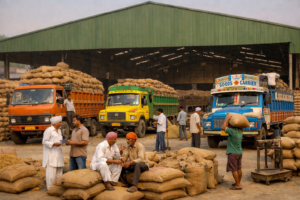
negotiable warehouse receipt

Warehouse receipt industry figures that matter

  • India’s regulated warehouse capacity reached approximately 44.8 million tonnes by March 2025, signalling expanding storage infrastructure.
  • Electronic Warehouse Receipts (e-NWRs) were issued for roughly 54 million metric tonnes of agricultural commodities, indicating growing adoption of digital instruments.
  • The warehouse receipt financing ecosystem, including negotiable receipts, was valued at around ₹35,000 crore in recent years, demonstrating substantial credit flows into agriculture.
  • Commodity valuations backed by storage receipts surged from ₹12,362 crore in FY23 to nearly ₹19,930 crore in FY25, reflecting institutional confidence and market growth. Based on current growth momentum, commodity valuations are expected to cross 24,000–26,000 crore in FY26.

How Agriwise helps farmers & agri-traders

At Agriwise, we empower farmers, traders, and agri-businesses to unlock the full potential of Warehouse Receipt Financing through a comprehensive suite of services:

  • Access to WHR (Warehouse Receipt) finance: Agriwise Finserv provides tailored financing solutions against warehouse receipts issued by the collateral manager (CM), ensuring borrowers get the cash they need without distress selling.
  • Wide network of accredited warehouses: We partner with Asia’s leading warehousing & collateral management company (Staragri). 
  • Market insights & advisory: Our platform gives real-time price trends, market data, and sell timing guidance, helping clients maximise returns on stored commodities.
  • Technology-driven transparency: Digital documentation and tracking through secure systems enhance lender confidence and streamline loan approvals.
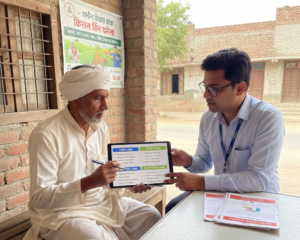
  • Farmer education & support: From documentation help to training on using receipts and understanding loan terms, Agriwise bridges the gap between farmers and formal credit.
Conclusion

Warehouse Receipt Financing stands out as a powerful tool in modern agricultural finance, enabling farmers and agri-traders to stabilise incomes, avoid premature selling, and access formal credit with fewer hurdles. As India’s regulated warehousing ecosystem expands and digital receipts gain traction, WRF will play an increasingly pivotal role in strengthening rural economies and enhancing farm profitability. With partners like Agriwise, stakeholders can confidently leverage these financial instruments to grow sustainably and prosper in a competitive market.

FAQs

  1. What is Warehouse Receipt Financing (WRF)?
    WRF is a credit facility that allows farmers or agri-traders to pledge stored commodities in certified warehouses/professional warehouses as collateral to access short-term loans.
  2. Who can benefit from WRF?
    Farmers, agri-traders, manufacturers, exporters, importers and agribusinesses who want timely working capital, better price realisation, and reduced post-harvest losses can benefit from WRF.
  3. How does WRF help avoid distress sales?
    By storing commodities in certified warehouses and using receipts as collateral for loans, farmers can wait for better market prices before selling immediately after harvest.
  4. What types of commodities are eligible for WRF?
    Grains, pulses, oilseeds, spices, and other non-perishable agricultural products stored in WDRA-approved or accredited warehouses can be financed under WRF.
  5. How does WRF improve financial inclusion?
    WRF builds formal credit history for farmers and traders, reducing reliance on informal lenders and enabling easier access to future loans at competitive interest rates.

Disclaimer

The content published on this blog is provided solely for informational and educational purposes and is not intended as professional or legal advice. While we strive to ensure the accuracy and reliability of the information presented, Agriwise make no representations or warranties of any kind, express or implied, about the completeness, accuracy, suitability, or availability with respect to the blog content or the information, products, services, or related graphics contained in the blog for any purpose. Any reliance you place on such information is therefore strictly at your own risk. Readers are encouraged to consult qualified agricultural experts, agronomists, or relevant professionals before making any decisions based on the information provided herein. Agriwise, its authors, contributors, and affiliates shall not be held liable for any loss or damage, including without limitation, indirect or consequential loss or damage, or any loss or damage whatsoever arising from reliance on information contained in this blog. Through this blog, you may be able to link to other websites that are not under the control of Agriwise. We have no control over the nature, content, and availability of those sites and inclusion of any links does not necessarily imply a recommendation or endorsement of the views expressed within them. We reserve the right to modify, update, or remove blog content at any time without prior notice.


What are the best finance options for Indian farmers in 2025?

December 10, 2025

As Indian agriculture modernises, choosing the right finance options determines whether a farmer merely survives or grows. In FY2024–25, institutional agricultural credit disbursements rose sharply, reaching around ₹28.7 lakh crore against the government target, reflecting stronger formal lending to the sector. Against the prior year’s ₹25.48 lakh crore disbursed in FY2023–24, this shows rising access to credit in rural India. 

In this article, we see 4 practical finance options that are proving most useful to Indian farmers in 2025.

  • Loan Against Property (LAP): Loan Against Property is a secured lending option in which land or residential/commercial property is pledged to obtain a larger ticket loan. LAP suits farmers who need substantial funds for land improvement, mechanisation, or the establishment of cold storage. Use LAP when planned investments promise multi-year returns (e.g., warehouse or drip irrigation installations).
  • Warehouse Receipt Financing (WRF): Warehouse Receipt Financing converts stored produce under accredited warehouses into collateral to borrow against, enabling farmers or aggregators to avoid distress sales at harvest. WRF is ideal for commodity traders, farmer-producer organisations (FPOs), and farmers with access to certified warehousing — it preserves price upside and improves cash flow.

finance options


  • Invoice / Supply chain Finance: Invoice financing (including factoring) helps farmers, aggregators and agri-SMEs turn receivables into immediate cash by discounting invoices from processors or buyers. This is best for those integrated into off-take contracts (dairy, vegetables, contract farming) and for enterprises that supply inputs or buy and sell commodities.
  • Solar Loans: Solarisation (pump sets, rooftops, cold-chain) is growing as a dual-purpose solution: lower electricity cost and potential revenue from surplus sale. Rooftop and agricultural solar financing is now widely available through banks, NBFCs and government-subsidised schemes, making solar loans attractive for long-term savings. India’s rooftop and distributed solar deployment continues to expand, strengthening the case for targeted solar finance.

Picking the correct finance option: A simple decision guide

  • Short-term working capital (seasonal inputs): consider WRF or invoice finance.
  • Large, long-term investments (warehouses, machinery): consider LAP or term loans.
  • Energy cost reduction / cold chain: choose solar loans with subsidy layering.
  • For assured buyer contracts: invoice finance may be the fastest.

2025 is a better year to access formal agri credit

Policy focus and rising lender appetite have expanded the availability of credit. Institutional disbursements rose to ₹28.7 lakh crore (FY2024–25), reflecting stronger outreach and diverse product offerings from banks, NBFCs and fintechs, a positive backdrop for farmers seeking customised finance solutions.

types of financial options

Agriwise helps farmers choose the right finance options

At Agriwise, we advise farmers and agri-enterprises on finding the right finance options for each stage of their farming cycle. Our services include:

  • Assessment of cash flow and funding needs to match LAP, WRF, invoice finance or solar loan structures.
  • Assistance with documentary requirements, warehouse/receipt linking, and subsidy layering for solar projects.
  • Facilitation of partnerships with banks and NBFCs for competitive rates and quick disbursements.

We combine field-level understanding with lender network access so farmers and FPOs can deploy capital faster and more safely.

Conclusion

“Best” depends on the purpose: short-term liquidity is best addressed with WRF or invoice finance, while infrastructure and high-ticket investments often require LAP. Solar loans are increasingly strategic — they lower recurring costs and may open new revenue lines. Given rising institutional disbursement and improved product diversity in 2025, farmers have more finance options than before — choosing the right one starts with defining the objective, tenure and acceptable collateral.

FAQs:

  • What are the most useful finance options available to farmers in 2025?
    The top finance options include Loan Against Property (LAP), Warehouse Receipt Financing (WRF), Invoice Financing, and Solar Loans—each serving different capital needs.
  • How does Warehouse Receipt Financing help farmers?
    WRF allows farmers to store their produce in accredited warehouses and borrow against it, helping them avoid distress sales and wait for better market prices.
  • When should a farmer choose a Loan Against Property (LAP)?
    LAP is ideal for high-value, long-term investments such as land development, machinery purchase, or building agri infrastructure.
  • Is invoice financing suitable for small farmers?
    Yes, especially for those supplying to processors, FPOs or agri companies. It offers quick liquidity without needing land as collateral.
  • Why are solar loans becoming popular for farmers?
    Solar loans reduce energy costs, improve irrigation reliability, and can generate additional income through surplus power sales.
  • How does Agriwise help farmers with financing?
    Agriwise guides farmers in selecting the right finance option, supports documentation, and connects them with lending partners for fast approvals.

Disclaimer

The content published on this blog is provided solely for informational and educational purposes and is not intended as professional or legal advice. While we strive to ensure the accuracy and reliability of the information presented, Agriwise make no representations or warranties of any kind, express or implied, about the completeness, accuracy, suitability, or availability with respect to the blog content or the information, products, services, or related graphics contained in the blog for any purpose. Any reliance you place on such information is therefore strictly at your own risk. Readers are encouraged to consult qualified agricultural experts, agronomists, or relevant professionals before making any decisions based on the information provided herein. Agriwise, its authors, contributors, and affiliates shall not be held liable for any loss or damage, including without limitation, indirect or consequential loss or damage, or any loss or damage whatsoever arising from reliance on information contained in this blog. Through this blog, you may be able to link to other websites that are not under the control of Agriwise. We have no control over the nature, content, and availability of those sites and inclusion of any links does not necessarily imply a recommendation or endorsement of the views expressed within them. We reserve the right to modify, update, or remove blog content at any time without prior notice.

How does warehouse receipt finance help farmers unlock working capital?

September 24, 2025

In India’s agricultural economy, cash flow challenges are one of the biggest barriers for farmers, especially smallholders, in accessing inputs, waiting for good market prices, and avoiding distress sales. Warehouse receipt finance (WHR finance) has emerged as a powerful tool to enable farmers to convert stored produce into working capital, improve bargaining power, and reduce risk.
But how does warehouse receipt finance work? Let’s explore the current status in India, benefits and challenges, and how Agriwise is helping farmers access commodity finance via warehouse receipt systems.

What is warehouse receipt finance?

Warehouse receipt finance refers to a financial arrangement where farmers deposit their agricultural produce in approved warehouses and receive a warehouse receipt (physical or electronic) that acts as collateral to obtain a loan or loan‐equivalent financing. Because the produce is stored under regulated conditions, the receipt assures both the lender and borrower about quality, quantity, and storage integrity.

In India, with the advent of e-NWR (electronic Negotiable Warehouse Receipts), warehouse receipt finance India has become more formalised, efficient, traceable, and scalable.

According to data published on the WDRA portal, the country’s active regulated warehousing capacity as of the end of March 2025 is approximately 44.8 million tonnes. In 2023-24, India produced ~330 million tonnes of food grains, but only about 1.24 million tonnes have been financed using warehousing / e-NWR instruments.

warehouse receipt finance

How does warehouse receipt finance help farmers?

Here are the ways in which WHR finance (often a subset of wider commodity finance for farmers) can make a difference:

  • Avoiding distress sales & price timing: Farmers often have to sell produce immediately after harvest when supply is high and prices are low. By using WHR finance, they can store produce under good conditions, obtain liquidity via the receipt, and sell when market conditions improve.
  • Higher bargaining power: With the ability to hold produce, farmers aren’t forced sellers. They can wait for better demand, possibly export markets, better MSP, or private buyers who pay premiums for quality. The formal system of such finance in India (primarily through e-NWR) improves trust in the quality and condition.
  • Reduced post-harvest losses: Warehouses registered under WDRA and collateral managers ensure quality, pest control, good storage practices. When produce is stored properly, spoilage reduces, so less loss, better quality, which fetches higher price. WHR finance makes storing financially viable.
  • Improved access to formal finance: Receipt acts as collateral; banks, NBFCs more willing to lend against regulated receipts. This is especially critical for small/marginal farmers who often lack land or other strong collateral. Commodity finance for farmers can be more inclusive via WHR finance.
  • Better cash flow & working capital: Input purchases (seeds, fertilisers, labour), paying workers, transportation—all need working capital. By converting stored produce into cash via credit, farmers can plan, invest in inputs, improve yield, rather than relying on informal (often more expensive) borrowing.
  • Risk mitigation (price, weather, market): Storage plus delayed selling helps farmers mitigate risk of price drop. Also, some financial schemes are linked with insurance or regulated storage, so the risk of spoilage or theft is lower.

loan against warehouse receipts

What needs to improve?

While warehouse receipt finance has strong potential, several challenges hinder its full deployment:

  • Low awareness and adoption among small farmers about e-NWR and WHR finance mechanism.
  • Insufficient number of registered/regulatable warehouses, especially close to production centres. Logistics cost is high; many warehouses do not meet regulatory or quality standards.
  • Operational costs, documentation, and collateral valuation complexities; lenders may perceive risk due to storage, quality, warehousing fraud.
  • Price volatility and shelf life constraints of some commodities: some perish quickly, so storage + loan tenure may not match.
  • Regulatory & policy barriers: though WDRA is pushing regulation, more clarity, standardised processes, better infrastructure, and stronger guarantee schemes are required.

Agriwise & its role in facilitating warehouse receipt finance

Agriwise, as part of StarAgri’s platform ecosystem, plays a pivotal role in bridging the gap between farmers, warehouses, and financiers. Here’s how Agriwise helps:

  • Offering warehouse receipt financing services: Agriwise Finserv provides financing to farmers by accepting electronic warehouse receipts (e-NWRs) or other approved warehouse receipts as collateral, enabling access to working capital without forcing immediate sale.
  • Linking with registered warehouses & collateral managers: Agriwise ensures that warehouses used meet regulatory requirements (e.g. WDRA registration), which raises lender confidence and assures quality of stored commodities.
  • Leveraging commodity finance for farmers: Through its network and partnerships, Agriwise facilitates commodity finance for farmers, not just via loans but also via advisory and market linkages, helping farmers decide when to sell for best returns.
  • Technology & transparency: Use of digital platforms, real-time tracking, and valuation tools helps in credible issuance of warehouse receipts. Transparency in storage conditions, quality checks, and valuations improves lender and farmer trust.
  • Education & capacity building: Agriwise provides training, information & awareness to farmers about the benefits of warehouse receipt finance, documentation required, storage quality, and risk mitigation. These reduce friction in adoption.

warehouse receipt financing process

Policy & institutional support in India

To support and scale up warehouse receipt finance, the following institutional & policy supports are important (some already underway):

  • WDRA is regulating warehouses to make them eligible for e-NWR and building a framework for negotiable receipts.
  • Government guarantee schemes provides over 50% loan‐to‐value and applies credit guarantee for e-NWR based pledge financing.
  • Efforts to expand warehousing network: India aims to reduce post-harvest losses via scientific storage. Over 100,000 warehouses identified or being brought into regulatory fold.
  • MSP increases and stable procurement policies allow farmers to be more confident of selling if they wait; storage plus finance is more effective under such stable procurement frameworks.

What’s the best farmers can do?

Farmers looking to use warehouse receipt finance should consider:

  • WDRA warehouses: Using warehouses registered with WDRA or recognised collateral managers, so receipts are valid and lenders accept them.
  • Understanding loan terms: loan-to-value ratio, tenure (often limited by the shelf life of the commodity), interest rates, repayment schedule.
  • Ensuring proper quality: moisture, grading, packaging; as quality defects reduce value.
  • Monitoring storage costs and fees: warehousing and handling costs can eat into profits.
  • Timing the market: balancing storage costs vs price rise; sometimes selling earlier may be better, in other cases waiting yields more.
  • Using Agriwise or similar service providers: for advice, tech platforms, and connections to financiers.

warehouse receipt financing

Conclusion

Warehouse receipt finance is a key instrument in unlocking working capital for farmers in India, enabling them to store produce, access formal credit, and sell under favourable conditions. While uptake remains modest relative to the scale of India’s agricultural production, policy momentum, regulatory frameworks like WDRA, and service providers such as Agriwise are helping overcome obstacles. For commodity finance for farmers to truly reach its potential, awareness, infrastructure, transparency, and trust are critical.

As Agriwise continues to invest in building capacities, integrating technology, and facilitating credible warehousing and finance linkages, more farmers will benefit from warehouse receipt finance, unlocking capital, improving incomes, and building resilience in India’s agricultural sector.

Disclaimer

The content published on this blog is provided solely for informational and educational purposes and is not intended as professional or legal advice. While we strive to ensure the accuracy and reliability of the information presented, Agriwise make no representations or warranties of any kind, express or implied, about the completeness, accuracy, suitability, or availability with respect to the blog content or the information, products, services, or related graphics contained in the blog for any purpose. Any reliance you place on such information is therefore strictly at your own risk. Readers are encouraged to consult qualified agricultural experts, agronomists, or relevant professionals before making any decisions based on the information provided herein. Agriwise, its authors, contributors, and affiliates shall not be held liable for any loss or damage, including without limitation, indirect or consequential loss or damage, or any loss or damage whatsoever arising from reliance on information contained in this blog. Through this blog, you may be able to link to other websites that are not under the control of Agriwise. We have no control over the nature, content, and availability of those sites and inclusion of any links does not necessarily imply a recommendation or endorsement of the views expressed within them. We reserve the right to modify, update, or remove blog content at any time without prior notice.