


As Indian agriculture modernises, choosing the right finance options determines whether a farmer merely survives or grows. In FY2024–25, institutional agricultural credit disbursements rose sharply, reaching around ₹28.7 lakh crore against the government target, reflecting stronger formal lending to the sector. Against the prior year’s ₹25.48 lakh crore disbursed in FY2023–24, this shows rising access to credit in rural India.
In this article, we see 4 practical finance options that are proving most useful to Indian farmers in 2025.
- Loan Against Property (LAP): Loan Against Property is a secured lending option in which land or residential/commercial property is pledged to obtain a larger ticket loan. LAP suits farmers who need substantial funds for land improvement, mechanisation, or the establishment of cold storage. Use LAP when planned investments promise multi-year returns (e.g., warehouse or drip irrigation installations).
- Warehouse Receipt Financing (WRF): Warehouse Receipt Financing converts stored produce under accredited warehouses into collateral to borrow against, enabling farmers or aggregators to avoid distress sales at harvest. WRF is ideal for commodity traders, farmer-producer organisations (FPOs), and farmers with access to certified warehousing — it preserves price upside and improves cash flow.

- Invoice / Supply chain Finance: Invoice financing (including factoring) helps farmers, aggregators and agri-SMEs turn receivables into immediate cash by discounting invoices from processors or buyers. This is best for those integrated into off-take contracts (dairy, vegetables, contract farming) and for enterprises that supply inputs or buy and sell commodities.
- Solar Loans: Solarisation (pump sets, rooftops, cold-chain) is growing as a dual-purpose solution: lower electricity cost and potential revenue from surplus sale. Rooftop and agricultural solar financing is now widely available through banks, NBFCs and government-subsidised schemes, making solar loans attractive for long-term savings. India’s rooftop and distributed solar deployment continues to expand, strengthening the case for targeted solar finance.
Picking the correct finance option: A simple decision guide
- Short-term working capital (seasonal inputs): consider WRF or invoice finance.
- Large, long-term investments (warehouses, machinery): consider LAP or term loans.
- Energy cost reduction / cold chain: choose solar loans with subsidy layering.
- For assured buyer contracts: invoice finance may be the fastest.
2025 is a better year to access formal agri credit
Policy focus and rising lender appetite have expanded the availability of credit. Institutional disbursements rose to ₹28.7 lakh crore (FY2024–25), reflecting stronger outreach and diverse product offerings from banks, NBFCs and fintechs, a positive backdrop for farmers seeking customised finance solutions.
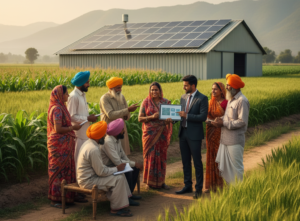
Agriwise helps farmers choose the right finance options
At Agriwise, we advise farmers and agri-enterprises on finding the right finance options for each stage of their farming cycle. Our services include:
- Assessment of cash flow and funding needs to match LAP, WRF, invoice finance or solar loan structures.
- Assistance with documentary requirements, warehouse/receipt linking, and subsidy layering for solar projects.
- Facilitation of partnerships with banks and NBFCs for competitive rates and quick disbursements.
We combine field-level understanding with lender network access so farmers and FPOs can deploy capital faster and more safely.
Conclusion
“Best” depends on the purpose: short-term liquidity is best addressed with WRF or invoice finance, while infrastructure and high-ticket investments often require LAP. Solar loans are increasingly strategic — they lower recurring costs and may open new revenue lines. Given rising institutional disbursement and improved product diversity in 2025, farmers have more finance options than before — choosing the right one starts with defining the objective, tenure and acceptable collateral.
FAQs:
- What are the most useful finance options available to farmers in 2025?
The top finance options include Loan Against Property (LAP), Warehouse Receipt Financing (WRF), Invoice Financing, and Solar Loans—each serving different capital needs. - How does Warehouse Receipt Financing help farmers?
WRF allows farmers to store their produce in accredited warehouses and borrow against it, helping them avoid distress sales and wait for better market prices. - When should a farmer choose a Loan Against Property (LAP)?
LAP is ideal for high-value, long-term investments such as land development, machinery purchase, or building agri infrastructure. - Is invoice financing suitable for small farmers?
Yes, especially for those supplying to processors, FPOs or agri companies. It offers quick liquidity without needing land as collateral. - Why are solar loans becoming popular for farmers?
Solar loans reduce energy costs, improve irrigation reliability, and can generate additional income through surplus power sales. - How does Agriwise help farmers with financing?
Agriwise guides farmers in selecting the right finance option, supports documentation, and connects them with lending partners for fast approvals.
Disclaimer
The content published on this blog is provided solely for informational and educational purposes and is not intended as professional or legal advice. While we strive to ensure the accuracy and reliability of the information presented, Agriwise make no representations or warranties of any kind, express or implied, about the completeness, accuracy, suitability, or availability with respect to the blog content or the information, products, services, or related graphics contained in the blog for any purpose. Any reliance you place on such information is therefore strictly at your own risk. Readers are encouraged to consult qualified agricultural experts, agronomists, or relevant professionals before making any decisions based on the information provided herein. Agriwise, its authors, contributors, and affiliates shall not be held liable for any loss or damage, including without limitation, indirect or consequential loss or damage, or any loss or damage whatsoever arising from reliance on information contained in this blog. Through this blog, you may be able to link to other websites that are not under the control of Agriwise. We have no control over the nature, content, and availability of those sites and inclusion of any links does not necessarily imply a recommendation or endorsement of the views expressed within them. We reserve the right to modify, update, or remove blog content at any time without prior notice.