


Two farmers apply for agricultural finance. Their farms may be in the same district. They may even grow the same crop. Yet the interest rates or overall financing terms offered to them can differ.
Why?
Because farmer loan interest rates are rarely determined by a single factor. Lenders look at the type of loan, borrower profile, repayment capacity, collateral, tenure, credit history, and the risks associated with the financing requirement.
Understanding these factors can help farmers look beyond one question: “What is the interest rate?” and ask the more useful one: “What determines the rate I am being offered?”
First, there is no single farmer loan rate
Agricultural finance covers many different needs. A short-term crop loan, equipment loan, warehouse receipt finance facility and property-backed business loan do not carry identical risks or structures. Consequently, their pricing can differ.
Government-supported programmes can make certain categories of agricultural credit considerably cheaper.
For example, under the Modified Interest Subvention Scheme, eligible short-term Kisan Credit Card agricultural loans of up to ₹3 lakh have been available at 7% annually, with a 3% Prompt Repayment Incentive reducing the effective cost to 4% for farmers who repay on time. Beyond subsidised schemes, however, farmer loan interest rates depend on lender-specific pricing and borrower risk.
- The Purpose of the Loan
What are you borrowing for?
Buying seeds for the coming season creates a very different financing requirement from purchasing machinery or expanding an agricultural business. Short-term working-capital requirements may be assessed around seasonal cash flows, while longer-term financing needs may involve a different repayment structure and risk assessment.
The clearer the purpose, the easier it becomes to identify an appropriate financing product.
- Credit History and Repayment Behaviour
Past borrowing behaviour can influence future borrowing costs.
A strong repayment history indicates that the borrower has previously handled credit responsibly. Delayed payments, defaults or excessive outstanding debt may signal greater lending risk. This is why maintaining a healthy credit profile matters even in agriculture.
- Repayment Capacity
A lender needs to answer a straightforward question: Can the borrower realistically repay this loan?
For agricultural borrowers, that assessment may consider income, cropping patterns, business cash flows, existing liabilities and the seasonal nature of earnings. Agriculture does not generate income like a monthly salary. Good agricultural lending therefore needs to understand when cash actually enters the borrower’s hands.
- Whether the Loan is Secured/Collateral backed loan
Collateral can materially influence lending risk.
A secured facility may be backed by property, agricultural inventory or another acceptable asset. Because the lender has security against the financing, secured lending may be evaluated differently from unsecured credit.
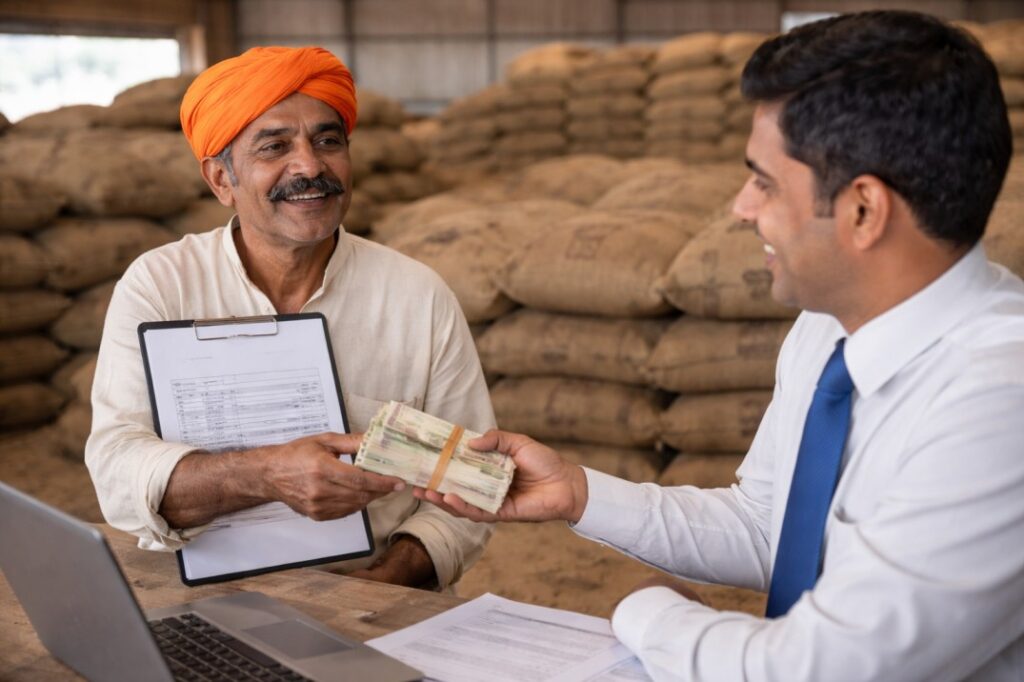
Warehouse Receipt Finance is an interesting example. Instead of immediately selling produce after harvest, eligible borrowers can store commodities in an approved warehouse and use the warehouse receipt to seek financing against that inventory.
- Loan Amount and Tenure (Short/medium/long term)
How much you borrow and for how long matters.
A ₹1 lakh seasonal requirement is fundamentally different from a multi-year, higher-value loan. Longer tenures expose lenders to risk for a greater period, while larger amounts require closer assessment of the borrower’s financial position and repayment capacity.
- External Interest-Rate Benchmarks and Lender Policies
Borrower characteristics are only part of the picture.
Banks and NBFCs price loans within the broader financial environment. Benchmark lending rates, cost of funds, internal credit policies and risk premiums can therefore influence the final rate offered. That is why agricultural lending rates can change even when the farmer’s own circumstances remain broadly the same.
Agricultural credit is getting bigger and more diverse
Formal agricultural lending is becoming an increasingly important part of India’s rural economy. The policy framework requires applicable banks to direct at least 18% of Adjusted Net Bank Credit or equivalent exposure towards agriculture, including a 10% sub-target for small and marginal farmers.
As agricultural businesses become more connected with warehousing, processing, renewable energy and supply chains, the financing requirement is also becoming more specialised.
Agriwise’s role in this
Agriwise approaches agricultural finance around different borrower requirements rather than treating every need as the same loan.
Its portfolio includes Farmer Financing, Warehouse Receipt Finance, Loan Against Property, Supply Chain Finance and Customised Working Capital Loans. Agriwise has disbursed ₹2,500+ crore across 5,300+ customers and works with leading Indian banking partners.
For example, its Warehouse Receipt Finance offering provides short-term working capital against agricultural stocks stored in warehouses, with financing of up to ₹10 crore and LTV of up to 75%.
Look beyond the headline rate
The lowest advertised interest rate is not automatically the best financing decision. Farmers should also understand tenure, repayment frequency, processing charges, collateral requirements, prepayment conditions and the total cost of borrowing.
Ultimately, Farmer Loan Interest Rates reflect both the financial market and the borrower behind the application. Understanding what lenders evaluate gives farmers something more valuable than simply knowing a number. It helps them approach agricultural credit better prepared.
FAQs
- What determines Farmer Loan Interest Rates in India?
Rates can depend on the loan type, amount, tenure, collateral, credit profile, repayment capacity, lender policy and applicable government support. - Does credit history affect agricultural loan rates?
Yes. Repayment history and existing debt can form part of a lender’s assessment of the borrower’s overall credit risk. - Are secured agricultural loans cheaper than unsecured loans?
They may be priced differently because acceptable collateral can reduce lender risk, but actual rates depend on the lender and borrower profile. - What is Warehouse Receipt Finance?
It allows eligible borrowers to obtain working capital against agricultural commodities stored in recognised warehouses instead of selling the produce immediately. - What agricultural finance products does Agriwise offer?
Agriwise offers Farmer Financing, Warehouse Receipt Finance, Loan Against Property, Supply Chain Finance and Customised Working Capital Loans.