

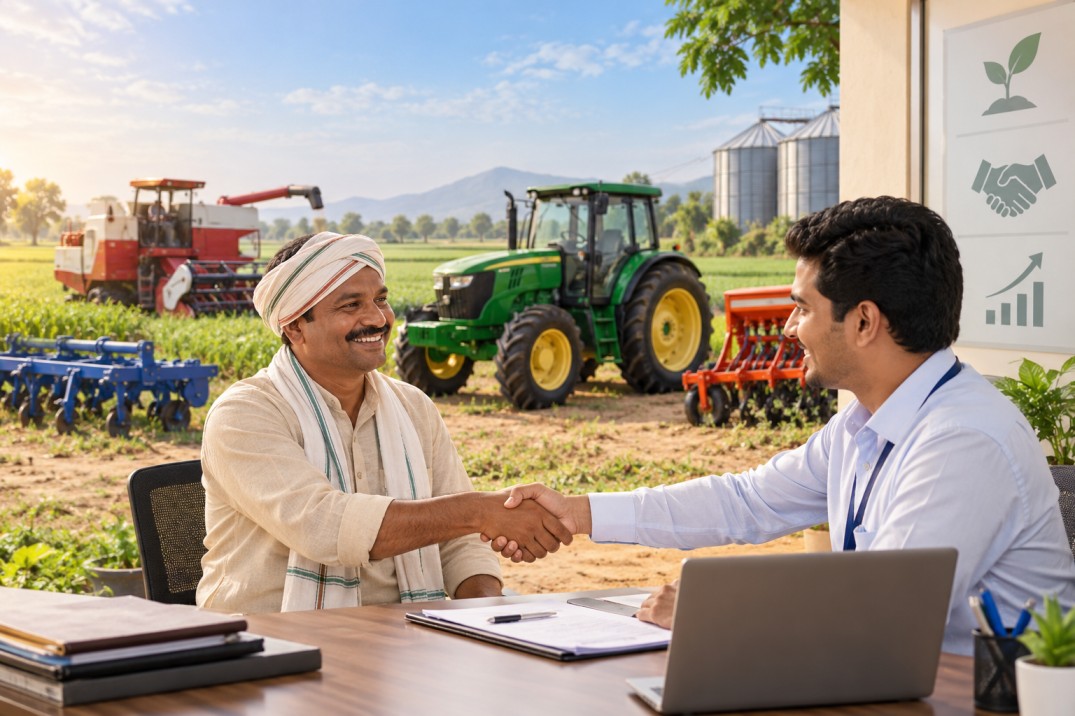
A tractor, harvester, irrigation system or other farm equipment can improve the way agricultural work gets done. But there is one obvious challenge: good equipment often requires a significant upfront investment. That is where Agri Equipment Finance comes into play.
Instead of paying the entire equipment cost upfront, eligible farmers and agricultural businesses can use financing to purchase machinery and repay the amount over an agreed period. This helps preserve cash for other requirements while allowing agricultural operations to benefit from mechanisation.
With India’s push towards farm mechanisation gathering momentum in 2026, understanding how equipment finance works has become increasingly important.
What is Agri Equipment Finance?
Agri Equipment Finance is financing designed to help eligible borrowers purchase agricultural machinery and equipment. Depending on the lender and product, financing may be used for equipment such as tractors, harvesters, tillers, irrigation equipment and other machinery used for agricultural activities.
In equipment-backed financing structures, the purchased asset may serve as security for the loan until repayment is completed. However, structures, collateral requirements, margins, interest rates and eligibility conditions differ across lenders.
Hence, the basic objective is simple: instead of delaying mechanisation until sufficient capital has accumulated, a borrower can spread the cost over time.
Why is Farm Mechanisation important in 2026?
As of July 2026, the government’s Sub-Mission on Agricultural Mechanization had supported the distribution of 21.61 lakh agricultural machines, backed by cumulative funding of ₹9,404.47 crore.
The government also provides financial assistance of generally 40–50% of the cost of eligible machines to farmers under SMAM, subject to scheme conditions. Custom Hiring Centres are another focus, helping make machinery accessible where individual ownership may not be economically viable.
This matters because mechanisation can help improve timeliness of farm operations, productivity, resource-use efficiency and reduce labour-intensive work.
Finance can complement this transition by addressing the upfront cost of acquiring machinery.
How Does Agri Equipment Finance Work?
While the exact process differs between lenders, it generally begins with identifying the equipment and understanding its total cost.
The borrower then approaches a lender with details such as identity and KYC documents, land or business information, income or cash-flow details and an equipment quotation. The lender evaluates repayment capacity, credit profile, agricultural activity and the asset being financed.
Once approved, the borrower may need to contribute a margin while the lender finances the eligible portion of the equipment cost.
The loan is then repaid according to the agreed repayment schedule. Because farm income can be seasonal, borrowers should carefully evaluate whether the repayment structure aligns with expected agricultural cash flows.
What Should You Check Before Taking Equipment Finance?
Buying a machine because it is available is very different from buying one because the farm actually needs it.
Before applying for Agri Equipment Finance, consider how frequently the equipment will be used, how much labour or operating cost it could save, expected maintenance and fuel costs, useful life and whether the additional productivity can justify the EMI.
Farmers should also compare interest rates, processing charges, down-payment requirements, repayment tenure, prepayment conditions and collateral requirements across lenders.
In some cases, hiring equipment through a Custom Hiring Centre may make more economic sense than ownership, particularly for smaller farms or machinery used only occasionally.
Agriwise and Agricultural Finance
Agriwise operates within India’s evolving agricultural credit ecosystem, providing financing solutions to farmers, FPOs, agricultural MSMEs and other stakeholders.
Its official website specifically identifies portable farm equipment among the future-forward projects it supports for progressive farmers. Agriwise has also previously described Agri Equipment Finance as a solution for clients seeking to purchase small farm equipment.
More broadly, Agriwise has facilitated ₹2,500+ crore in loan disbursements across 5,300+ customers and works with leading banking and financial institution partners across 5 Indian states.
Its current financing ecosystem includes Farmer Financing, Warehouse Receipt Finance, Supply Chain Finance, Loan Against Property and Customised Working Capital, helping address different capital requirements across agriculture.
Financing Mechanisation, Not Just Machinery
The real value of agricultural equipment does not come from owning another machine. It comes from what that machine enables.
Faster operations, better timing, reduced dependence on manual labour and more efficient use of farm resources can all strengthen agricultural productivity when the right equipment is selected.
Agri Equipment Finance can make that investment more accessible by spreading the upfront cost over time. The important part is ensuring that the equipment, financing structure and expected farm cash flow work together. Because the smartest equipment investment is not necessarily the biggest one. It is the one that makes the farm work better.
FAQs
- What is Agri Equipment Finance?
Agri Equipment Finance helps eligible farmers and agribusinesses purchase farm machinery without paying the entire cost upfront. - How does Agri Equipment Finance work?
A lender assesses the applicant, equipment cost and repayment capacity before approving financing under agreed repayment terms. - What agricultural equipment can be financed?
Depending on the lender, financing may cover tractors, harvesters, tillers, irrigation equipment and other agricultural machinery. - What should farmers consider before financing equipment?
Farmers should evaluate equipment usage, total cost, productivity benefits, repayment terms and expected farm cash flows. - How does Agri Equipment Finance support mechanisation?
It makes machinery more accessible by spreading its upfront cost over time while preserving capital for other farm needs.